

Architecting the Future of Organizations and Societies
Golden Hook & Introduction
SECTION
Nova: Geography is rapidly becoming a legacy feature of the human experience. For centuries, where you were born dictated your opportunities, your legal framework, and even your identity. But that model is fracturing right before our eyes.
Atlas: That sounds like a bold claim, Nova. Most people still wake up, check their commute, and pay taxes to a specific local government. Is this really a shift in the foundation of society, or just a change in how we order groceries?
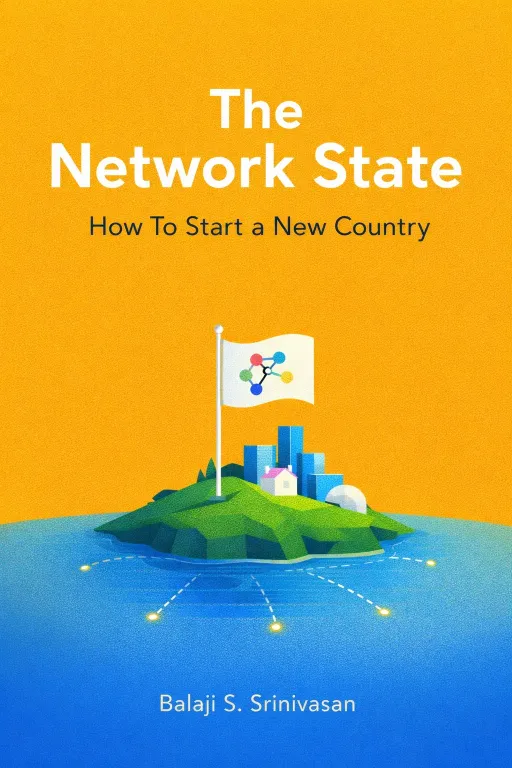
Nova: It is a fundamental rewiring of the human operating system. Today, we are looking at two massive, converging forces. One comes from the mind of Balaji Srinivasan in his book, The Network State, which argues that technology now allows us to build highly aligned online communities that can eventually crowd-fund physical territory and gain diplomatic recognition. The other is Klaus Schwab’s The Fourth Industrial Revolution, which maps out how the convergence of physical, digital, and biological technologies is fundamentally redefining governance, production, and even what it means to be human.
Atlas: Those are two heavy-hitting, world-altering concepts to tackle in one go. Balaji is essentially talking about the end of the nation-state as we know it, and Schwab is talking about the end of the industrial status quo. It feels like we are living through a massive transition, but for the person running a business or leading a team, it can feel like a blur of noise.
Nova: Exactly. And that is why we need to pause. The deep question for our listeners is not how to keep up with the news cycle, but how to position your organization to thrive in a decentralized, hyper-technological future rather than merely reacting to its disruptions. Let us start with this idea of the Network State.
The Rise of the Network State
SECTION
Atlas: I have been thinking about the Balaji concept. It is fascinating because it sounds like science fiction, yet the precursors are everywhere. We have online communities that are more cohesive than many small towns. But how does a digital community actually make the jump to becoming a physical, recognized state?
Nova: It starts with an idea of high alignment. Think about the history of the nation-state. Historically, you were born into a territory, and you had to accept the laws of that territory. Balaji flips that. He suggests that we start with the community first—the shared values, the shared goals, the digital consensus—and then we find the territory. It is cloud-first, land-second.
Atlas: That implies a massive shift in loyalty. Currently, my loyalty is tied to my passport and my zip code. If I move to a network state, my loyalty is tied to a shared purpose. But what happens when that digital community needs to interact with the physical world? You mentioned crowd-funding territory. That sounds expensive and fraught with legal nightmares.
Nova: It is complex, absolutely. But look at how we already handle capital and coordination. We have decentralized autonomous organizations, or DAOs, managing millions of dollars. We have remote teams spanning twenty time zones who have never met but build world-class software together. The leap to purchasing land or creating a special economic zone is the next logical step. The friction is high, but the incentive is higher. People are increasingly willing to pay a premium for a jurisdiction that aligns with their values.
Atlas: That makes sense. It is like the difference between buying a house in a neighborhood you didn't choose, and moving into a planned community where you know exactly what the neighbors value. But for a business leader, this is a disruption. If your employees can live anywhere and exist in a digital network state that offers better benefits or a more compelling mission than your company, how do you retain them?
Nova: You have to become the platform, not just the employer. If the future is decentralized, your organization needs to be the hub that provides the tools, the purpose, and the infrastructure for these high-alignment individuals to do their best work. You cannot rely on geographic lock-in anymore. You have to win on alignment.
The Convergence of Everything
SECTION
Atlas: That brings us to the second piece of the puzzle. If the Network State is the new political and social layer, then Klaus Schwab’s Fourth Industrial Revolution is the technological layer underneath it. He talks about the blurring lines between the physical, the digital, and the biological.
Nova: It is a total fusion. Think about it. We are not just talking about the internet of things. We are talking about the internet of bodies. We have wearables that monitor our health in real-time, AI that can predict our professional performance, and biological technologies that can edit our very makeup.
Atlas: It is staggering. I remember reading that Schwab emphasizes that this revolution is different because it is systemic. It is not just a new tool; it is a new environment.
Nova: Exactly. In the first three industrial revolutions, we had steam, electricity, and computing. Those were external tools. The Fourth Industrial Revolution is internal. It is pervasive. When you have a machine that can learn, and a biological system that can be optimized, the distinction between the machine and the human starts to dissolve.
Atlas: I can imagine how this is causing a crisis of identity for many people. If my job can be done by an AI, and my health can be optimized by a digital coach, what is my unique contribution? And for an organization, how do you manage a workforce that is becoming increasingly integrated with these technologies?
Nova: That is the crucial point. Organizations that treat their people as mere cogs in a machine are going to fail. In this new era, the value proposition of an organization is no longer about managing labor; it is about architecting systems where human potential can scale alongside these technologies. You have to create an environment where the technology augments the human, rather than replacing or alienating them.
Atlas: I am thinking about the risk of this. If we get this wrong, we end up with a surveillance state or a hyper-controlled corporate environment. How do we ensure this convergence actually benefits the individual?
Nova: That is where the conscious leadership comes in. You have to be intentional. If you are using AI to track employee productivity down to the millisecond, you are missing the point. You are using the Fourth Industrial Revolution to replicate the factory floor of the 1800s. But if you use that same AI to identify where your team is struggling and provide them with the resources to grow, you are architecting a sustainable future.
Architecting for the Future
SECTION
Atlas: So, we have the Network State providing the new community structure, and the Fourth Industrial Revolution providing the technological infrastructure. If I am an operator or a leader, how do I synthesize this? How do I stop reacting and start positioning?
Nova: You start by looking at your organization's "jurisdiction." What is the specific value you provide that creates high alignment? Forget about the office space. Forget about the traditional HR manual. Focus on the core mission. Why do people choose to be part of your network?
Atlas: That is a powerful shift. Instead of saying, "We are a software company in San Francisco," you say, "We are a community of people solving X, and we happen to use these technologies to do it."
Nova: Precisely. And then, you look at your operational efficiency. Are you leveraging the Fourth Industrial Revolution tools to remove the drudgery? Are you using automation to free up your people for the high-level, human-centric, creative work that AI cannot touch?
Atlas: I see where you are going. It is about removing the friction that prevents people from doing meaningful work. If I am a leader, my job is to curate the environment where this high-alignment community can flourish. I am not the boss; I am the architect.
Nova: That is the exact mindset shift. Architects do not dictate how every brick is laid; they design the structure that allows the building to stand and serve its purpose. If you are an efficient operator, you are building the systems that allow for this scale without sacrificing the human element.
Atlas: And what about the "meaning" aspect? You mentioned that deep down, leaders are driven by a search for meaning. If we are moving toward this hyper-technological, decentralized world, where does meaning come from?
Nova: It comes from the intentionality of the community. In a world where everything is automated and decentralized, the things that are intentionally human—the culture, the shared values, the real-world connection—become the most valuable assets. Meaning is the currency of the future. The organizations that can provide a sense of belonging and purpose are the ones that will win the war for talent and loyalty.
Atlas: That is a beautiful way to put it. Meaning as the currency. It makes sense. In a world of infinite digital noise, a signal of genuine human purpose is incredibly rare and valuable.
Nova: Exactly. And it is not just about sentiment. It is about strategy. If your team feels like they are part of a mission that matters, they will work harder, innovate faster, and stay longer than any financial incentive could ever force them to.
Synthesis & Takeaways
SECTION
Atlas: This has been a whirlwind, Nova. We went from the potential of crowd-funded sovereign territories to the reality of biological-digital integration. If I had to boil this down for our listeners, it feels like the message is: Stop playing the old game of geographic and industrial management. Start playing the new game of alignment and architectural design.
Nova: You nailed it. The future belongs to those who can build high-alignment communities and leverage technology to amplify human potential rather than suppress it.
Atlas: And for the listener who feels overwhelmed by this—the one who is trying to balance this high-stakes ambition with their own inner peace—what is the one thing they should do tomorrow?
Nova: Pick one aspect of your organization or your life and ask yourself, "Is this a legacy structure or a future-ready system?" If it is a legacy structure—if it is just about control, or geography, or manual labor—find a way to automate it or delegate it. If it is a future-ready system—if it fosters alignment, connection, or meaningful output—invest everything you have into it.
Atlas: That is a great, actionable challenge. It is not about changing everything overnight; it is about starting to filter your decisions through that lens.
Nova: Exactly. You do not have to build a new nation-state tomorrow. Just start by being the architect of a more aligned, more intentional environment today.
Atlas: I love that. It makes the transition feel manageable. It turns the anxiety of the future into a design project.
Nova: And that is the only way to thrive. We are not just observers of this revolution; we are the architects. Whether it is a small team or a large organization, the principles of alignment and intentional technology use remain the same.
Atlas: This has been incredibly eye-opening. I think a lot of our listeners are going to be looking at their work through a very different lens after this.
Nova: I hope so. Because the future is not something that happens to us. It is something we build.
Atlas: Well, that is a perfect place to wrap up. Thank you for this deep dive, Nova. It has been a pleasure to unpack these complex ideas with you.
Nova: The pleasure was all mine, Atlas. To all our listeners, keep building, keep questioning, and keep aligning.
Atlas: This is Aibrary. Congratulations on your growth!