Unlocking New Markets Through Disruptive Thinking
Golden Hook & Introduction
SECTION
Nova: What if the biggest barrier to your next breakthrough isn't a lack of ideas, but a stubborn belief in how innovation work? And what if the secret to outcompeting everyone is simply to stop competing altogether?
Atlas: Whoa, Nova. Stop competing? That sounds almost too good to be true for anyone battling in today's crowded markets. It feels like we're constantly told to sharpen our elbows, not put them away.
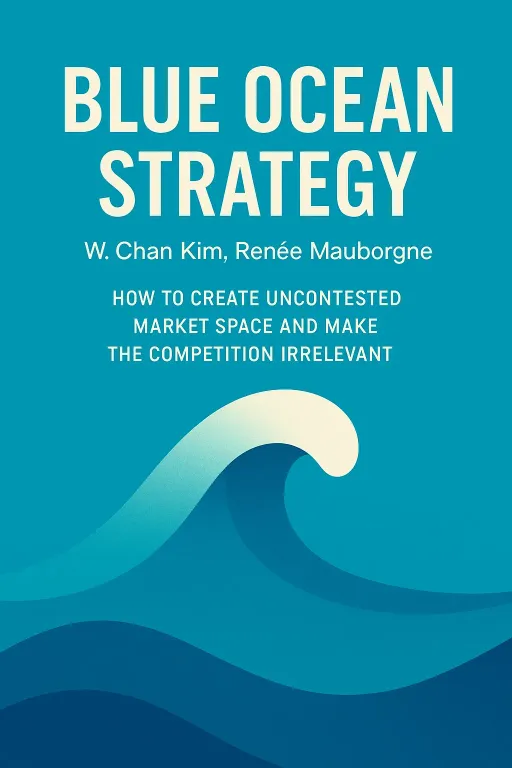
Nova: Absolutely, Atlas. It's counter-intuitive, isn't it? But that's precisely the provocative idea we're diving into today, inspired by two incredibly influential books. First, "Blue Ocean Strategy" by W. Chan Kim and Renée Mauborgne, whose groundbreaking research at INSEAD has reshaped global business thinking. And then, "The Myths of Innovation" by Scott Berkun, a former Microsoft veteran who offers a wonderfully pragmatic, demystifying look at how breakthroughs actually happen.
Atlas: So, we’re talking about strategy and mindset, which is perfect for our listeners who are focused strategists and pragmatic visionaries, always seeking clarity amidst complexity. They're driven by impact, but sometimes the path to that impact feels like an endless red ocean of competition.
Nova: Exactly. These books don't just offer theories; they provide a toolkit for transforming that struggle. And the first, most powerful tool is understanding the difference between merely competing and truly creating.
The Lure of Blue Oceans – Creating New Value, Not Just Competing
SECTION
Nova: Imagine the business world as an ocean. Most companies are swimming in what Kim and Mauborgne call a "Red Ocean." It's red because it's bloody from fierce competition. Companies are fighting over existing demand, trying to outperform rivals, cutting prices, and constantly differentiating on marginal improvements. The water gets murkier, the margins shrink, and the sharks get hungrier.
Atlas: That’s a vivid, and frankly, a bit unsettling image. For anyone in a high-stakes industry, that red ocean feels very real. You're constantly looking over your shoulder, trying to gain a slight edge. But how do you escape that?
Nova: By sailing into a "Blue Ocean." This is an uncontested market space, where you create new demand, rather than fight over existing customers. Competition becomes irrelevant because you’re offering something entirely new, or a dramatically different value proposition. It’s about value innovation – simultaneously pursuing differentiation and low cost.
Atlas: That sounds like the holy grail, Nova. But for a focused strategist trying to navigate established industries, doesn't that sound incredibly risky? Like, how do you even looking for an ocean that doesn't exist yet? Are we just talking about inventing flying cars?
Nova: Not at all! The beauty of "Blue Ocean Strategy" is that it’s not about technological invention in every case. It’s about rethinking market boundaries. Take Cirque du Soleil, for example. The traditional circus industry was a classic red ocean: declining audience, rising costs from animal acts and star performers, competition from other entertainment forms.
Atlas: Right, elephants and clowns, a bit dated for many.
Nova: Precisely. Cirque du Soleil didn't try to compete with Ringling Bros. They asked, "What if we removed the most expensive and least valued elements of the traditional circus, like animal acts and celebrity performers, and instead added elements of sophisticated theater, original storylines, and artistic music?" They created a new form of entertainment that appealed to adults and corporate clients, not just children. They offered the grandeur and excitement of a circus, but with the intellectual and artistic richness of theater.
Atlas: So, they cut costs on one side and elevated value on another, attracting an entirely new audience. That’s clever. It’s like they didn't just improve the circus; they reinvented the very idea of what a circus could be. I can see how that would resonate with someone looking to create meaningful growth, not just incremental gains.
Nova: Exactly. They made the competition irrelevant. The cause was a re-evaluation of customer value; the process involved eliminating and reducing traditional elements while raising and creating new ones; and the outcome was a thriving, uncontested market with premium pricing. It’s about looking at your industry with fresh eyes and asking, "What can I eliminate, reduce, raise, or create?"
Atlas: That’s a powerful framework. It makes me wonder, though, how do you even get to that point of radical rethinking? Because often, we’re so entrenched in our daily grind, fighting those red ocean battles, that seeing a blue ocean feels like trying to spot a new continent from a rowboat. It almost feels like you need a different kind of thinking to even begin that process.
Busting Innovation Myths – The Messy Reality Behind Breakthroughs
SECTION
Nova: And that, Atlas, leads us perfectly into the second part of our discussion, because creating a blue ocean innovation, but not the kind we often romanticize. Scott Berkun, in "The Myths of Innovation," brilliantly dismantles the popular fairy tales we tell ourselves about how breakthroughs happen.
Atlas: Fairy tales? I thought innovation was all about that sudden "aha!" moment, the lone genius in a garage, the lightbulb flashing over someone's head. Isn't that the story we’re always told?
Nova: That's one of the biggest myths Berkun busts! He argues that innovation is rarely a sudden flash of genius. It's usually a messy, human process of hard work, iteration, collaboration, and often, failure. Think about the Post-it Note. It wasn't an "aha!" moment. It started with Spencer Silver's "failed" super-weak adhesive in 1968. It took years, and another colleague, Art Fry, singing in a choir and getting frustrated with his bookmarks falling out, to connect that weak adhesive to a real problem.
Atlas: So, the cause wasn’t a Eureka moment, but a "failure" and a separate, unrelated frustration. The process was years of development, an accidental discovery, and then someone else finding a practical application. And the outcome was one of the most ubiquitous office supplies in history. That’s actually a huge relief. It means innovation isn’t reserved for the chosen few with divine inspiration.
Nova: Precisely! Berkun’s point is that the messy reality involves countless dead ends, arguments, miscommunications, and the slow, grinding work of making something functional and valuable. It’s a process, not an event. This perspective is vital for our listeners who embrace the journey and understand that consistency builds momentum. It’s less about one grand stroke and more about persistent, focused effort.
Atlas: That’s going to resonate with anyone who struggles with the pressure to be a "genius" overnight. It sounds like innovation is less about waiting for lightning to strike and more about consistently showing up and chipping away at the problem. So, if the lone genius is a myth, what’s the biggest myth holding most people back from pursuing blue oceans or even just meaningful innovation?
Nova: One of the most damaging myths is the idea that "good ideas are rare." Berkun shows that good ideas are actually abundant. What's rare is the courage, persistence, and organizational structure to on those ideas, to see them through the messy middle, and to learn from the inevitable setbacks. People often discard ideas too quickly, assuming they need to wait for the "perfect" idea, rather than iterating on a good one.
Atlas: So, it's not about the absence of potential blue oceans, but the internal stories we tell ourselves about the struggle of finding them, or the perceived need for a flawless, instant solution. That makes me wonder about our user profile again – the pragmatic visionary. They seek clarity, they're decisive. This "messy" reality might feel uncomfortable, but it’s crucial for real growth.
Nova: It is. It reframes "failure" from a dead end into a necessary part of the iterative process. It's about having the mental clarity to quiet the noise of perfectionism and trust your intuition, as your growth recommendations suggest. The journey the progress.
Synthesis & Takeaways
SECTION
Nova: So, bringing these two powerful ideas together: if you want to create a blue ocean, to truly unlock new markets and make competition irrelevant, you must shed the myths of innovation. You need to understand that the path will be messy, iterative, and require persistence, not just a single flash of brilliance.
Atlas: It’s less about finding a shortcut and more about understanding the actual, often challenging, landscape of creation. So, the deep question for our listeners, for the pragmatic visionaries and focused strategists out there, really boils down to: where in your current or prospective markets can you create new demand rather than fight over existing customers, and what 'myth' about innovation might be holding you back from pursuing it?
Nova: It's about having the courage to look beyond existing boundaries and the resilience to embrace the sometimes frustrating, often collaborative, and always human process of bringing something truly new into the world. It’s a mindset shift that empowers you to build a secure future and share your vision more effectively.
Atlas: And that requires that dedication to focused learning, to consistently questioning assumptions and scouting for those blue opportunities. Because the true impact comes from seeing possibilities others miss, and then having the tenacity to build them, even when it’s not neat or linear.
Nova: Absolutely. It’s about finding your center in the storm of change and trusting that the journey, with all its messiness, is where true growth happens.
Atlas: This is Aibrary. Congratulations on your growth!