The Question of Meaning: Why Life's Big Puzzles Are Your Greatest Teachers.
Golden Hook & Introduction
SECTION
Nova: What if I told you that the most uncomfortable, unsettling questions you have about life—the "why are we here" moments—aren't a sign of weakness, but actually your greatest strength?
Atlas: Whoa. That's a bold claim, Nova. My initial reaction is, "Wait, aren't those the questions that keep us up at 3 AM, spiraling into an existential dread spiral?" Why do you call that a strength?
Nova: Because, Atlas, that very pull towards something deeper, that unshakeable need to understand the 'why' behind it all, is a profound and uniquely human drive. It’s the engine of personal evolution. And today, we're diving into two absolute titans who wrestled with this idea, giving us incredible frameworks: Viktor E. Frankl's "Man's Search for Meaning" and Albert Camus's "The Myth of Sisyphus." These books aren't just philosophy; they're blueprints for resilience.
Atlas: Ah, Frankl and Camus. Two names that often come up when you talk about the big questions. I can definitely relate to that "pull towards something deeper." I imagine a lot of our listeners, the seekers and innovators out there, feel it too, amidst the daily grind. It's like an internal compass pointing to something beyond the to-do list.
The Inherent Human Need for Meaning & The Universal Quest
SECTION
Nova: Exactly! It's not a weakness; it’s a profound human need for meaning and purpose. Think about it: we spend so much of our lives chasing external goals—the career, the relationship, the perfect vacation. And often, even when we achieve them, there's still this whisper inside, this feeling that something is missing. That whisper isn't a malfunction; it's a signal.
Atlas: Okay, so it’s a signal. But why do we so often try to silence that signal? Why do we see it as a problem to be fixed, something to distract ourselves from, rather than a valuable piece of internal feedback?
Nova: Because it's uncomfortable. Society often pushes us towards easy answers, towards consumption, towards a kind of superficial happiness that doesn't require deep introspection. We're conditioned to believe that life should be simple, predictable. But the truth is, life is messy, and the search for meaning requires leaning into that mess. It demands that we ask hard questions, and sometimes, live with uncomfortable answers.
Atlas: That makes me wonder, so it's not about finding definitive answer to the meaning of life, but recognizing the importance of the itself? Like, the quest is the point?
Nova: Precisely. Exploring existential questions isn't about finding definitive answers, it's about enriching your perspective and building resilience. It’s the journey itself that transforms you. Every time you grapple with a 'why,' you're expanding your capacity for understanding, for empathy, for growth. It's a journey many have taken, and you are definitely not alone in this quest.
Forging Meaning in the Face of Absurdity and Suffering
SECTION
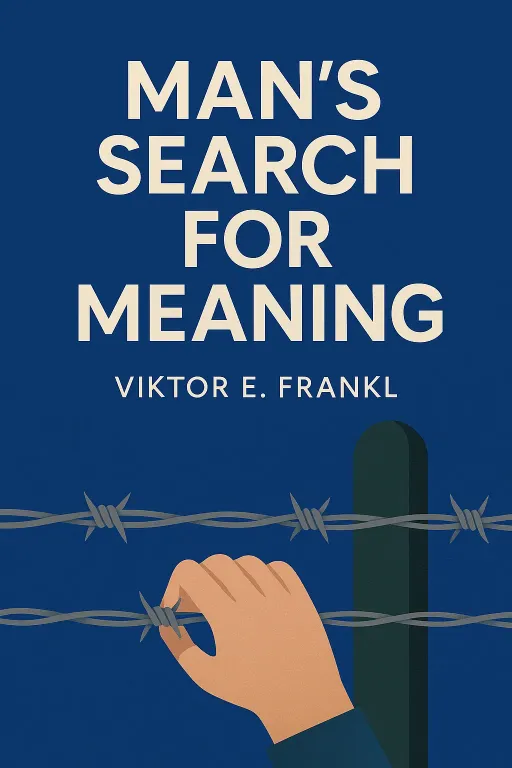
Nova: And recognizing that journey is vital, especially when life throws us into the deepest challenges. Because it's often there, in the crucible of suffering or the face of absurdity, that meaning is most powerfully forged. This brings us to Viktor Frankl and his incredible work, "Man's Search for Meaning."
Atlas: Oh, Frankl. His story is just… it’s almost unimaginable. Finding purpose in a concentration camp. How do you even begin to process that?
Nova: Frankl, a psychiatrist, endured unimaginable horrors in Nazi concentration camps. He observed that those who survived often weren't the strongest physically, but those who clung to a sense of meaning – a loved one to reunite with, a book to finish, a purpose to fulfill. He famously said, "Everything can be taken from a man but one thing: the last of the human freedoms—to choose one's attitude in any given set of circumstances, to choose one's own way." His account is a powerful testament to the human spirit's capacity for meaning, regardless of circumstances.
Atlas: Wow, that's incredibly powerful. That gives me chills. But for someone not facing such extreme circumstances, how does that translate? How do you 'choose your attitude' when the suffering feels mundane, like a difficult job, a personal setback, or just feeling adrift?
Nova: That's where Albert Camus offers a complementary perspective with "The Myth of Sisyphus." Camus grapples with the 'absurd' – the fundamental conflict between our human desire for meaning and the universe's ultimate indifference. He uses the ancient Greek myth of Sisyphus, condemned to eternally push a boulder up a hill, only for it to roll back down.
Atlas: So, are you saying we should just embrace the pointlessness? That sounds a bit bleak. Where's the 'defiant revolt' in a Tuesday morning commute or dealing with a never-ending inbox?
Nova: Not bleak at all! Camus suggests that true freedom comes from embracing this absurdity, not denying it. Sisyphus, realizing the futility of his task, chooses to find meaning in the act of pushing the boulder itself. His freedom comes in his conscious defiance, his scorn for his fate. He doesn't find meaning the boulder, but his attitude towards it. For our listeners, it means that even in the repetitive, seemingly meaningless tasks of everyday life, we can infuse them with our own purpose, our own rebellion against apathy. It’s about creating your own values, your own meaning, in a world that offers none pre-packaged.
Atlas: I see. So it's not about the universe giving you meaning, it's about what you bring to the universe, even if it's just pushing that metaphorical boulder up the hill every day. It's about finding freedom in the embrace, not the denial, of that existential weight. That's a profound shift.
Synthesis & Takeaways
SECTION
Nova: Exactly. These narratives connect directly to that desire for personal evolution, showing that even in the face of profound questions, even in suffering or absurdity, meaning can be forged. The inherent human need to question, to seek that deeper 'why,' is met by the active forging of purpose, whether through Frankl's choice of attitude or Camus's defiant creation of self-worth.
Atlas: So, for our listeners, the seekers and innovators who are driven by curiosity and personal evolution, what's one practical way they can start to engage with these 'big puzzles' in their own lives, beyond just reading these incredible books?
Nova: Take a moment to reflect on a recent challenge, big or small. How did your search for meaning or purpose—even just finding a tiny silver lining, or a lesson, or choosing to endure with grace—help you navigate it? It’s not about finding a grand, universal meaning, but about recognizing the small, personal meanings we forge every day. The journey of questioning itself is a form of healing and growth.
Atlas: That's actually really inspiring. It frames the quest not as a burden, but as a pathway to resilience and a richer perspective. It’s a powerful reminder that you are not alone in this quest.
Nova: Perhaps the greatest lesson isn't finding 'the' meaning of life, but understanding that the very act of asking, of seeking, of pushing that boulder, is where our profound human purpose truly lies. What meaning are you choosing to forge today?
Nova: This is Aibrary. Congratulations on your growth!