The Stress-Health Paradox: Why Pushing Harder Makes You Sicker
Golden Hook & Introduction
SECTION
Nova: Atlas, I want to play a quick game with you. Give me your five-word review of the common idea that stress is just a mental thing. Just five words. Go.
Atlas: Oh, that's easy. "Your body always has the last word."
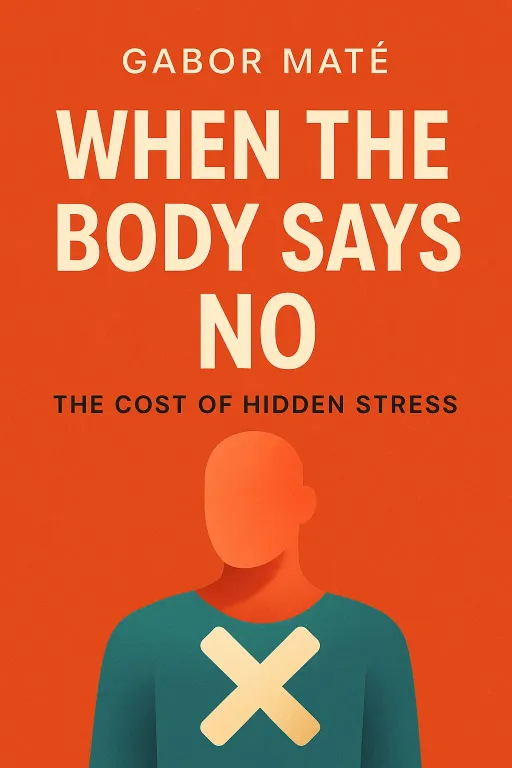
Nova: Oh, I love that! "Your body always has the last word." And that, my friend, is exactly what we're dissecting today because we're diving into the profound and sometimes provocative work of Dr. Gabor Maté, specifically his seminal book, "When the Body Says No: Understanding the Stress-Disease Connection."
Atlas: What a title! It immediately makes you lean in. So, what's his angle on this "body always has the last word" idea?
Nova: Well, Maté is a physician with a truly unique background, having worked extensively in addiction, trauma, and palliative care. His insights come from observing patterns in patients that traditional medicine often missed. He's widely acclaimed for his courage in challenging conventional medical paradigms, often highlighting the deeply personal and societal roots of illness, even if some of his views spark debate among a more conservative medical establishment. He essentially argues that the notion of stress as purely a mental burden is a dangerous blind spot.
Atlas: A blind spot? Like, we think we're just toughing it out mentally, but our body's secretly keeping a very detailed, and potentially devastating, score?
Nova: Exactly! For those of us constantly pushing boundaries, constantly striving, and I imagine many of our intellectually curious listeners identify with that, we often compartmentalize stress. We think, "Oh, it's just a busy week, I'll relax later." But Maté reveals that your physiological self, your immune system, your hormones, they're not waiting for "later." They're reacting in real-time, every single demanding day.
The Blind Spot: Stress as Physical Illness
SECTION
Nova: He illustrates this with powerful cases, like the story of a woman he calls 'Naomi,' who developed severe rheumatoid arthritis. Naomi was, for all intents and purposes, a model patient. Compliant, positive, always putting others first. On the surface, incredibly resilient.
Atlas: Okay, so a 'good patient' develops a debilitating autoimmune disease. Where's the blind spot here?
Nova: The blind spot was in not connecting her lifelong pattern of emotional repression and self-sacrifice to her physical condition. Maté observed that Naomi had an almost pathological inability to express anger or even acknowledge her own needs. She was constantly caring for others, from childhood, to the point where her own emotional landscape became a desert. Her body, in essence, was screaming the 'no' that her voice couldn't utter.
Atlas: So, you're saying her unexpressed emotions, her chronic self-neglect, literally manifested as her immune system attacking her own joints? That sounds… almost too poetic for medicine. How does that physically happen?
Nova: That's the crucial part. Maté isn't suggesting it's purely psychological in a vague sense. He points to the intricate interplay between our emotional brain, our nervous system, and our immune system. When we're under chronic stress, especially the kind that involves suppressing our authentic feelings or needs, our bodies are constantly in a state of low-grade emergency. This sustained fight-or-flight response, fueled by hormones like cortisol, can dysregulate the immune system. It can make it overactive, leading to autoimmune conditions, or underactive, making us vulnerable to infections and even cancer.
Atlas: Hold on, so it’s not just "stress makes you tired" or "stress gives you a headache." It's a fundamental breakdown of the body's self-regulatory mechanisms because of a sustained emotional state? For someone who thrives on pushing limits, that's a pretty stark warning.
Nova: Absolutely. It's a fundamental re-evaluation of the mind-body connection. He's showing us that our emotional lives aren't separate from our biology. They are deeply, irrevocably intertwined. The body isn't just a vessel; it's a silent, deeply intelligent chronicler of our experiences, especially our unacknowledged ones. He challenges the very notion of 'psychosomatic' as something dismissive, arguing that all illness has a psychosomatic component.
Atlas: Wow. That's a huge shift in perspective. It means we can't just power through emotional turmoil with sheer grit and expect our bodies to just… ignore it. It also makes me wonder, if individual emotional repression can do that, what happens when an entire society encourages that kind of repression?
Societal Pressures and The Myth of Normal
SECTION
Nova: That's a brilliant pivot, Atlas, because it leads us directly into his expanded work in "The Myth of Normal." Maté argues that our individual illnesses aren't just personal failures; they're often symptoms of a broader "diseased" culture.
Atlas: So, the very idea of 'normal' itself might be pathological? That's quite a claim. What does he mean by that?
Nova: He means that in our modern, achievement-driven societies, we often define "normal" as being constantly productive, always performing, suppressing vulnerability, and prioritizing external validation over internal well-being. This creates immense pressure to conform, to ignore our authentic selves, and to silence the internal signals our bodies are sending us. For example, he talks about the prevalence of ADHD in children, not just as a neurological disorder, but as a potential symptom of a society that demands continuous attention and performance in highly unnatural settings, ignoring the need for play, connection, and intrinsic motivation.
Atlas: That's fascinating. So, for those of us in demanding fields, constantly striving for the next achievement, the very structure of our success might be inherently unhealthy? We're applauded for traits that could be making us sick?
Nova: Precisely. The "myth of normal" suggests that fitting in, achieving conventional success, and suppressing our emotional truth—often to maintain a certain image or pace—is celebrated. Yet, this very path can lead to profound alienation from self, which Maté links directly to chronic stress and physical illness. He highlights how many successful individuals, outwardly thriving, are inwardly struggling with chronic conditions, anxiety, or addiction, because they've been conditioned to ignore their deepest needs.
Atlas: Can you give an example of how this plays out? Like, someone who seems to be doing everything 'right' by societal standards, but is actually on a collision course with their own health?
Nova: Think of the high-powered executive, always "on," always available, pushing through exhaustion, fueled by coffee and adrenaline. They might receive accolades, promotions, and financial success. They are the epitome of "normal" in that corporate environment. But Maté would ask: what emotional needs are being neglected? What boundaries are being violated? What authentic desires are being suppressed in service of this relentless drive? Often, these individuals end up with severe burnout, chronic fatigue, or even more serious autoimmune conditions, because their body can no longer sustain the disconnect between their inner truth and their outer performance. The body eventually says "no" louder than any external demand.
Atlas: That's actually really sobering. It makes you question every 'hustle culture' mantra out there. So, if "normal" is making us sick, what's the alternative? What's the path to health according to Maté?
Synthesis & Takeaways
SECTION
Nova: The path, for Maté, is about re-establishing connection – connection to our authentic selves, to our bodies, and to our true needs, rather than chasing external validation or conforming to societal pressures that are fundamentally unhealthy. It's about recognizing that our emotional burdens aren't just 'baggage,' but vital communications from our deepest selves. True health isn't the absence of symptoms; it's the presence of self-awareness and emotional integrity.
Atlas: That's a powerful idea: our bodies are not just passive recipients of stress; they are active communicators of our deepest emotional truths. It really shifts the responsibility from just managing symptoms to understanding the root cause. For those of us who are always striving for intellectual growth, it's a reminder that our physical and emotional growth are inseparable.
Nova: Absolutely. It encourages us to ask that deep question Maté often poses: What emotional burdens might your body be trying to communicate to you through its current state? It’s a profound inquiry that can unlock so much. We have to listen to the whispers before they become shouts.
Atlas: That’s a fantastic question to end on, Nova. It really forces a moment of introspection.
Nova: Indeed. So, to our curious listeners, as you go about your day, perhaps pause and ask yourself that question. What is your body trying to tell you?
Atlas: That’s an impactful challenge.
Nova: This is Aibrary. Congratulations on your growth!