

The Mountain Is You: A Blueprint for Your Best Self
Golden Hook & Introduction
SECTION
Nova: Have you ever found yourself on the verge of something you desperately want—maybe a new relationship, a big opportunity—only to do something, almost unconsciously, that pushes it all away? It’s a confusing, frustrating feeling, right?
Mercury: It really is. It’s like one part of you is hitting the gas pedal, and another part is secretly slamming on the brakes. You end up just spinning your wheels, wondering why you can't seem to move forward towards the thing you know you want.
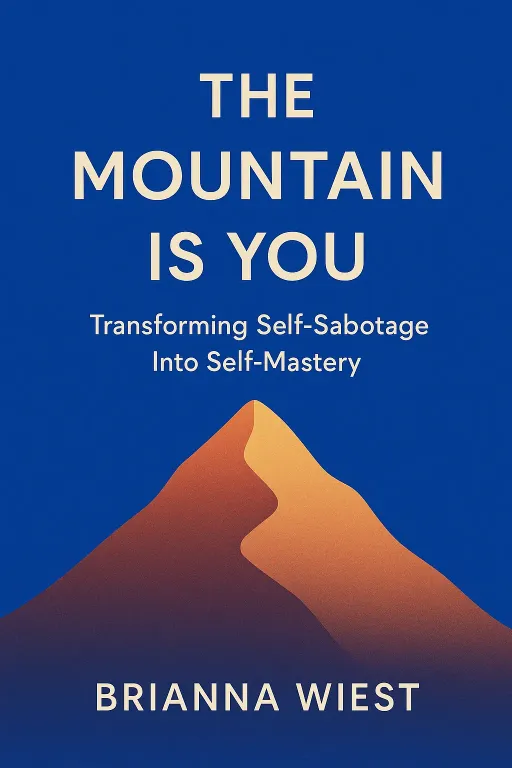
Nova: Exactly! And that internal conflict is the very heart of the book we're exploring today, "The Mountain Is You" by Brianna Wiest. Her core idea is that the biggest obstacle in our lives, our 'mountain,' isn't some external force. It's us. But not in the way we think. It's not about being broken or not trying hard enough. It's something much deeper and, surprisingly, more logical.
Mercury: I love that reframe already. It takes the blame out of it and replaces it with curiosity.
Nova: That's the perfect word for it, Mercury. And that's our goal today. We're going to explore this with a three-part roadmap to help us understand and conquer our own mountains. First, we'll uncover the surprising truth about why we self-sabotage. Then, we'll learn how to use our most difficult emotions as a guide. And finally, we'll talk about a concrete technique for building the future you want. Ready to start the climb?
Mercury: Absolutely. I've got my hiking boots on.
Deep Dive into Core Topic 1: The True Motive Behind Self-Sabotage
SECTION
Nova: Alright, so let's tackle that first big, counterintuitive idea from the book: What we call 'self-sabotage' is actually a form of self-protection. Wiest argues that these behaviors aren't born from a desire to fail, but from an unconscious need that's being met. It’s a coping mechanism that’s just, well, running on outdated software.
Mercury: So it’s not that we hate ourselves, it’s that our subconscious is trying to keep us safe, but its definition of 'safe' might be stuck in the past.
Nova: You've hit it precisely. The subconscious mind prioritizes the familiar over the desired. Even if the familiar is painful, it's predictable. A new, happy, successful life? That's unknown territory, and for the subconscious, 'unknown' can equal 'dangerous.' The book gives a powerful example of this in the context of relationships. Let’s talk about a woman we'll call Emily.
Mercury: I'm listening.
Nova: So, Emily is 32, she's smart, she's kind, and she consciously wants a loving, stable, committed relationship more than anything. But her dating history is a graveyard of emotionally unavailable, commitment-phobic partners. She keeps falling for the same type of person—charming and exciting at first, but ultimately distant and unreliable.
Mercury: And she probably blames herself or her 'bad picker' every time it ends.
Nova: Of course. She's frustrated, saying things like, "I know this isn't good for me, but I can't help how I feel." But Wiest would say the attraction isn't random. Through therapy, Emily uncovers that her father was emotionally distant during her childhood. So, her young mind created an equation: love equals a feeling of longing, of trying to win over someone who is just out of reach.
Mercury: Wow. So she's not choosing the wrong partners. She's choosing partners who feel 'right' according to a blueprint drawn up in her childhood. She's trying to solve an old emotional equation with new people, but since she's the constant variable, the result is always the same.
Nova: That is such a brilliant way to put it. Her subconscious isn't trying to make her unhappy. It's trying to finally 'win' that old game and heal that original wound. It's a protective measure to resolve the past. The 'sabotage'—choosing the unavailable partner—is actually an attempt to find a solution. The problem is, as you said, it's a flawed strategy.
Mercury: It's like the subconscious is a movie director, constantly trying to reshoot a traumatic scene from childhood, hoping for a different ending. But by casting the same type of actor over and over, the ending is always the same. The real work isn't to change the actor in the scene, but to have a chat with the director and give them a completely new script.
Nova: A new script! I love that. And that's the first step to climbing the mountain: realizing you're not fighting a saboteur. You're negotiating with a well-meaning, but misguided, protector.
Deep Dive into Core Topic 2: Your Triggers: An Unlikely Guide to Freedom
SECTION
Nova: And Mercury, your analogy is the perfect transition. If the subconscious is the director, then our emotions, especially the uncomfortable ones, are the script notes telling us what's not working. This brings us to our second key idea from the book: using your triggers as a guide to freedom.
Mercury: This is a big one for me. As an INFP, I feel things very deeply, and it's easy to get overwhelmed by negative emotions and just want them to go away. The idea of them being useful is... intriguing.
Nova: It's a game-changer. Wiest argues that we should stop trying to suppress or ignore feelings like anger, sadness, or especially jealousy. Instead, we should get curious and ask, "What are you trying to tell me?" She has a fantastic quote: "If you want to know what you truly want out of life, look at the people who you are jealous of."
Mercury: That feels a little dangerous, doesn't it? Like it could just feed into comparison culture.
Nova: It could, if you stop at the surface level. But the book tells a story about a woman named Sarah, a graphic designer. She's doing okay in her career, but she feels stuck. She scrolls through social media and feels a familiar pang of jealousy seeing friends buy houses or get married. But one day, a friend posts about opening her own small bakery, and the jealousy Sarah feels is different. It's sharp, it's resonant.
Mercury: It hits a different nerve.
Nova: Exactly. So instead of just stewing in it, she gets curious. Why? And she realizes she's always loved baking, but had dismissed it as a silly hobby, not a real career. That pang of jealousy wasn't just envy; it was her buried passion screaming for attention. It was a GPS signal pointing directly to a life she wanted but hadn't dared to admit. She starts taking classes, and eventually opens her own successful bakery. The jealousy was the map.
Mercury: That's a powerful distinction. But how do we differentiate between that kind of productive jealousy that points to a true desire, and what might be just... petty envy or a general feeling of inadequacy? Is there a way to test the feeling?
Nova: That's a fantastic and crucial question. The book suggests the key difference is in the feeling's texture. Petty envy feels like a complaint about the other person—"Why them and not me?" It's outward-focused. But the jealousy that Wiest is talking about is deeply personal and inward-focused. It’s a feeling of recognition. It’s a quiet, aching whisper that says, "That should be me," not out of spite, but out of a profound sense of alignment. It feels less like an attack and more like a homecoming.
Mercury: So you're looking for resonance, not just resentment. You're looking for the signal that activates a part of your own soul.
Nova: Precisely. Your triggers aren't the enemy. They are your soul's most honest and direct messengers.
Deep Dive into Core Topic 3: From Wishful Thinking to Active Creation
SECTION
Nova: And once you use that emotional GPS to identify your destination—that bakery, that healthy relationship, that creative life—the final step is to actually start driving. This is our third and final idea for today: moving from just understanding the past to actively creating your future.
Mercury: This is the part where it gets real. It's one thing to have insights in therapy or while reading a book, but it's another to actually change your daily life.
Nova: It's everything. And Wiest offers a beautiful, practical tool for this. It's a visualization technique to connect with your highest potential future self. It sounds a bit 'out there' at first, but it's incredibly grounding.
Mercury: I'm open to it. How does it work?
Nova: You find a quiet, peaceful moment. You close your eyes and imagine yourself sitting at a table in a place you love. Then, you invite your future self—maybe you in 10 or 20 years, the version of you who has climbed the mountain—to come and sit with you. You just observe them. How do they carry themselves? What are they wearing? What does their energy feel like?
Mercury: You're gathering data.
Nova: Yes! Then, you simply ask for guidance. "What do I need to know? What's the most important thing for me to do right now?" And you just listen. The book stresses that the messages should feel calm, affirming, and clear. If it feels scary or anxious, that's your fear talking, not your higher self.
Mercury: That's so interesting. It sounds less like a magical fantasy and more like a strategic planning session with your own future CEO. My interest in people like Steve Jobs or Walt Disney... they were famous for holding an unwavering vision of a future that didn't exist yet. This feels like a personal version of that—defining the vision so clearly that the daily steps to get there become obvious.
Nova: What a perfect connection! It's exactly that. You're not just wishing for a different life; you're getting instructions from the person who has already built it. You're reverse-engineering your own success. The final step is to imagine that future self handing you the 'keys' to your new life—maybe it's a key to a new home, a book representing wisdom, or just a feeling of peace. You accept it, and you integrate it.
Mercury: So you're creating a new 'familiar' for your subconscious. You're showing it the destination, making the unknown known, so it stops hitting the brakes. You're giving your inner protector a new, updated map.
Nova: You've just summarized the entire process beautifully, Mercury. That's the whole journey.
Synthesis & Takeaways
SECTION
Nova: So, as we come to the end of our climb today, let's look back at the path. We started by reframing self-sabotage, seeing it not as a flaw but as a misguided protector running on an old script.
Mercury: Then we learned to listen to our triggers, especially feelings like jealousy, not as pain to be avoided, but as a GPS pointing us toward our true desires and passions.
Nova: And finally, we moved into the role of creator, using a powerful visualization to connect with our future self and get a clear blueprint for the life we want to build. It's a journey from understanding, to guidance, to action.
Mercury: It feels so much more empowering than just telling yourself to 'stop sabotaging yourself.' It gives you real tools and a sense of compassion for why you're stuck in the first place.
Nova: It really does. And it leaves us with a final, crucial question to ponder, not just for you, Mercury, but for everyone listening. The question isn't just 'What is my mountain?' The real question, the one that holds the key, is 'What deep, unmet need is this mountain trying to protect?'
Mercury: And when you can answer that, you're not just staring at an obstacle anymore. You're looking at the starting point of your own transformation.
Nova: That's the path to self-mastery. Thank you so much for climbing this mountain with me today, Mercury.
Mercury: Thank you, Nova. The view from up here is already starting to look a lot clearer.









