

Overcoming Cognitive Blocks and Self Sabotage
Golden Hook & Introduction
SECTION
Nova: Most people think self-sabotage is a character flaw. It is actually a highly efficient, albeit outdated, survival strategy. Your brain is not trying to ruin your life; it is trying to protect you from the unknown.
Atlas: That is a startling way to frame it. Usually, when I catch myself procrastinating on a major project, I just label it as a failure of willpower. You are telling me my brain is actually just acting like a security guard who has gone a little bit rogue?
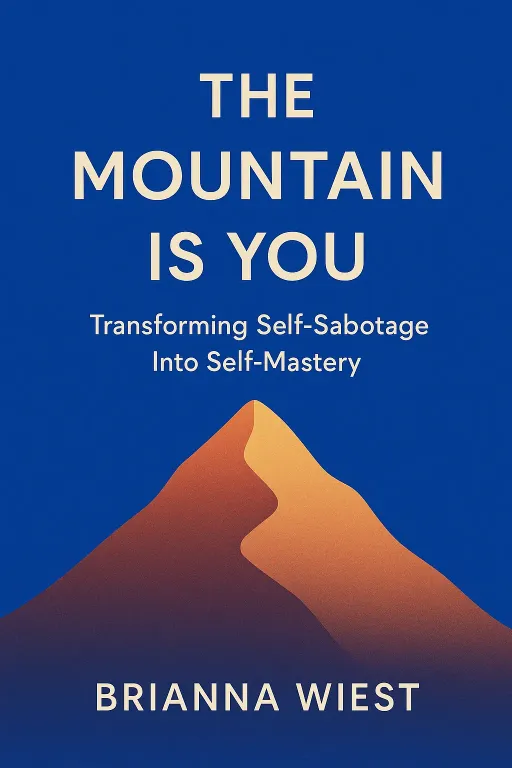
Nova: Exactly. That security guard is doing its job, but it is working off a threat assessment that is ten years out of date. Today, we are looking at how to update that internal software. We are diving into two essential texts: The Mountain Is You by Brianna Wiest and Master Your Emotions by Thibaut Meurisse.
Atlas: Brianna Wiest has built a massive following by deconstructing the messy, often invisible ways we hold ourselves back. And Thibaut Meurisse is known for turning vague emotional concepts into these rigid, almost engineering-like frameworks for personal development.
Nova: That is the perfect pairing. Wiest helps us understand the psychology of why we stay stuck, and Meurisse provides the tactical manual for reprogramming our responses. We are going to bridge the gap between understanding the root cause and executing the daily fix.
Decoding the Subconscious Mechanism
SECTION
Atlas: Let us start with this idea of self-sabotage as a survival mechanism. If I am an Analytical Architect, I look at my life as a system. If the system is stalling, I assume there is a bug in the code. But what you are suggesting is that the bug is actually a feature.
Nova: That is the core insight from Wiest. She argues that we engage in self-sabotage because we derive a hidden benefit from staying stuck. If you are not moving forward, you are not risking failure. If you are not risking failure, you are not risking the pain that comes with it.
Atlas: So, procrastination is a risk-mitigation strategy. That makes sense, but it feels counterintuitive. I am sabotaging my long-term goals to secure short-term safety.
Nova: Precisely. Wiest calls this the mountain. The mountain is the comfort zone we have built around our past experiences. When we try to climb out of it, our subconscious triggers a warning siren. It says, this is new, this is dangerous, go back to the familiar.
Atlas: I see how that applies to high-stakes environments. If I am launching a new product, the fear of public failure is a massive, tangible threat. My brain decides that staying in the research phase—indefinitely—is safer than shipping the product and finding out if the market likes it.
Nova: That is the perfect example of the hidden benefit. The research phase provides the illusion of progress without the risk of judgment. You get to feel busy, you get to feel productive, but you are actually just running in place to avoid the vulnerability of the unknown.
Atlas: That is a tough pill to swallow. It means my obsession with perfectionism is just a fancy way of hiding. But how do we actually decode this? If the subconscious is the one pulling the strings, how do I, as a conscious agent, intervene?
Nova: You have to play detective with your own behavior. Wiest suggests that when you feel the urge to sabotage—when you want to reach for your phone instead of doing the deep work—you need to pause and ask what you are protecting yourself from.
Atlas: So, the next time I find myself organizing my desk instead of writing the strategy document, I should stop and ask, what am I afraid of right now?
Nova: Exactly. And be specific. Is it the fear of being wrong? Is it the fear of being seen? Is it the fear that if you succeed, you will have to maintain that level of performance forever?
Atlas: That last one hits home. The fear of sustained success is a real thing. It is the fear that you have reached your ceiling and have nowhere to go but down.
Nova: That is a classic subconscious block. You are protecting yourself from the pressure of the future. Once you identify that, you take the power away from the impulse. You are no longer just procrastinating; you are managing a very specific, very human fear.
Atlas: I like this approach because it turns the problem into a data point. It is not about willpower anymore. It is about identifying the trigger and the benefit. Once I name the benefit—like, protecting myself from the pressure of success—I can then address that fear directly, rather than just beating myself up for being lazy.
Emotions as Biological Signals
SECTION
Nova: That brings us perfectly to the second piece of the puzzle. Once you have identified the fear, you are going to feel it. That is where Thibaut Meurisse comes in. He shifts the conversation from psychology to biology. He argues that emotions are not facts. They are signals.
Atlas: I have heard that before, but it is hard to put into practice when you are in the middle of a high-stress moment. If I am feeling overwhelmed, that feeling is very real. It feels like a fact.
Nova: Meurisse would say that feeling is just data. Think of it like a dashboard in a car. When the check engine light comes on, you do not get angry at the light. You do not try to smash the dashboard. You use the information to figure out what is wrong with the engine.
Atlas: That is a great analogy. So, if I am feeling overwhelmed, I shouldn't try to suppress it or force myself to be positive. I should treat it as a notification.
Nova: Exactly. Your emotions are telling you something about your current state. Maybe you are overwhelmed because you have taken on too much. Maybe you are anxious because your goals are not aligned with your values. The emotion is the signal; your job is to decode the message.
Atlas: This feels like a system update. I am constantly trying to optimize my workflow, but I rarely optimize my emotional inputs. If I am constantly running on anxiety, that is a bad input for my cognitive output.
Nova: Meurisse emphasizes that we can reprogram these signals through systematic daily habits. He talks about the concept of emotional regulation as a muscle. You do not just decide to be emotionally stable. You build the capacity to be stable through repetition.
Atlas: What does that repetition look like in a practical sense? Because if I just tell myself to be calm, I usually end up more stressed.
Nova: He advocates for proactive management. Instead of waiting for the emotional emergency, you track your triggers daily. It is a five-minute habit. You list what you felt, what triggered it, and what that emotion was trying to tell you.
Atlas: So, I am building a log. A historical database of my own emotional volatility.
Nova: That is exactly what it is. Over time, you start to see patterns. You might notice that you consistently feel a spike of anxiety on Tuesday mornings. Maybe that is not a random mood. Maybe that is because you have a recurring meeting that drains your energy.
Atlas: And once I have that data, I can engineer a solution. I can move the meeting, or I can schedule a recovery block immediately after. It is not about fixing my personality; it is about adjusting the environment.
Nova: You have got it. You are moving from a reactive state, where you are a victim of your mood, to an active state, where you are the architect of your emotional environment.
Atlas: I can see how this bridges the gap between Wiest and Meurisse. Wiest helps me identify the subconscious block, and Meurisse gives me the habit-based framework to manage the emotional fallout of breaking that block.
Synthesis & Takeaways
SECTION
Nova: We have covered a lot of ground here, from the deep-seated subconscious protection mechanisms to the daily, granular management of emotional data.
Atlas: It feels like the main takeaway is that self-sabotage is not a sign that you are broken. It is a sign that you are human, and that you have some outdated internal systems that need an upgrade.
Nova: That is the key. You are not a broken machine. You are a highly complex system that is currently running on legacy software. The goal is not to eliminate fear or anxiety. The goal is to understand the signal and update your response.
Atlas: I think I am going to try the five-minute trigger tracking. It sounds simple, but I can see how, over a month, that would provide a massive amount of insight. It is basically debugging my own psychology.
Nova: That is the perfect way to frame it. You are the architect of your future, and your emotional data is the blueprint. Start small. Identify the hidden benefit of your current stuckness, and track your emotional triggers for five minutes a day.
Atlas: It is a manageable, high-leverage move. I like that it removes the moral judgment from the process. It is not about being "better"; it is about being more efficient and more aware.
Nova: And that awareness is the first step toward true growth. You stop fighting yourself and start working with your own biology.
Atlas: This has been a great session. We have taken some heavy psychological concepts and turned them into actionable systems. I am excited to see what the data looks like after a week of tracking.
Nova: Keep us posted on how that debugging process goes. It is a journey, not a destination.
Atlas: Absolutely. For everyone listening, start by observing, not by judging. Use the data.
Nova: This is Aibrary. Congratulations on your growth!









