

Breaking the Myths of Fixed Identity
Golden Hook & Introduction
SECTION
Nova: We spend our entire lives collecting labels like they are rare trading cards. I am a procrastinator. I am an introvert. I am just not a morning person. We wear these tags as if they are biological imperatives, permanent fixtures of our character. But what if those labels are not descriptions of who you are, but the very bars of the cage you have built for yourself?
Atlas: That is a brutal way to start the morning, Nova, but I cannot say you are wrong. I think everyone listening has at least one label they cling to, almost like a security blanket. It explains away the failures, right? Oh, I missed that deadline because I am a creative type, not a detail person. It is a convenient excuse.
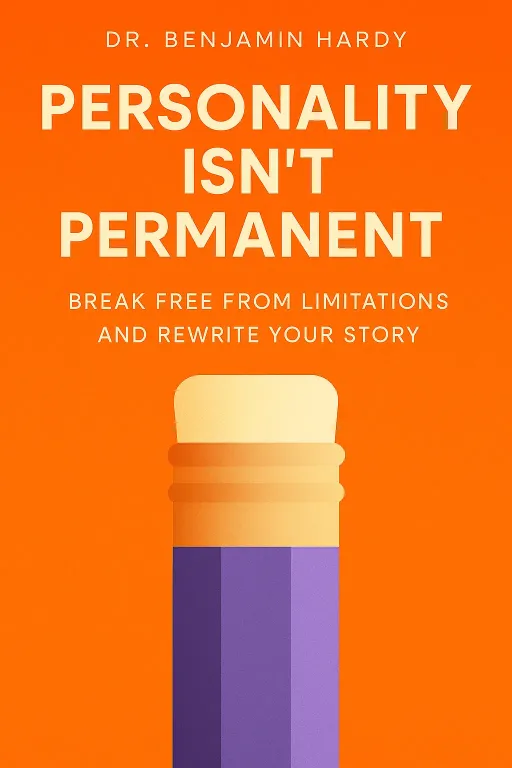
Nova: Exactly. And that is why we are diving into two books that dismantle this entire way of thinking. First, we have Personality Isn't Permanent by Dr. Benjamin Hardy. He completely flips the script on how we view our character, arguing that our personality is a dynamic state we choose, not a fixed destination we arrive at.
Atlas: And then we pair that with The Mountain Is You by Brianna Wiest. I have always found her work fascinating because she doesn’t just talk about change; she talks about the internal mechanics of why we stay stuck. She looks at self-sabotage not as a character flaw, but as a protective mechanism. It is a brilliant combination. Hardy gives us the vision for who we can become, and Wiest gives us the map for navigating the resistance we feel when we try to move toward that person.
The Myth of Fixed Identity
SECTION
Nova: Let’s start with the big one. The idea that you have a fixed personality. Most people treat their personality like a fingerprint. You are born with it, it stays the same, and if you are grumpy or shy or disorganized, well, that is just your lot in life. Hardy’s research argues that this is fundamentally backwards. He suggests that your personality is actually a byproduct of your goals.
Atlas: Hold on, I have to jump in there. That sounds great in a self-help book, but let’s look at the reality. If I am naturally an introvert who gets drained by large crowds, are you telling me that if I just set a goal to be the life of the party, I will magically become an extrovert? That feels like we are ignoring the biological reality of how our brains are wired.
Nova: That is the crucial distinction to make. You are conflating temperament with personality. Temperament is your biological baseline. It is how you process sensory input. But personality is the way you act, the way you interact with the world, and the way you identify yourself. Hardy’s point is that we often confuse our past behavior with our identity. We look at a decade of being disorganized and say, I am a disorganized person.
Atlas: I see the pivot. So, it is about moving from a descriptive model of the past to a prescriptive model of the future.
Nova: Precisely. Think about it like a professional athlete. If a player is known for being a defensive specialist, they don’t just accept that as their identity for life. They train for the goal of being a well-rounded scorer. They change their training, their focus, and their habits to align with the new identity they want to inhabit. They don't wait for their personality to change; they act in accordance with the person they are becoming.
Atlas: That makes sense. It is like the difference between saying I am a smoker and saying I am someone who is in the process of quitting. The first one traps you in the identity; the second one gives you a pathway to a different future. But how does someone actually execute this? If I wake up tomorrow and decide, I want to be a decisive leader, but my entire history is being a people-pleaser, that transition feels massive.
Nova: It is massive, and that is where the friction happens. Hardy talks about the concept of the Future Self. He suggests that you should write down exactly who you want to be in twelve months and then work backwards. The key is that you stop treating your current personality as the boss of you. You start treating your Future Self as the boss. When you face a decision, you don't ask, what would the current, people-pleasing Atlas do? You ask, what would the decisive, visionary leader I am becoming do in this situation?
Atlas: I like that. It creates a psychological distance. It is not about changing who I am; it is about making decisions on behalf of the person I am building. That feels like a strategic move rather than a personality overhaul.
Self-Sabotage as a Coping Mechanism
SECTION
Nova: And that leads perfectly into what Brianna Wiest explores in The Mountain Is You. Because even when you know who you want to be, and you have that clear goal, you will inevitably hit a wall. You will start to self-sabotage. You will procrastinate, you will get sick, you will pick a fight with your partner, or you will get distracted by something trivial.
Atlas: Oh, I know that wall well. It is not just a wall; it is a brick fortress. But why do we do it? If we want the goal, why do we actively destroy our chances of getting there? It feels like we are fighting ourselves.
Nova: That is the genius of Wiest’s perspective. She argues that self-sabotage is not a sign that you are broken or lazy. It is a sign that you are trying to protect yourself. Your subconscious mind is terrified of the unknown. Even if your current situation is painful, it is familiar. It is predictable. Your brain knows how to survive in the pain you are currently in.
Atlas: So, success is actually a threat to the safety of the current system?
Nova: Exactly. Think of it like a thermostat. If your internal thermostat is set to a certain level of stress or a certain level of achievement, and you suddenly try to turn the heat up—meaning, you try to go for that big promotion or launch that business—your system will kick back in to cool things down. It will trigger self-sabotage to bring you back to your baseline. It is trying to keep you safe from the unknown, which it perceives as a danger.
Atlas: That is a profound way to look at it. It changes the narrative from, I am a self-destructive person, to, I am a system that is currently optimized for a lower level of output. If I want to change that, I have to recalibrate my internal safety protocols.
Nova: And that requires radical honesty. Wiest talks about identifying your emotional triggers. When you feel the urge to procrastinate, don't just judge yourself for being lazy. Pause and ask, what am I afraid of right now? Am I afraid of being seen? Am I afraid of failing? Am I afraid of succeeding and then having to maintain that level of performance? Usually, the answer is in the fear.
Atlas: I can see how that would change the approach. Instead of beating yourself up for the sabotage, you treat it like a data point. You are essentially debugging your own operating system.
Nova: Yes, and the beauty of that approach is that it removes the shame. When you remove the shame, you can actually see the mechanics of the sabotage clearly. You start to see the patterns. Maybe you sabotage every time you get close to a financial goal because you have an underlying belief that money is dangerous. Maybe you sabotage every time you start a new relationship because you are terrified of being vulnerable. Once you see the pattern, you can choose a different response.
Synthesis & Takeaways
SECTION
Atlas: Okay, let's bring this home for our listeners. We have two powerful ideas here. One, your personality is a strategy for your goals, not a life sentence. And two, your self-sabotage is a protective mechanism, not a character flaw. If I am listening to this and I want to apply this tomorrow morning, what is the bridge between these concepts?
Nova: You have to start by identifying the tags you have given yourself. That is the assignment. Tonight, I want you to write down one limiting identity tag you have been carrying around. Maybe it is, I am not good at public speaking, or I am not a technical person, or I am just bad with money. Write it down.
Atlas: Okay, I have one in mind. Now what?
Nova: Now, you write a three-step action plan to actively contradict it this week. Not next month, not when you feel ready. This week. If the tag is, I am not good at public speaking, your action plan isn't to sign up for a TED Talk. It is to speak up once in a meeting, record yourself explaining a concept, and ask a friend for feedback on a short presentation. You are actively gathering evidence that contradicts the tag.
Atlas: I see how that works. By taking those small actions, you are essentially rewriting the data that your brain uses to define your personality. You are proving to yourself that the old label is no longer accurate.
Nova: You are proving it to your subconscious. And as you do that, you will trigger that resistance we talked about. You will feel the urge to sabotage. And when you do, you catch it. You say, ah, there it is. That is just my safety mechanism kicking in because I am doing something new. And then you proceed anyway.
Atlas: It is a cycle of growth. You redefine the goal, you act in alignment with the new identity, you handle the inevitable resistance, and then you repeat. It is not about being a different person overnight. It is about becoming a different person through the accumulation of small, intentional acts.
Nova: That is the essence of it. You are not discovering who you are. You are creating who you want to be. And the future you are building is worth far more than the comfort of the labels you are currently hiding behind.
Atlas: That is a powerful note to end on. I think that is the perfect challenge for anyone listening who feels like they have hit a ceiling. Don't look for the exit; look at the label you’ve stuck to the door.
Nova: Precisely. We are the architects of our own identity. It is time to start building something that actually reflects our potential, not our past. Thank you for joining us in this exploration of the self. This is Aibrary. Congratulations on your growth!









