

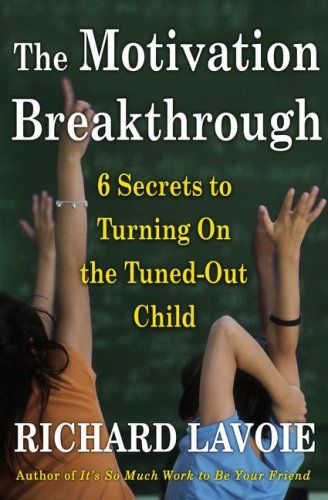
The Motivation Breakthrough
6 Secrets to Turning On the Tuned-Out Child
The Myth of the Unmotivated Child
The Myth of the Unmotivated Child
Nova: Have you ever looked at a student or maybe even your own child and thought, they are just not motivated? Like, there is simply no engine under the hood?
Atlas: Oh, absolutely. I think every parent or teacher has had that moment of pure frustration where it feels like you are pushing a car uphill with the parking brake on. You try the rewards, you try the threats, and nothing happens.
Nova: Well, Richard Lavoie, the author of The Motivation Breakthrough, would tell you that you are actually looking at it all wrong. His core argument is a complete paradigm shift. He says there is no such thing as an unmotivated human being.
Atlas: Wait, no such thing? I can think of a dozen kids right now who would disagree with that just by sitting on the couch all day.
Nova: Lavoie's point is that everyone is motivated. The question is, what are they motivated by? That kid on the couch might be highly motivated to avoid failure, or motivated to maintain their social status by appearing too cool to care. They have an engine; we just haven't found the right key to start it.
Atlas: So it is not a lack of energy, it is a misdirection of energy. That is a big claim. How does he actually back that up?
Nova: He spent decades working with kids who have learning disabilities, the ones who are often labeled as the most unmotivated. He realized that our traditional school system only uses one or two keys to try and start every single engine. If those keys do not fit, we blame the engine. But Lavoie identified six distinct forces that drive us, and that is what we are diving into today.
Key Insight 1
The Social and External Drivers
Nova: Lavoie breaks motivation down into what he calls the six P's. The first three are very social and external: People, Praise, and Prizes. Let's start with People. These are the kids who are motivated by relationships.
Atlas: I know these kids. They are the ones who will work their tails off for a teacher they like, but won't lift a finger for a teacher they don't connect with.
Nova: Exactly. For a People-motivated student, the relationship is the currency. They are gregarious, they want to please the adults they respect, and they thrive on connection. If you try to motivate them with a cold, data-driven approach, they will shut down. They need to feel that you care about them as a person before they care about your lesson plan.
Atlas: That makes sense, but what about Praise? Isn't everyone motivated by praise? I mean, who doesn't like a pat on the back?
Nova: You'd be surprised. While most people like it, for some, it is their primary fuel. But Lavoie makes a huge distinction here between praise and encouragement. Praise is often about the result, like saying, great job on that A. Encouragement is about the process, like saying, I saw how hard you worked on those math problems.
Atlas: So praise can actually be a trap if it is only about the outcome?
Nova: Precisely. If a kid is only motivated by the A, they might stop taking risks because they are afraid of losing that praise. Lavoie suggests that for these kids, the feedback needs to be specific and immediate. It is not just saying good job, it is acknowledging the specific effort they put in.
Atlas: Okay, so People and Praise. What about the third one? Prizes. That sounds like the classic sticker chart approach that everyone uses.
Nova: It is, and Lavoie is actually quite cautious about Prizes. He says they are the most overused and often the least effective long-term motivator. Prizes are extrinsic. Once the prize is gone, the motivation often vanishes too.
Atlas: So why include it as one of the six P's if it is so risky?
Nova: Because for some kids, especially those with certain learning profiles, a tangible reward is the only thing that can jumpstart the process. The trick, Lavoie says, is to use prizes to get the momentum going, but you have to bridge it to one of the other P's as soon as possible. You can't run a car on starter fluid forever; eventually, you need real fuel.
Key Insight 2
The Internal and Status Drivers
Nova: Now we get into the more internal and status-driven forces: Projects, Power, and Prestige. These are often the ones that teachers and parents struggle with the most because they require giving up some control.
Atlas: Let's talk about Power. That sounds like a recipe for a classroom rebellion. Are we really supposed to motivate kids by giving them power?
Nova: It sounds counterintuitive, right? But Lavoie argues that many kids who are labeled as defiant are actually just Power-motivated. They have a deep need for autonomy and control over their environment. If you fight them for control, you both lose. But if you give them legitimate choices, they become your most invested workers.
Atlas: Give me an example. How do you give a ten-year-old power without losing the room?
Nova: It is about choice. Instead of saying, do this worksheet, you say, would you like to do the even numbers or the odd numbers first? Or, do you want to write your report on a poster board or create a digital presentation? You are still directing the learning, but they feel they have a hand on the steering wheel.
Atlas: Okay, I can see how that would stop a power struggle before it starts. What about Prestige? That sounds a bit like vanity.
Nova: It is more about status and being seen as an expert. These are the kids who love to be the line leader, or the ones who want their work displayed on the bulletin board. They want to be recognized by their peers as being capable. Lavoie suggests giving these students responsibilities that carry status, like being the classroom tech expert or the person who introduces a guest speaker.
Atlas: And the last one is Projects. I'm guessing this is for the kids who just want to get their hands dirty?
Nova: Exactly. These students are task-oriented. They don't want to hear a lecture; they want to build the model, conduct the experiment, or solve the puzzle. They are motivated by the work itself. For them, the reward isn't a grade or a sticker; it is the completion of the project.
Atlas: It is interesting because these six P's cover almost every personality type. But I imagine the challenge is that a single classroom has all six types of kids sitting in it at the same time.
Nova: That is the ultimate challenge for any educator. Lavoie's point is that you can't use a one-size-fits-all approach. You have to be a bit of a detective. You observe the student, see what makes them light up, and then you tailor your approach to match their specific motivational force.
Key Insight 3
The Fairness Doctrine and Learned Helplessness
Nova: One of the most famous concepts from Lavoie's work is his definition of fairness. In most classrooms, fairness means everyone gets the same thing. Lavoie completely rejects that.
Atlas: If fairness isn't everyone getting the same thing, then what is it?
Nova: He says fairness means that everyone gets what they need. Think about it like a doctor's office. If ten people come in with different injuries, it wouldn't be fair to give them all a bandage on their left arm. One person needs a cast, another needs an aspirin, and another needs surgery. That is true fairness.
Atlas: That is a powerful analogy. But I can hear the kids now: That's not fair! Why does he get to use a computer while I have to write by hand?
Nova: Lavoie actually suggests teaching this concept directly to kids. Tell them on day one: In this house or this classroom, fairness means everyone gets what they need to succeed. Because you are all different, you will all be treated differently. It removes the resentment because the focus shifts from comparison to individual growth.
Atlas: It also seems like it would help with what he calls learned helplessness. Can you explain that concept?
Nova: Learned helplessness is a psychological state where a student has failed so many times that they have literally learned that their effort has no impact on the outcome. They stop trying not because they are lazy, but because they are protecting themselves from the pain of failing again.
Atlas: So they just give up before they even start because, in their mind, the result is already a failure.
Nova: Exactly. It is a defense mechanism. Lavoie points out that for these kids, the cycle of failure is a downward spiral. They fail, they feel bad, they lose motivation, they put in less effort, and then they fail again. To break that cycle, you have to provide them with what he calls guaranteed success. You have to give them tasks that are small enough and supported enough that they cannot fail, which slowly rebuilds their belief that their effort actually matters.
Key Insight 4
Practical Strategies for the Real World
Nova: So how do we actually put this into practice? Lavoie is very big on the idea of the hidden curriculum. These are the social and motivational rules that aren't written down but are essential for success.
Atlas: Like knowing how to ask for help without feeling embarrassed?
Nova: Exactly. Or knowing how to read a teacher's body language. For kids with learning disabilities, this hidden curriculum is often a mystery. Lavoie suggests we need to make these things explicit. Don't assume they know how to stay organized or how to start a big project. Teach the process as clearly as you teach the content.
Atlas: He also talks about the importance of the environment, right? Not just the physical space, but the emotional atmosphere.
Nova: Yes, he uses the term psychological safety. A student cannot be motivated if they are in a state of anxiety. If the classroom is a place where mistakes are mocked or where speed is valued over depth, the unmotivated student will just retreat further into their shell.
Atlas: I love his tip about the three-second rule. Can you explain that one?
Nova: It is so simple but so effective. When you ask a question, wait at least three to five seconds before calling on anyone. It gives the slower processors time to think and realize they might have the answer. If you always call on the first hand that goes up, you are only motivating the fastest kids, and everyone else just tunes out.
Atlas: It is like giving everyone a chance to get their engine started before the race begins.
Nova: Precisely. And for parents, he suggests looking at chores and homework through the lens of the six P's. If your kid is motivated by Prestige, maybe they aren't just cleaning their room; they are the Room Inspector. If they are motivated by People, maybe you do the dishes together so they get that connection time.
Atlas: It really turns the whole idea of discipline on its head. Instead of punishing the behavior, you are looking for the need behind the behavior and using that to drive them forward.
Conclusion
Nova: We have covered a lot today, from the six P's of motivation to the radical idea that fairness means everyone getting what they need. Richard Lavoie's work is really a call to empathy. It asks us to stop judging the unmotivated student and start studying them.
Atlas: It is a hopeful message. The idea that the engine is always there, even if it is buried under years of failure or frustration, is something every educator and parent needs to hear. It is not about changing the kid; it is about changing the key we use to reach them.
Nova: If you take one thing away from The Motivation Breakthrough, let it be this: Motivation is not something you do to someone. It is something you release within them. When you find the right force, whether it is Power, Projects, or People, you don't have to push anymore. They will start to drive themselves.
Atlas: And that is when the real breakthrough happens. Not just in their grades, but in their confidence and their belief in what they can achieve.
Nova: Thank you for joining us on this deep dive into the psychology of motivation. We hope these insights help you unlock the potential in the people around you.
Atlas: This is Aibrary. Congratulations on your growth!