

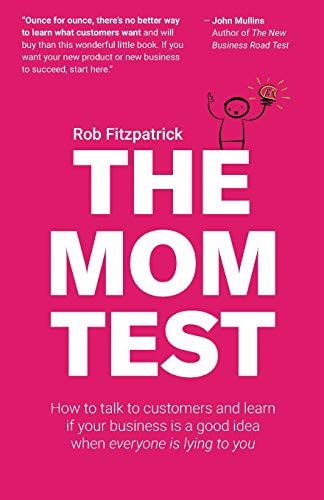
The mom test
How to talk to customers and learn if your business is a good idea when everyone is lying to you
Introduction
Nova: Have you ever had a brilliant business idea, told your friends about it, and had them all tell you it was a stroke of genius? Or maybe you showed it to your mom and she said she would definitely buy it? Well, I hate to be the bearer of bad news, but those people are probably lying to you. Not because they are mean, but because they love you.
Atlas: Wait, wait. Are you saying I can't trust my own mother's feedback on my startup? That feels a little harsh, Nova. I thought the whole point of customer discovery was to find people who love what you are doing.
Nova: It is, Atlas! But the problem is that most of us are asking the wrong questions. We are essentially begging for compliments rather than digging for the truth. Today we are diving into a book that completely flipped the script on entrepreneurship. It is called The Mom Test by Rob Fitzpatrick.
Atlas: The Mom Test. I assume the title implies that if you can talk to your mom and get an honest answer, you can talk to anyone?
Nova: Exactly. It is a set of simple rules for talking to customers when everyone is lying to you. The core premise is that you should never ask anyone if your business is a good idea. It is a bad question, and everyone will lie to you at least a little bit. By the end of this episode, we are going to learn how to find out if your business is going to fail before you spend a single dollar building it.
Atlas: I love the idea of failing fast and cheap, but the thought of my mom lying to me still stings. Let's see how Rob Fitzpatrick suggests we fix this.
Key Insight 1
The Golden Rules of Conversation
Nova: The first thing Rob Fitzpatrick tells us is that the measure of a good conversation is not how much you liked what they said, but how much useful data you actually collected. He breaks this down into three golden rules that make up The Mom Test.
Atlas: Alright, I am ready. What is rule number one?
Nova: Rule number one: Talk about their life instead of your idea. This is where most founders trip up. They start the meeting by pitching. They say, I am building this amazing app for dog walkers, what do you think? As soon as you do that, you have biased the entire conversation.
Atlas: So if I do not talk about my idea, what am I actually talking about? Is it just small talk?
Nova: Not at all! You are talking about their specific problems and habits. If you are building that dog walker app, you should be asking them how they currently find dog walkers, how often they walk their dogs, and what the last major headache was when they went on vacation.
Atlas: That makes sense. You are looking for a gap in their life rather than trying to force your solution into it. What is rule number two?
Nova: Rule number two is to ask about specifics in the past instead of generics or opinions about the future. This is huge. If you ask someone, Would you ever use an app that does X? they will almost always say yes. It costs them nothing to be optimistic about the future.
Atlas: Right, because saying yes makes them feel supportive and it makes me feel good. But that doesn't mean they will actually open their wallet later.
Nova: Precisely. Instead, you ask, Tell me about the last time this problem happened. How did you handle it? What else have you tried to solve this? If they have not tried to solve it in the past, they probably won't pay for your solution in the future.
Atlas: That is a reality check. If it is not a big enough pain point for them to seek out a solution already, my app isn't going to magically make them care.
Nova: Exactly. And the third rule is simple but the hardest for founders: Talk less and listen more. Rob says you should be listening about eighty percent of the time. You are a researcher, not a salesperson.
Atlas: I can see how that would be hard. When you are excited about an idea, you want to shout it from the rooftops. But if you are talking, you aren't learning.
Nova: And that is the core of it. The Mom Test is about getting people to tell you about their life in a way that provides you with facts, not opinions. If you follow these three rules, the feedback you get becomes incredibly reliable, even if it comes from your mom.
Key Insight 2
The Danger of Compliments and Fluff
Nova: One of the most dangerous things a founder can hear is a compliment. Rob calls compliments the fool's gold of customer research. They feel great, but they are actually a sign that the meeting has gone off the rails.
Atlas: Wait, since when are compliments bad? If someone tells me my idea is great, I am going home happy!
Nova: And that is the trap, Atlas! When someone says, That is a great idea, or I would totally use that, they are usually just trying to be polite and end the conversation. It is a way to get you to stop talking without having to hurt your feelings. It provides zero data on whether they will actually buy.
Atlas: So how do I distinguish between a polite compliment and genuine interest?
Nova: You basically ignore the compliment entirely and pivot back to facts. Rob suggests that if someone says, I love that idea, you should say, Thanks, but I am more interested in your current process. When was the last time you actually faced that problem? You have to aggressively steer the conversation away from fluff.
Atlas: Fluff. I like that term. What else counts as fluff besides compliments?
Nova: Fluff also includes generic statements like, I usually do this, or I would always want that. These are hypothetical versions of themselves. People like to think they are the kind of person who goes to the gym every day or eats healthy, but the data of their past week might say otherwise.
Atlas: So if I ask, Do you like to cook? they might say yes because they identify as a foodie, even if they ordered takeout six nights last week.
Nova: Exactly! That is why the cookbook app example in the book is so famous. If you ask your mom if she likes your digital cookbook app idea, she says yes because she loves you and she loves cooking. But if you look at her actual behavior, she has a shelf full of dusty cookbooks she never opens because she just uses YouTube. The app idea is dead on arrival, but her compliments would have led you to build it anyway.
Atlas: Wow. So by accepting the compliment, I am actually sabotaging my own business. I am building on a foundation of polite lies.
Nova: It is a hard pill to swallow. Rob even says that if you are doing this right, you should be terrified of some of the questions you are asking. You should be looking for the answer that might prove you wrong.
Atlas: That takes a lot of courage. Most of us go into these meetings looking for validation, not for the reasons why our idea won't work.
Nova: But finding out it won't work now saves you years of your life. Every time you hear a compliment, you should treat it as a red flag. Dig deeper. Ask for the hard facts.
Key Insight 3
Mastering the Interview Dialogue
Nova: Let's look at how a real Mom Test conversation sounds versus a bad one. Rob uses this great example of a founder talking to a potential customer about an iPad app for chefs. In the bad version, the founder starts with, We have this idea for a digital cookbook, do you think it is useful?
Atlas: And the chef probably says, Sure, I can see people using that. Very non-committal.
Nova: Exactly. The chef is being nice. But in the Mom Test version, the founder doesn't even mention the app. Instead, they say, How do you currently manage your recipes in a busy kitchen?
Atlas: That is much better. Now the chef has to talk about the actual environment. They might say, It is too messy for electronics, we use paper because we can throw it away.
Nova: Boom! Right there, you just learned a massive constraint that might kill your product. And you learned it in thirty seconds without writing a line of code. Another great question Rob suggests is, What else have you tried to solve this problem?
Atlas: Oh, I see why that is powerful. If they say, I have tried five different apps and none of them worked, you know there is a real desire but the current solutions are lacking. But if they say, I haven't really looked into it, then it is not a real problem for them.
Nova: Exactly. He also emphasizes asking, How does this problem affect your bottom line? or How much time does this waste? You want to find the money or the pain. If there is no money being lost and no major pain being felt, you don't have a business; you have a hobby.
Atlas: I also read that there are five specific questions that can work in almost any situation. Do you know which ones those are?
Nova: Yes! They are incredibly versatile. First: Why do you bother with this? This gets at the motivation. Second: What are the implications of that? This finds the consequences of the problem. Third: Talk me through the last time that happened. This gets the specific narrative.
Atlas: And the other two?
Nova: Fourth: What else have you tried? As we discussed, this shows how much they care. And fifth: Is there anything else I should have asked? This is the golden question because it allows the customer to reveal things you didn't even know were relevant.
Atlas: I like that last one. It acknowledges that I don't know everything. It turns the customer into a partner in the research.
Nova: It also opens the door for referrals. You should always end by asking, Who else should I talk to about this? If the person is genuinely interested, they will want to connect you with others who have the same problem.
Atlas: It sounds like these conversations should feel less like a formal interview and more like a casual chat at a coffee shop.
Nova: That is the goal. Rob says if they know it is a formal interview, they might start acting differently. If you can keep it casual and focused on their life, you get the best data.
Key Insight 4
Commitment and Advancement
Nova: Now, eventually, you do have to show them what you are building. You can't keep the idea a secret forever. But when you do, you need to look for something very specific: commitment.
Atlas: Commitment. Like a marriage? Are we getting engaged to our customers now?
Nova: In a way, yes! Rob defines a successful meeting not by whether the person said they liked the idea, but by whether they moved forward in the sales funnel. He calls this advancement. If a meeting doesn't end with a clear next step that involves a sacrifice from the customer, it was a waste of time.
Atlas: A sacrifice? You mean they have to pay me right then and there?
Nova: Money is the ultimate commitment, but it is not the only one. Rob breaks it down into three categories: Time, Reputation, and Cash. A time commitment could be scheduling a follow-up meeting to look at a prototype or agreeing to a week-long trial.
Atlas: What about reputation? How does that work?
Nova: A reputation commitment is when they offer to introduce you to their boss or a key decision-maker. They are putting their own professional standing on the line for your product. That is a huge signal that they believe in what you are doing.
Atlas: I see. So if I ask for an intro to their CFO and they hesitate, they don't actually believe the product is worth it, regardless of how many compliments they gave me earlier.
Nova: Exactly. You have to push for that commitment. Rob says you should never leave a meeting with a maybe. A clear No is a great result because it saves you time. A clear Yes with a commitment is a great result. But a maybe or a that sounds interesting is the danger zone.
Atlas: It sounds like we are being a bit more assertive here. We are moving from researcher to a bit of a closer.
Nova: You are testing the strength of the evidence you gathered. If you have spent thirty minutes hearing about how much they hate a problem, and then you offer a solution and they refuse to give you twenty minutes next week to see a demo, then one of two things is true: either the problem isn't that bad, or they were lying to you during the first half of the meeting.
Atlas: That is a brilliant way to keep yourself honest. It forces the customer to put their money, or at least their time, where their mouth is.
Nova: And this is where the Advancement part comes in. You should always have a goal for the next step before you even go into the meeting. If you are just collecting notes, you are a hobbyist. If you are moving them toward a goal, you are a founder.
Atlas: It makes the whole process feel much more professional and less like you are just fishing for a pat on the back.
Key Insight 5
Preparing and Structuring the Process
Nova: The last major piece of the puzzle is how to actually organize this work. You can't just wander around talking to people and hope for the best. Rob has some very practical advice on the prep and post-meeting process.
Atlas: I imagine note-taking is a big part of this. How do you keep track of all these conversations without it becoming a mess?
Nova: Rob suggests that you shouldn't do these alone if you can help it. Ideally, you have two people. One person is the primary talker, maintaining eye contact and the flow of the conversation, while the other person is the note-taker, capturing specific quotes and emotional cues.
Atlas: Quotes are better than summaries, right? Because a summary is just my interpretation of what they said.
Nova: Exactly! You want the raw data. If they say, This is a nightmare to deal with, you write that down. Don't just write customer is frustrated. You want the emotional weight behind their words.
Atlas: And what about the preparation? Do I need a full script?
Nova: Definitely not a script, but you do need a list of three big things you want to learn. Rob calls this the Rule of Three. Before every meeting, ask yourself: What are the three most important things I need to find out right now to move this business forward? If you go in without those, the conversation will drift into fluff.
Atlas: That seems manageable. Just three goals. It keeps you focused without making the conversation feel stiff.
Nova: And immediately after the meeting, you should spend ten minutes reviewing your notes with your partner. This is when the memory is fresh. You categorize the feedback. Is it a feature request? Is it a pain point? Is it a potential deal-breaker?
Atlas: One thing I am curious about is the scale. How many of these Mom Test interviews do I need to do before I actually start building?
Nova: Rob says you usually start seeing patterns after five to ten conversations. If you talk to ten people in a specific niche and they all tell you the same thing, you have a solid foundation. If every person tells you something completely different, you either haven't narrowed down your customer segment enough, or there is no coherent problem to solve.
Atlas: So the goal is to reach a point where you can almost predict what the customer is going to say before they say it.
Nova: Precisely. That is the moment of clarity. Once you have that, the risk of your project drops significantly because you are no longer guessing. You are building for a reality you have witnessed firsthand.
Conclusion
Nova: We have covered a lot today. From the three golden rules of the Mom Test to the danger of compliments and the necessity of getting real commitment. The common thread throughout Rob Fitzpatrick's work is a pursuit of the cold, hard truth, even when it is uncomfortable.
Atlas: It is a bit of a shift in mindset. You have to stop being a cheerleader for your own idea and start being a detective. It is less about being right and more about finding out what is true.
Nova: That is the perfect way to put it. If you can master the art of the Mom Test, you will save yourself months or even years of building things that nobody wants. You will be able to walk into any room, talk to anyone, and walk out with data that actually matters.
Atlas: I think I am ready to go talk to my mom. But this time, I am not going to ask her about my app. I am going to ask her about how she organized her recipes last Thanksgiving.
Nova: That is the spirit! Remember, the best questions are the ones that give the person you are talking to the room to tell you why you might be wrong. Embrace the bad news early, and you will find the good ideas much faster.
Atlas: Thanks for the masterclass, Nova. This has been eye-opening.
Nova: My pleasure. To all our listeners out there, go out and start failing your own Mom Tests. It is the only way to eventually pass the real test of the market. This is Aibrary. Congratulations on your growth!