

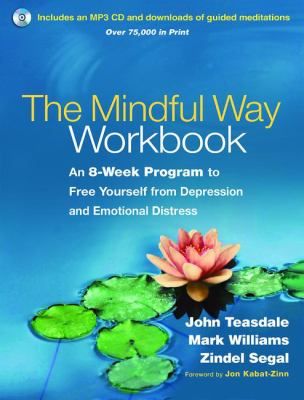
The Mindful Way Workbook An 8week Program To Free Yourself From Depression And Emotional Distress
An 8-Week Program to Free Yourself from Depression and Emotional Distress
Introduction
Nova: Imagine you are stuck in a patch of quicksand. Your natural instinct, the one that has kept humans alive for millennia, is to struggle. You kick, you pull, you try to climb your way out. But in quicksand, that very effort is what pulls you under. The harder you fight, the faster you sink.
Nova: Exactly. I am talking about the mental quicksand of depression and emotional distress. Today we are diving into a book that has changed the landscape of mental health: The Mindful Way Workbook. It is an eight-week program designed by four of the biggest names in psychology: J. Mark G. Williams, John Teasdale, Zindel Segal, and Jon Kabat-Zinn.
Nova: He is. And his co-authors are world-renowned researchers in cognitive therapy. What they realized is that for people dealing with recurring depression or chronic unhappiness, our standard way of solving problems actually becomes the problem. We try to think our way out of sadness, and that thinking is the struggle that pulls us deeper into the quicksand.
Nova: Precisely. It is a workbook based on Mindfulness-Based Cognitive Therapy, or MBCT. It is not just a book you read; it is a program you do. Over the next few minutes, we are going to break down why our brains get stuck in these loops and how this eight-week journey provides a literal map for getting out.
Key Insight 1
The Fix-It Trap
Nova: To understand why this workbook is so effective, we have to talk about what the authors call the Doing Mode of the mind. This is our default problem-solving state. If your car breaks down, you use Doing Mode. You analyze the gap between where you are and where you want to be, and you take steps to close that gap.
Nova: Because the Doing Mode relies on comparison and judgment. It constantly asks, How am I feeling right now? and How do I want to be feeling? If the answer to the first is sad and the second is happy, the Doing Mode starts churning. It tries to analyze why you are sad, which leads to rumination. You start thinking about past failures or future worries to solve the current sadness.
Nova: Every single time. The authors point out that the mind treats an emotion like a technical problem to be solved. But emotions are not broken engines. When we try to fix them with the Doing Mode, we end up in a loop of self-criticism. We think, I should not feel this way, or What is wrong with me? This is what they call the critical inner voice.
Nova: Yes, the Being Mode. In Being Mode, the goal is not to change anything. It is to experience the present moment exactly as it is, without the immediate need to judge it or fix it. It sounds simple, but for a brain wired for survival and problem-solving, it is actually a radical shift.
Nova: It is the ultimate paradox of mindfulness. By dropping the struggle to change how you feel, you stop the downward spiral. You stop the secondary distress—the sadness about being sad. The workbook shows that when you stop feeding the fire with more analytical thought, the fire eventually runs out of fuel.
Key Insight 2
The Eight-Week Roadmap
Nova: The workbook is structured as a literal eight-week course. It is not something you rush through. They actually insist that you take it one week at a time because you are essentially retraining your nervous system.
Nova: Not at all. Week One is all about Autopilot. They want you to notice how much of your life you spend not actually being there. They use the famous raisin exercise, where you spend several minutes eating a single raisin as if you have never seen one before. You look at the texture, smell it, feel it in your mouth.
Nova: Exactly. Most of us eat while watching TV or scrolling through our phones. We are miles away. By Week Two and Three, the program moves into the body. They introduce the Body Scan, which is a forty-five-minute practice of just moving your attention from your toes to your head. It is not about relaxing; it is about noticing sensations without trying to change them.
Nova: It is, and the authors are very honest about that. They acknowledge that when you are depressed, even getting out of bed is hard. But they argue that this time is an investment. By Week Four, you start looking at how your mind reacts to unpleasant experiences. You keep a calendar of pleasant and unpleasant events.
Nova: Not just what went wrong, but how your body felt in that moment. Did your chest tighten? Did your breath get shallow? The goal is to catch the physical signs of stress before they turn into a full-blown emotional collapse. By the time you hit Weeks Five and Six, you are learning to allow things to be as they are and realizing that thoughts are not facts.
Nova: That is the core of the whole program. In Week Six, they teach Decentering. It is the ability to step back and see a thought as just a mental event, like a cloud passing in the sky, rather than an absolute truth about who you are.
Key Insight 3
The Exhaustion Funnel
Nova: One of the most powerful concepts in the book is something called the Exhaustion Funnel. It was developed by a researcher named Marie Asberg, and it perfectly explains why we burn out.
Nova: Picture a funnel. At the top, the circle is wide. This represents your life when things are going well. You have work, but you also have hobbies, friends, exercise, and sleep. You have a broad base of activities that nourish you.
Nova: As stress increases, we start to give things up to make room for the demands. But here is the mistake: we almost always give up the nourishing things first. We stop going to the gym, we stop seeing friends, we stop reading for pleasure. We think, I do not have time for that, I need to focus on work or solving this problem.
Nova: Exactly. You are at the bottom of the funnel, where the only things left are the very tasks that are exhausting you. You have no joy, no replenishment, and that is where clinical depression often sets in. The workbook uses this to show why we need to intentionally bring back those nourishing activities, even when we feel like we do not have the energy.
Nova: That is a perfect analogy. The workbook actually has you map out your own funnel. It helps you identify your early warning signs—those things you stop doing when you are starting to slip. For some people, it is stopping the morning coffee ritual; for others, it is not answering texts from friends.
Nova: It is very practical. They even have a tool called the Three-Minute Breathing Space. It is designed to be used in the middle of a busy day, especially when you feel that funnel narrowing. It is a three-step process: first, you check in with your current experience; second, you gather your attention on the breath; and third, you expand your awareness back out to the whole body.
Key Insight 4
The Science of Staying Well
Nova: Now, we should talk about why this specific program is so highly regarded in the medical community. This is not just another self-help book. It is backed by massive clinical trials.
Nova: The research is actually staggering. The authors conducted studies showing that for people who have had three or more episodes of depression, MBCT—the program in this workbook—reduces the risk of relapse by about fifty percent. That is as effective as staying on maintenance doses of antidepressants.
Nova: Because of something called cognitive reactivity. When someone has been depressed before, their brain creates a strong link between sad moods and negative thoughts. Even a small, normal dip in mood can trigger a massive avalanche of negative thinking because those neural pathways are so well-worn.
Nova: Precisely. The workbook trains you to recognize that initial dip in mood and, instead of falling into the old patterns of rumination, you use the mindfulness skills to stay in the present. You learn to see the sadness as just a feeling, not a sign that you are failing again.
Nova: That is exactly how the authors describe it. They talk about the difference between reacting and responding. Reacting is the automatic, autopilot slide into depression. Responding is a conscious choice to acknowledge the pain and care for yourself without letting it take over.
Nova: That was their goal. They wanted to take this clinical intervention and put it in the hands of the people who need it most. It includes logs, worksheets, and even links to guided meditations so you are never just guessing what to do next.
Conclusion
Nova: As we wrap up our look at The Mindful Way Workbook, it is worth remembering that this is a journey of a thousand small steps. The authors emphasize that there is no such thing as doing it wrong. If your mind wanders a thousand times during a meditation, that is just a thousand opportunities to practice coming back.
Nova: That is the ultimate takeaway. Whether you are dealing with deep depression or just the everyday stress of a high-pressure life, the shift from Doing to Being is transformative. It is about reclaiming your life from the autopilot and the exhaustion funnel.
Nova: If you are looking for a structured, evidence-based way to improve your emotional well-being, this workbook is gold standard. It requires commitment, but the reward is a level of mental freedom that many people never thought possible.
Nova: Exactly. Thank you for joining us on this deep dive into the mind. This is Aibrary. Congratulations on your growth!