

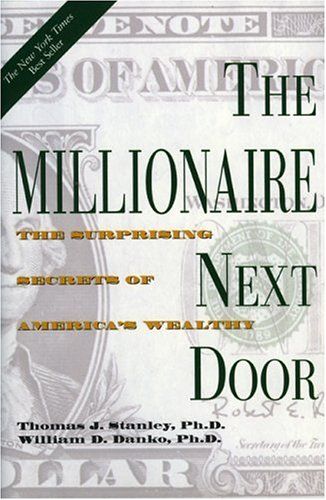
The millionaire next door
Introduction: The Invisible Millionaire
Introduction: The Invisible Millionaire
Nova: Welcome to Aibrary, the show where we dissect the ideas that shape our world. Today, we are diving into a book that fundamentally changed how America views wealth: Thomas Stanley and William Danko's 1996 classic, The Millionaire Next Door.
Nova: : That book is legendary, Nova. I think everyone pictures a millionaire as someone driving a Lamborghini or living in a mansion. But the entire premise of Stanley and Danko's work is that the real millionaires are hiding in plain sight, driving used Fords.
Nova: Exactly. The most shocking finding, which we'll unpack today, is the massive disconnect between and. Stanley’s research, based on interviews with hundreds of high-net-worth individuals, revealed that the flashy spender is often deeply in debt, while the quiet saver is sitting on a fortune. It’s a masterclass in financial camouflage.
Nova: : So, this isn't about getting rich quick; it’s about understanding the of staying rich, or rather, becoming rich slowly. What was the core methodology that gave this book such staying power?
Nova: That's our first deep dive. Stanley wasn't just guessing. He and Danko built a massive database by surveying and interviewing actual millionaires. They weren't looking at people who rich; they were looking at people who rich. They separated the population into two key groups: Prodigious Accumulators, who have high net worth relative to their income, and Under Accumulators, who have high income but low net worth. The difference between those two groups is the entire book.
Nova: : That distinction is crucial. It means we aren't talking about inherited wealth or lottery winners. We are talking about disciplined, self-made financial habits. Let's peel back the layers on those habits. Where do we start with the 'Next Door' millionaire?
Key Insight 1: The High-Earner Trap
The Great Misconception: Income vs. Net Worth
Nova: We have to start with the most jarring contrast Stanley presents: the difference between high earners and actual wealth holders. Stanley found that many people who affluent are actually asset-poor. They are status seekers, not wealth builders.
Nova: : I remember reading a statistic that really stuck with me. Something about people living in expensive houses but having surprisingly low incomes. Can you pull that up?
Nova: Absolutely. One of the most powerful examples they cite involves housing. They found that roughly 30 percent of American families living in homes valued at $300,000 or more—which was a significant figure back then—had annual household incomes of only $60,000. Think about that. They are house-rich, cash-poor, and likely mortgage-heavy.
Nova: : That’s terrifying. They are living on the edge, one job loss away from financial ruin, all to project an image of success. They are prioritizing consumption over accumulation.
Nova: Precisely. The Prodigious Accumulators, the true millionaires, do the opposite. They view their home as a place to live, not a status symbol to broadcast their success. They understand that a massive mortgage payment is an anchor dragging down their investment potential.
Nova: : So, if they aren't spending on the house, where is the money going? Are they just hoarding cash under the mattress?
Nova: Not at all. They are investing it. The key metric Stanley uses is the 'Wealth Index,' which is your net worth divided by your annual gross income. A score of 1.0 means you have accumulated wealth equal to one year's income. The average millionaire in their study scored 3.2, meaning they had accumulated three times their annual income in net worth. The Under Accumulators? They often scored below 0.5.
Nova: : That’s a tangible measure of success. It’s not about the salary you pull in; it’s about the gap between what you earn and what you keep and grow. It forces you to look at your own lifestyle inflation.
Nova: It does. And this leads directly to the second major theme: the relentless pursuit of frugality, which they don't see as deprivation, but as a necessary defense mechanism.
Nova: : Defense against what? Against the urge to spend?
Nova: Defense against lifestyle inflation, yes, but also defense against the taxman. Stanley noted that millionaires pay a surprisingly small fraction of their wealth in income tax. Why? Because they aren't spending their income on depreciating assets like luxury cars or massive homes; they are channeling it into tax-advantaged investments and appreciating assets.
Nova: : So, the high-income earner is paying a huge tax bill on their consumption, while the quiet millionaire is paying taxes on their, which is often deferred or taxed at lower capital gains rates. It’s a completely different financial game being played.
Nova: It is. And this discipline extends to every purchase, which brings us to the most famous, and perhaps most relatable, example of their frugality: transportation.
Nova: : Ah, the cars. I’m ready for the Ford versus Ferrari comparison.
Case Study: Cars, Shopping, and Status Symbols
The Discipline of Defense: Frugality in Action
Nova: Let's talk about the garage. If you picture a millionaire, you probably picture a Mercedes or a BMW. Stanley’s research paints a very different picture from the original study. What was the most common make of car owned by millionaires?
Nova: : If I recall correctly, it was Ford. Or maybe Toyota in the updated analysis. The point was that it was a reliable, mass-market vehicle, not a status symbol.
Nova: Exactly. In the original data, Ford was the top make. And the average maximum amount these millionaires ever paid for a car was shockingly low—around $20,000. Furthermore, very few of them leased, and a significant portion—about one-third—owned used cars.
Nova: : Twenty thousand dollars for a primary vehicle for someone with a net worth in the millions. That’s a powerful statement. It means they view a car as transportation, not as a reflection of their portfolio value.
Nova: It’s a complete rejection of the 'keeping up with the Joneses' mentality. The Joneses, in Stanley's view, are often broke. The millionaire next door is focused on maximizing the on every dollar, and cars are notorious for rapid depreciation. They are financial black holes.
Nova: : What about shopping habits? Did they avoid malls entirely, or were they just smarter shoppers?
Nova: They were smarter shoppers. They weren't afraid to bargain hunt. They shopped at discount stores. They bought clothing from places like Sears, which was a major retailer at the time. They prioritized value and longevity over brand prestige. They were masters of the discount.
Nova: : This is where the book becomes challenging for modern listeners. In an age of instant gratification and social media showcasing, telling someone to drive a ten-year-old sedan feels almost counter-cultural. How did Stanley justify this extreme frugality?
Nova: He framed it as 'playing great defense.' Wealth accumulation is a two-part equation: offense and defense. The Under Accumulators are great at offense—they get the big salaries—but they have terrible defense. Their spending leaks money faster than they can earn it. The millionaires next door are disciplined defenders. They protect their principal.
Nova: : It sounds like they are playing a long game, a multi-decade game, where small savings compound into massive advantages over time. If you save $10,000 a year by driving a cheaper car and buying used furniture, that $10,000, invested over 30 years at a modest 7% return, becomes nearly $1.1 million.
Nova: That’s the math they relied on. It’s not about the single purchase; it’s about the of not wasting capital. They understood that the difference between a $70,000 car and a $20,000 car isn't just $50,000; it's $50,000 that compounding for decades.
Nova: : And this discipline wasn't just about material goods, right? It extended to their time and energy as well.
Nova: Precisely. They allocate their time, energy, and money efficiently toward wealth-building activities. They spend time planning their investments, researching good deals, and managing their budgets. They don't spend time trying to impress people they don't even like with things they can't afford. It’s a fundamental shift in priorities from external validation to internal financial security.
Nova: : Okay, we've established the defense. Let's talk about the offense—how did these people actually make their money in the first place, and how does that contrast with the high-salaried professionals?
Deep Dive: Self-Employment and Financial Independence
The Accumulation Engine: How Wealth is Actually Built
Nova: When we look at the occupations of these self-made millionaires, we see a clear pattern emerging that separates them from the high-income Under Accumulators. What was the dominant path to wealth?
Nova: : I believe the research heavily favored self-employment, small business ownership, or commission-based sales over traditional salaried professions like doctors or lawyers, even though those professions often have higher starting incomes.
Nova: That’s spot on. Stanley found that a vast majority of these millionaires were self-employed or owned their own businesses. They were entrepreneurs, engineers, successful salespeople, or specialized consultants. They weren't just trading time for a fixed salary.
Nova: : Why is that distinction so important? A surgeon makes a huge salary, but they are capped by the hours they can physically work.
Nova: Exactly. The self-employed millionaire has an ceiling on their earning potential, and crucially, they control the capital allocation. They can reinvest profits, take calculated risks, and benefit directly from the compounding growth of their enterprise. A salaried executive, even one earning $500,000, is still fundamentally limited by their W-2 income and often has massive lifestyle costs associated with maintaining that corporate image.
Nova: : So, the offense is about ownership and control, not just a high hourly rate. It’s about building an asset that generates income, rather than just earning income.
Nova: And this ties back to the defense. Because they built their wealth through disciplined effort and smart reinvestment, they inherently value that wealth more. They don't see $100,000 as something to immediately spend on a new luxury SUV; they see it as 100,000 units of future freedom.
Nova: : What about the next generation? Stanley and Danko dedicated a lot of focus to how these habits are passed down, or perhaps, passed down. That must be a major point of concern for these self-made individuals.
Nova: It is. They found that the children of millionaires often struggle precisely because they never learned the discipline of accumulation. They inherit the without understanding the. Stanley noted that many wealthy parents are overly generous, effectively subsidizing their children's high-consumption lifestyles, which prevents them from ever developing their own Wealth Index.
Nova: : That’s the ultimate irony—the very success that creates the wealth can destroy the habits needed to maintain it across generations.
Nova: It highlights that wealth is not a static inheritance; it's a dynamic process. If you stop the process—the saving, the planning, the frugality—the wealth erodes, even if the principal remains large for a while. They emphasize that teaching children about budgeting and delayed gratification is more valuable than leaving them a trust fund they don't understand.
Nova: : This all sounds incredibly rigorous. It sounds like a life dedicated to financial optimization. I have to ask, after all this research, did Stanley and Danko ever acknowledge that maybe, just maybe, people deserve to enjoy some of the fruits of their labor? Is there room for balance?
Nova: That's the perfect transition to our final segment. The book is often criticized for being too austere, but the authors did address the concept of balance, though perhaps not in the way modern consumers expect.
Key Insight 4: Is Frugality Still the Key?
Modern Relevance and The Balance Question
Nova: We've established the core tenets: live below your means, avoid status symbols, prioritize investment over consumption. But the world has changed since 1996. Inflation is different, housing costs are astronomical, and the pressure to display success online is constant. Is The Millionaire Next Door still relevant today?
Nova: : I think the core principles are more relevant than ever, precisely of lifestyle inflation. If the average millionaire in 1996 drove a Ford, imagine the pressure today. The baseline for 'normal' consumption has skyrocketed. The gap between the wealthy and everyone else is now often displayed on Instagram, not just in the driveway.
Nova: That's a critical point. The pressure to signal wealth is amplified. However, the research suggests that the habits that create wealth—discipline, planning, and delayed gratification—are timeless. Fidelity studies, for example, continue to show that the habits of the wealthy remain rooted in frugality and smart investing, even as the dollar amounts shift.
Nova: : But what about the critique? Some argue the book promotes a joyless existence. If I earn $500,000 a year, shouldn't I be allowed to buy a nicer car than the guy earning $80,000? Where is the line between smart defense and unnecessary self-deprivation?
Nova: Stanley and Danko would argue that the line is drawn at. They aren't saying you can't buy nice things; they are saying you must achieve financial security. The millionaires they studied found satisfaction in their work, their families, and their achievements, not in material possessions. Their reward wasn't the Bentley; their reward was the freedom that the saved capital provided.
Nova: : So, the book isn't a mandate against luxury; it’s a warning against luxury. It’s about ensuring your spending doesn't compromise your future self.
Nova: Exactly. They found that the truly wealthy are often indifferent to what others think of their possessions. They are secure in their net worth. The people who the expensive watch are usually the ones who can least afford it. It’s about internal validation versus external signaling.
Nova: : If someone is listening now and feels overwhelmed by the idea of being frugal, what is the single most actionable takeaway that bridges the gap between their current life and the 'Next Door' lifestyle?
Nova: It’s the Wealth Index. Stop focusing on your gross income. Start calculating your net worth—assets minus liabilities—and divide it by your annual income. Set a goal to move that number from 0.5 to 1.0, then to 2.0, and so on. That metric is objective; it ignores the flashy car and the big house and tells you the truth about your financial progress.
Nova: : That shifts the focus immediately from appearance to substance. It’s a powerful reframing tool. It forces you to ask: Is this purchase moving my Wealth Index up or down?
Conclusion
Nova: We've covered a lot of ground today, moving from the perception of wealth to the gritty reality of accumulation. The biggest takeaway from Thomas Stanley and William Danko is that wealth is rarely glamorous in its creation. It’s built through consistency, discipline, and a profound indifference to social status.
Nova: : The key pillars remain: live significantly below your means, prioritize owning appreciating assets over consuming depreciating ones, and understand that your time and energy are your most valuable investment tools. The millionaire next door isn't defined by their job title, but by their balance sheet.
Nova: And remember the data: they drive Fords, they bargain shop, and they are masters of playing great defense. If you want to join their ranks, you have to stop trying to look rich and start focusing on rich, one disciplined decision at a time.
Nova: : It’s a timeless message that cuts through the noise of consumer culture. Financial security isn't about what you buy; it's about what you buy.
Nova: Indeed. It’s about choosing freedom over flash. Thank you for joining us on this deep dive into the habits that truly build lasting wealth. This is Aibrary. Congratulations on your growth!