

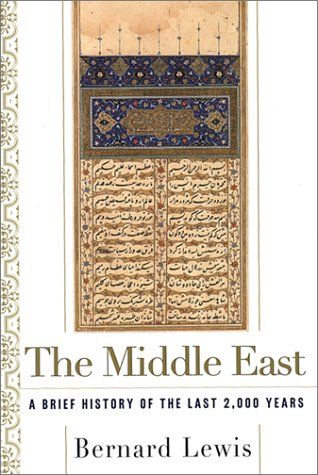
The Middle East
A Brief History of the Last 2,000 Years
Introduction
Nova: Imagine trying to pack two thousand years of history, dozens of empires, and the birth of three major world religions into a single narrative. It sounds impossible, right? But that is exactly what Bernard Lewis attempted in his landmark book, The Middle East.
Atlas: Two thousand years? That is a massive undertaking. I mean, where do you even start? Usually, when people talk about the Middle East today, they are thinking about the last fifty or sixty years of conflict. Going back two millennia feels like a completely different world.
Nova: It really is. And that is Lewis's point. He was often called the doyen of Middle Eastern studies, and this book is essentially his magnum opus. He argues that you cannot understand the modern headlines without seeing the deep, tectonic shifts that started with the Roman and Persian empires.
Atlas: So he is not just giving us a list of dates and kings. He is trying to show us the DNA of the region.
Nova: Exactly. He takes us from the ancient clash of civilizations between Byzantium and Persia all the way to the modern struggle for identity. It is a story of how a region that was once the undisputed center of the world's science, trade, and culture began to grapple with the rise of the West.
Atlas: I am ready to dive in. If we are going to understand why the Middle East looks the way it does today, we have to see where it began.
Key Insight 1
The Great Transformation
Nova: Lewis starts the book by setting the stage with two massive superpowers: the Roman Empire in the West and the Persian Empire in the East. For centuries, they were locked in this exhausting, back-and-forth struggle that basically drained both of them dry.
Atlas: It sounds like a Cold War, but with more swords and chariots.
Nova: Very much so. And then, out of nowhere, this third force emerges from the Arabian Peninsula. Lewis describes the rise of Islam not just as a religious event, but as a genuine revolution. It swept through these exhausted empires with incredible speed.
Atlas: Why was it so fast? Was it just military conquest, or was there something else going on?
Nova: Lewis points out that it was a message of unity and a new social order. Before this, the region was fractured by different languages, religions, and legal systems. Islam provided a single, coherent framework. It created a vast common market and a common language, Arabic, which allowed ideas to travel from Spain to India.
Atlas: So it was like an early version of the European Union, but with a religious core?
Nova: In a way, yes. Lewis emphasizes that for centuries, the Islamic world was the most advanced civilization on Earth. While Europe was in the so-called Dark Ages, the Middle East was preserving Greek philosophy, inventing algebra, and mapping the stars.
Atlas: It is wild to think about that reversal. Today we often think of the West as the source of innovation, but Lewis shows that for a long time, the Middle East was the one looking down on a relatively backward Europe.
Nova: He actually shares a funny anecdote about how early Muslim scholars viewed Europeans. They saw them as distant, cold-dwelling barbarians who lacked intelligence and culture. It is a complete flip of the modern perspective.
Atlas: That is a perspective shift I think a lot of people need to hear. It was not just a religion; it was a global superpower of the mind.
Key Insight 2
The Mongol Shock and the Turning Tide
Nova: Everything changes in the 13th century. Lewis identifies the Mongol invasions as one of the most traumatic turning points in Middle Eastern history. In 1258, the Mongols sacked Baghdad, which was the intellectual heart of the world at the time.
Atlas: I have heard about this. Didn't they say the Tigris River ran black with the ink of all the books they threw into the water?
Nova: That is the legend, and Lewis uses it to illustrate the sheer scale of the destruction. It was not just the loss of life; it was the destruction of the irrigation systems and the administrative structures that had sustained the region for centuries. Lewis argues that the Middle East never quite recovered its previous level of creativity after the Mongol shock.
Atlas: So the decline started way earlier than most people realize. It was not just about Western colonialism in the 1900s.
Nova: Exactly. Lewis is very clear that internal factors and external shocks like the Mongols played a huge role. But then, the region found a new champion: the Ottoman Empire. For a few hundred years, the Ottomans were the terror of Europe. They were organized, technologically advanced, and they pushed all the way to the gates of Vienna.
Atlas: So the Ottomans were the comeback story?
Nova: They were. But Lewis points out a specific date as the beginning of the end: 1683. That was the second failed siege of Vienna. After that, the Ottomans started losing territory. But more importantly, they started realizing that the Europeans had surpassed them in science, warfare, and industry.
Atlas: That must have been a massive psychological blow. To go from seeing Europeans as barbarians to realizing they have better cannons and better ships.
Nova: Lewis describes this as a slow, painful awakening. The Middle East began to ask a question that would define the next three centuries: What went wrong? Why was the West pulling ahead while they were standing still?
Atlas: It is a heavy question. And I imagine the answers they came up with were pretty varied.
Key Insight 3
The Struggle for Modernity
Nova: As the 19th century rolled around, the Middle East tried to catch up by imitating the West. Lewis details how they brought in European advisors, translated Western books, and tried to modernize their armies. But he notes a fundamental problem: they wanted the Western technology without necessarily wanting the Western philosophy or social structures.
Atlas: Like trying to run modern software on old hardware?
Nova: That is a great analogy. Lewis talks about the rise of the Dragomans, the professional interpreters who became the bridge between the two worlds. But these interpreters were often viewed with suspicion. There was this deep tension between wanting to be powerful like the West and wanting to remain authentic to their own Islamic heritage.
Atlas: And then the 20th century hits, and the map gets completely redrawn after World War I, right?
Nova: Right. The fall of the Ottoman Empire led to the creation of the modern state system we see today. Lewis explains how concepts like nationalism, which were imported from Europe, didn't always fit the region's traditional identities. People used to identify by their religion or their tribe, and suddenly they were told they were Iraqis or Syrians.
Atlas: It feels like a recipe for the instability we see now. You are forcing these Western-style borders onto a region with a totally different historical logic.
Nova: Lewis doesn't shy away from that. He also discusses the impact of oil, which brought immense wealth but also reinforced authoritarian regimes. He argues that the sudden influx of wealth allowed governments to avoid making the difficult political reforms that might have led to more stable, democratic societies.
Atlas: So oil was almost a curse in disguise because it let them bypass the hard work of building a modern state.
Nova: That is a key part of his thesis. He sees the 20th century as a period of intense frustration, where the gap between the glorious past and the difficult present became almost unbearable for many in the region.
Key Insight 4
The Legacy and the Critics
Nova: We have to talk about the elephant in the room. Bernard Lewis is a giant in the field, but he is also incredibly controversial. Have you heard of the debate between him and Edward Said?
Atlas: I have. Said wrote Orientalism, right? He basically accused Western scholars like Lewis of looking at the Middle East through a biased, imperialist lens.
Nova: Exactly. Said argued that Lewis was essentializing the Middle East, treating it as this unchanging, monolithic entity that was inherently different from the West. Critics say Lewis focused too much on religion and not enough on the actual political and economic realities of the people living there.
Atlas: How did Lewis respond to that? Did he change his tune?
Nova: Not really. Lewis stood his ground. He argued that religion is the primary lens through which people in the Middle East have historically viewed the world, and to ignore that is to ignore the most important part of their identity. He saw himself as a historian trying to be objective, while his critics saw him as a relic of the colonial era.
Atlas: It is a tough debate. On one hand, you need to understand the culture, but on the other, you don't want to fall into stereotypes.
Nova: Lewis's work actually became very influential in U. S. foreign policy, especially around the time of the Iraq War. Some people blame his ideas for the belief that you could just drop democracy into the Middle East and it would flourish. Others say his warnings about the deep-seated cultural tensions were actually ignored.
Atlas: It sounds like his work is a double-edged sword. It provides this incredible historical depth, but it can also be used to justify some pretty questionable interventions.
Nova: That is why reading the book is so important. You have to see the nuances for yourself. He provides a wealth of data on everything from the role of women in Islamic society to the history of slavery in the region, which he notes was very different from the Atlantic slave trade.
Atlas: He really does cover everything. It is like a crash course in a world most of us only see through a very narrow window.
Conclusion
Nova: As we wrap up our look at Bernard Lewis's The Middle East, the biggest takeaway is that history is not just a collection of old stories. It is the very ground we stand on. Lewis shows us that the tensions, the triumphs, and the tragedies of the region today are the result of two thousand years of evolution.
Atlas: It has definitely changed how I look at the news. Instead of just seeing a chaotic mess, I am starting to see the echoes of the Ottomans, the Mongols, and the ancient Persians. It makes the world feel a lot bigger and more complex.
Nova: That is the power of a great historian. Even if you don't agree with all of Lewis's conclusions, his ability to synthesize such a massive amount of information is staggering. He challenges us to look beyond the immediate and understand the long-term forces that shape our world.
Atlas: It is a reminder that if we want to build a better future, we have to be brave enough to look at the past, even the parts that are uncomfortable or difficult to understand.
Nova: Well said. Understanding the Middle East is not just about a region; it is about understanding the human story of power, faith, and the struggle to adapt to a changing world.
Nova: This is Aibrary. Congratulations on your growth!