

The Network Trap: Why Your Best Ideas Need Diverse Connections
Golden Hook & Introduction
SECTION
Nova: Forget the lone genius in a dusty attic having a sudden 'aha!' moment. The truth about groundbreaking ideas is far messier, much more collaborative, and frankly, a lot more fun.
Atlas: Whoa, Nova, you're telling me all those movies and comic books got it wrong? No more lightbulbs over solitary heads? My entire childhood understanding of invention is crumbling!
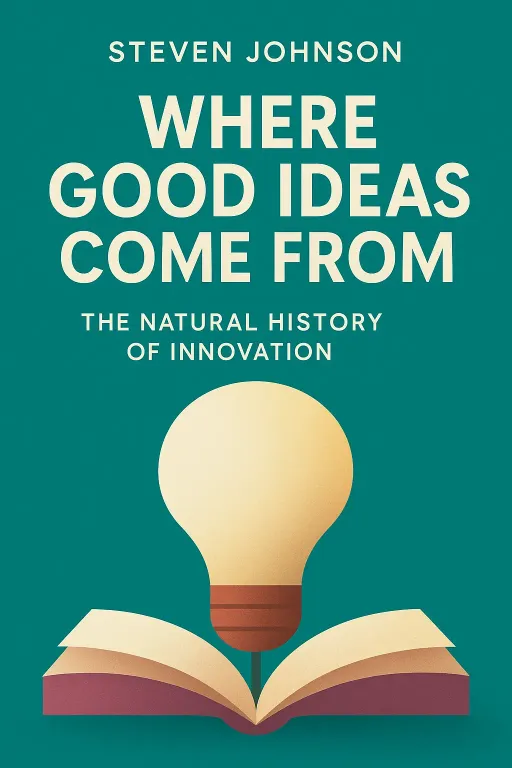
Nova: Well, Atlas, not crumbling, but expanding! Today, we’re dissecting the fascinating insights from Steven Johnson’s and Frans Johansson’s. What’s truly remarkable is how both authors, from different angles, meticulously dismantle the myth of isolated genius, revealing that true innovation thrives on connection.
Atlas: That’s actually a huge relief. For anyone trying to spark new ideas, or just a curious learner like myself who loves connecting dots, this sounds like an essential guide to setting up your creative playground, not just waiting for inspiration to strike.
Nova: Exactly! And we’re going to start by diving into what Steven Johnson calls 'slow hunches' and the kind of fluid environments that nurture them into existence.
The Power of Slow Hunches and Fluid Environments
SECTION
Nova: Johnson's core argument is that groundbreaking innovations rarely appear as sudden flashes of brilliance. Instead, they often begin as incomplete ideas, what he terms 'slow hunches,' that require time and interaction with other hunches to fully form. Think of it like a puzzle piece that doesn't make sense until it finds its matching edge.
Atlas: Oh, I love that – 'slow hunches.' It makes so much more sense than the idea of instantaneous genius. I imagine a lot of our listeners have had that feeling of an idea brewing, but not quite solidifying. But how do these hunches actually connect? Does it just happen by magic?
Nova: Far from magic, Atlas! It happens in what Johnson calls 'liquid networks.' These are environments where information and ideas can flow freely, intermingle, and collide with each other. He emphasizes that the most innovative periods in history, like the Enlightenment or the Renaissance, weren't just about brilliant individuals, but about highly connected networks of people and ideas.
Atlas: So it’s less about one person being smart, and more about smart ideas finding each other in a bustling marketplace of thoughts? Can you give us an example? Because 'liquid networks' sounds a bit like an abstract concept.
Nova: Absolutely. Let's look at the invention of the World Wide Web. We often credit Tim Berners-Lee as its sole inventor, and he was undeniably critical. But Johnson illustrates how Berners-Lee’s 'slow hunch' wasn't born in a vacuum. He was working at CERN, the European Organization for Nuclear Research, a highly collaborative and open environment in the late 1980s.
Atlas: CERN! The place with the giant particle collider? That’s not exactly a typical startup garage.
Nova: Precisely. Berners-Lee had a problem: scientists at CERN needed a better way to share research documents across different computer systems. He wasn't inventing communication from scratch; he was combining existing technologies: hypertext, which links documents; the internet, which was a pre-existing network; and graphic user interfaces. His genius was in seeing how these disparate elements, floating around in the 'liquid network' of CERN, could be combined to create something entirely new and incredibly powerful.
Atlas: Wow, so it was a slow hunch that found its missing pieces in a super-connected, open environment. That’s fascinating. But Nova, for those of us not working at a global research facility, how do we create our own 'liquid networks'? It sounds a bit unattainable for the average person.
Nova: That’s a brilliant question, Atlas, and it gets to the heart of applying this. It’s not about grand institutions; it’s about micro-habits. It's about actively seeking diverse inputs: reading outside your field, attending workshops on unrelated topics, having conversations with people from different departments or industries. Even your random coffee breaks, if you're actively engaging and listening, can become vital innovation hubs.
Atlas: Oh, I like that. So, my boss needs to hear that my long coffee breaks are actually strategic innovation sessions! I can totally get behind that. It’s about being open to those unexpected collisions of thought.
The Medici Effect: Breakthroughs at Intersections
SECTION
Nova: And that idea of ideas colliding naturally leads us to Frans Johansson and what he calls 'The Medici Effect,' which takes this concept of diverse connections even further. Johansson argues that the most novel and impactful ideas don't come from deepening your expertise in one narrow field, but from intentionally stepping into the 'intersection' of different fields, cultures, and disciplines.
Atlas: So, it's not just about letting ideas bump into each other, but actively engineering those collisions? That sounds more strategic, which I appreciate. But what does an 'intersection' look like in practice?
Nova: Think of it as a crossroads where different worlds meet. Johansson's inspiration comes from the Medici family in Renaissance Florence. They weren't just patrons of the arts; they deliberately brought together architects, sculptors, scientists, philosophers, and financiers. They created an environment where these disparate groups interacted, shared ideas, and learned from each other. The result? An explosion of creativity that became the Renaissance.
Atlas: That’s a powerful historical example. They weren’t just funding individuals; they were cultivating an ecosystem of cross-pollination. So, the cause was intentional diversity, the process was facilitated interaction, and the outcome was an unprecedented leap in human achievement. But what about today? For someone trying to solve a specific problem, how do you these intersection points without just randomly smashing things together and hoping for the best?
Nova: That’s a crucial distinction. Johansson isn't advocating for random chaos. He provides strategies for identifying and leveraging these intersection points. It could be a chef studying chemistry to create molecular gastronomy, or an architect collaborating with a biologist to design self-healing buildings. It's about bringing your unique perspective from one domain to another.
Atlas: So you're saying, for a curious learner, it’s about intentionally broadening your horizons, but with a purpose? Reading books like these, for example, is a step in that direction. But isn't there a risk of becoming a 'jack of all trades, master of none' if you're constantly jumping between disciplines? That sounds a bit out there for someone trying to build deep expertise.
Nova: That’s a valid concern, Atlas, and it highlights the nuance. It's not about abandoning your core expertise. It's about enriching it. You use your deep knowledge as a lens through which to view other fields. The breakthrough often comes when you apply a principle from one area to a problem in another, rather than trying to become an expert in everything. It’s about leveraging diversity, not diluting focus. The goal is to bring a fresh perspective, not necessarily to become a new expert in every field you touch.
Synthesis & Takeaways
SECTION
Nova: So, whether Steven Johnson's 'slow hunches' maturing in liquid networks or Frans Johansson's 'Medici Effect' at the intersection of disciplines, the core message is undeniably clear: your best ideas don't thrive in isolation. They demand diverse connections, varied perspectives, and an openness to unexpected collisions.
Atlas: I guess that makes sense. It’s about actively cultivating an environment where ideas can cross-pollinate, rather than waiting for some bolt of lightning. It really challenges the conventional wisdom that you just need to work harder in your specific silo.
Nova: Absolutely. And that brings us to Nova's Take: actively seeking out varied experiences and voices will organically lead to more original and impactful creative contributions. It's a proactive approach to creativity.
Atlas: So, whether it’s a slow hunch or a deliberate intersection, the message is clear: get out of your echo chamber and broaden your intellectual diet. I imagine a lot of our listeners feel that pull to connect with new ideas.
Nova: And we have a tiny step for you this week. Connect with someone this week from a completely different professional field and discuss a current challenge you're both facing. Just one conversation. You don't need a grand plan, just an open mind.
Atlas: And who knows what 'slow hunch' might spark from that single chat? Or what unexpected intersection your conversation might create. That’s actually really inspiring.
Nova: It’s about building those bridges, one conversation at a time. We’d love to hear about your experiences! Share your thoughts and insights with the Aibrary community.
Atlas: Definitely. There's so much to learn when you step outside your comfort zone.
Nova: This is Aibrary. Congratulations on your growth!