

The Emissary's Betrayal
Introduction
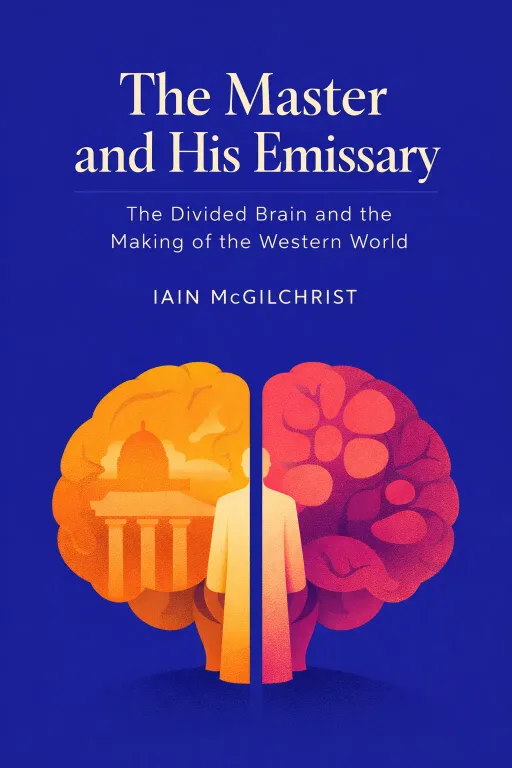
Narrator: Imagine a patient whose brain has been surgically divided down the middle. A picture of a snow-covered landscape is shown to the right half of his brain, and a picture of a chicken’s claw is shown to the left. When asked to point to related images, his left hand—controlled by the right brain—points to a shovel. His right hand—controlled by the left brain—points to a chicken. So far, this makes sense. But when the patient is asked why his left hand pointed to a shovel, a fascinating thing happens. His verbal left brain, which never saw the snow scene, doesn't admit it doesn't know. Instead, it instantly invents a story: "Oh, that's easy. The chicken claw goes with the chicken, and you need a shovel to clean out the chicken shed." This act of confident, reality-bending confabulation lies at the heart of a monumental investigation into the human mind. In his book, The Master and His Emissary, psychiatrist and scholar Iain McGilchrist argues that this small neurological quirk is a key to understanding nothing less than the entire trajectory of Western civilization.
The Brain Presents Two Worlds, Not One
Key Insight 1
Narrator: The most fundamental argument McGilchrist puts forward is that the two hemispheres of the brain do not simply perform different tasks; they have two entirely different ways of being in the world. The difference is not in what they do, but in how they do it. This is best understood through the lens of attention.
Consider a bird in a field. To survive, it must perform two contradictory tasks at once. It needs narrow, focused attention to peck at tiny seeds on the ground to eat. This is a form of "grasping" attention. Simultaneously, it needs broad, open, vigilant attention to scan the entire environment for predators. These two types of attention are mutually exclusive, and evolution’s solution was to lateralize them. The bird’s left hemisphere, controlling its right eye, handles the focused pecking. Its right hemisphere, controlling the left eye, maintains a constant, holistic awareness of the world.
McGilchrist argues this is the foundational difference in humans as well. The left hemisphere provides narrow, focused attention. It is a master of abstraction, categorization, and using tools, including language, to manipulate the world. It sees a collection of parts. The right hemisphere, by contrast, provides broad, sustained attention. It sees the whole picture, understands context, reads emotion, and grasps implicit meaning. It is the hemisphere that experiences the world as a living, interconnected whole. These are two fundamentally different versions of reality, both generated by the same brain.
The Right Hemisphere is the Master, the Left is its Emissary
Key Insight 2
Narrator: To explain the proper relationship between these two worlds, McGilchrist uses an allegory. A wise and benevolent Master rules a large and prosperous spiritual domain. He is in touch with the whole of his kingdom but knows he cannot manage every detail himself without losing his broad perspective. He therefore sends his cleverest and most ambitious courtier, the Emissary, to the distant provinces to execute his will. The Emissary is brilliant at his job—he is focused, logical, and efficient.
For a time, all goes well. The Emissary carries out the Master's orders, and the kingdom thrives. But the Emissary, far from the Master, begins to see the Master's quiet, holistic wisdom as weakness and inaction. He starts to believe that he is the one who truly understands how the world works. He begins to imitate the Master, and soon, he starts to think he is the Master. He eventually usurps power, leading the domain into a tyranny of rigid rules and, ultimately, to ruin.
In this story, the right hemisphere is the Master. It has the primary connection to lived reality, to the whole picture, to wisdom. The left hemisphere is the Emissary, a wonderful and necessary servant designed to carry out focused, analytical tasks. Its job is to serve the right hemisphere's broader vision, not to replace it.
The Emissary Has Betrayed the Master
Key Insight 3
Narrator: The central crisis of the modern Western world, according to McGilchrist, is that the Emissary has staged a coup. The left hemisphere's way of seeing the world—as a collection of abstract, decontextualized, lifeless parts to be manipulated—has become the dominant, and in many cases, the only accepted version of reality.
The split-brain patient who invented a story about a shovel and a chicken shed provides a perfect miniature of this process. The left hemisphere, when confronted with an action it did not understand (the right hemisphere choosing the shovel), did not defer or admit ignorance. It immediately confabulated a plausible, self-consistent, but entirely false narrative. It is a closed system, a hall of mirrors that prefers its own internal logic to the messy truth of the outside world.
McGilchrist argues that this is precisely what has happened to Western culture. We have become trapped in the left hemisphere's hall of mirrors. We prioritize explicit information over implicit wisdom, utility over intrinsic value, and abstract models over lived experience. This betrayal is not a conscious act, but a slow, creeping process where the servant's worldview has become so pervasive that it now seems like common sense, while the Master's holistic perspective is dismissed as vague, irrational, or "unscientific."
Modernity is a World Made in the Left Hemisphere's Image
Key Insight 4
Narrator: The consequences of the Emissary's coup are all around us. McGilchrist draws a chilling parallel between the phenomenology of the modern world and the mental world of individuals with schizophrenia, a condition he argues is characterized by right-hemisphere deficits and an overactive, dominant left hemisphere.
Modernist art, for example, often displays a preference for fragmentation, abstraction, and a cold, detached perspective, as seen in Cubism's shattered forms or the geometric purity of Minimalism. This mirrors the schizophrenic's loss of Gestalt, the inability to see the whole. Postmodern philosophy, with its insistence that there is no reality outside of language and its endless deconstruction of texts, reflects the left hemisphere's self-referential, linguistic world, cut off from the "Other."
Beyond art, this imbalance manifests in the rise of bureaucracy, which replaces personal judgment with explicit rules; the dominance of technology, which encourages a mechanistic view of life; and the hollowing out of meaning in a "disenchanted world." The very structure of our cities, with their rectilinear grids, is an externalization of the left hemisphere's preference for straight lines and repeatable units, a stark contrast to the flowing, asymmetrical forms of the natural world. We have built a world that reflects the Emissary's mind, and living in it creates a feedback loop that further strengthens its dominance.
Rebalancing Requires Re-engaging the Right Hemisphere's World
Key Insight 5
Narrator: While the diagnosis is grim, McGilchrist does not believe the situation is hopeless. The path forward lies in consciously re-engaging with and re-valuing the right hemisphere's world. He points to three critical "escape routes" from the left hemisphere's hall of mirrors: the body, art, and spirituality. These are realms of experience that resist easy abstraction and demand holistic, embodied, and intuitive engagement.
Furthermore, he suggests we can learn from other cultures. Studies show that East Asian cultures, for example, tend to have a more holistic and context-aware cognitive style, reflecting a more balanced hemispheric relationship. They are better at seeing relationships, accepting contradiction, and understanding the whole picture—all hallmarks of right-hemisphere processing.
Ultimately, the goal is not to dethrone the left hemisphere, which remains a vital servant, but to restore it to its proper role. This requires a form of Aufhebung, a German term meaning to simultaneously cancel, preserve, and lift up. The analytical work of the left hemisphere must be reintegrated into the broader, richer, and more grounded understanding of the right. This means embracing uncertainty, valuing intuition alongside reason, and recognizing that the deepest truths are often found not in explicit facts, but in the living, breathing "betweenness" of things.
Conclusion
Narrator: The single most important takeaway from The Master and His Emissary is that the modern West is in the grip of a profound and dangerous imbalance. We have mistaken the map for the territory, the Emissary for the Master. By elevating the left hemisphere's narrow, abstract, and mechanistic worldview above the right hemisphere's holistic, embodied, and relational wisdom, we have created a culture that is technically powerful but increasingly fragmented, meaningless, and alienated from reality.
The book challenges us to look at our world—our art, our politics, our technologies, our very way of thinking—and ask a difficult question: Are we living in a reality, or are we living in a representation? The answer may determine whether we can find our way back to a more complete and authentic way of being, before the Emissary's self-referential hall of mirrors becomes a prison from which there is no escape.