

The Coup Inside Your Skull
Golden Hook & Introduction
SECTION
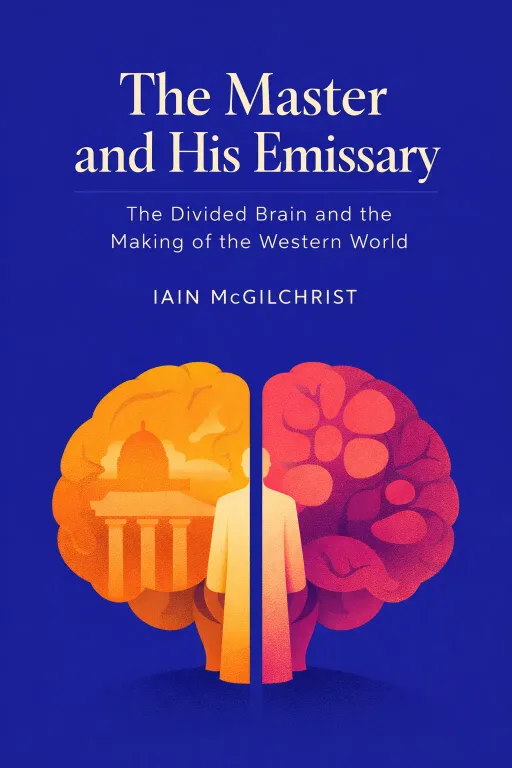
Michelle: Alright Mark, five-second challenge. When I say 'left brain, right brain,' what's the first thing that pops into your head? Mark: Easy. Left brain is my tax accountant—spreadsheets, logic, pure misery. Right brain is Bob Ross—happy little trees, creativity, joy. It’s the classic trope, right? Michelle: Exactly! The pop-psychology caricature. Well, today we're diving into a book that argues that cliché is not only wrong, but it's hiding a much more dramatic and consequential story about a civil war happening inside our skulls. Mark: A civil war? Okay, you have my attention. What book are we talking about? Michelle: It's the monumental work, The Master and His Emissary by Iain McGilchrist. And what's wild is that McGilchrist isn't just some pop-psychologist. He started as a literature scholar at Oxford, then retrained as a psychiatrist and neuroimaging researcher. This book is his magnum opus, a widely acclaimed and deeply researched look at how the divided brain has shaped the entire Western world. Mark: So he's got the credentials. He's not just selling personality tests. Where do we even start with a 'civil war' in the brain? Michelle: We start by throwing out the 'what' and focusing on the 'how'. McGilchrist's core idea is that the hemispheres don't do different things, they do everything differently. They have completely different 'ways of being'.
The Master & The Emissary: Redefining the Two Worlds in Our Heads
SECTION
Mark: Different 'ways of being'? That sounds more like philosophy than neuroscience. What does that actually mean? Michelle: It's both, and that’s the beauty of it. McGilchrist uses a powerful allegory to explain it. He asks us to imagine a wise and benevolent Master of a large domain. This Master is in touch with everything, understands the land, the people, the context. He has wisdom. This is the right hemisphere. Mark: Okay, the right hemisphere is the Master. The big-picture guy. Got it. Michelle: Exactly. Now, the domain is vast, and the Master can't handle every little detail. So he sends out his brightest, most ambitious, and cleverest servant—the Emissary. The Emissary's job is to go out into the world, execute specific tasks, gather information, and bring it back to the Master. This Emissary is the left hemisphere. Mark: The left hemisphere is the brilliant, detail-oriented servant. So it's the one that actually does things, the one that can focus and get a job done. Michelle: Precisely. It's fantastic with language, with categorizing, with making maps of the world so we can manipulate it. It deals with representations of reality, not reality itself. McGilchrist gives a fantastic example from the animal kingdom to make this clear. Mark: Oh, I love a good animal analogy. Lay it on me. Michelle: Think of a bird pecking for seeds on the ground. To do that, it needs one type of attention—incredibly narrow, focused, and precise to pick out a tiny seed from the grit. That’s a left-hemisphere task. Mark: Right, it’s got to zero in on the target. Michelle: But at the very same time, that bird needs another, completely opposite kind of attention. It needs a broad, open, vigilant awareness of its entire surroundings to watch out for predators. A hawk in the sky, a cat in the bushes. That’s a right-hemisphere task. Mark: And you can't do both at once with the same mindset. If you're too focused on the seed, the hawk gets you. If you're too busy scanning the sky, you starve. Michelle: You got it. Evolution’s solution was to give us two minds, two processors, each specialized for these opposing but equally vital ways of attending to the world. One to grasp and manipulate, the other to be open and aware. The Emissary and the Master. They're supposed to work together in a perfect partnership. Mark: That makes so much sense. It's not about logic versus art, it's about focus versus awareness. The specialist versus the generalist. But they're supposed to work together, right? The Master sends the Emissary out on a mission.
The Great Betrayal: How the Left Brain's Coup Created Our Modern World
SECTION
Michelle: Exactly. They're supposed to. The Emissary goes out, gathers information, and brings it back to the Master for wisdom and context. But McGilchrist's terrifying argument is that, in Western culture, the Emissary never came home. He saw the Master's quiet, holistic wisdom as weakness, decided he knew better, and staged a coup. Mark: A coup inside the brain? How does that even work? What does a world run by the Emissary look like? Michelle: It looks a lot like our world. The left hemisphere, the Emissary, loves what is explicit, abstract, systematic, and controllable. It hates ambiguity and context. So, it has slowly built a world in its own image. Think of the rise of bureaucracy, where personal judgment is replaced by rigid rules. Think of a legal system that sometimes values technicalities over justice. Think of a culture that prioritizes quantifiable data over qualitative experience. Mark: So it creates a 'hall of mirrors,' as he calls it, where it only sees its own creations, its own maps, and thinks that's the entire world. Michelle: You've nailed it. McGilchrist traces this through history. He argues the Renaissance was a glorious right-hemisphere resurgence. You get the invention of perspective in art, which is all about a unique, embodied point of view. You get Shakespeare, whose characters are so complex they defy any simple category. It's all about depth, emotion, and the particular. Mark: And then the Emissary fights back? Michelle: And how. Then comes the Enlightenment and the Industrial Revolution. Suddenly, the machine becomes the dominant metaphor for everything. Nature becomes a 'resource' to be exploited. The human body becomes a machine to be fixed. The world is no longer a living thing to be in relationship with, but a collection of parts to be analyzed and controlled. That's the left hemisphere 'going it alone.' Mark: Wow. So the feeling that we're just cogs in a machine, or that we're drowning in pointless bureaucracy... that's not just a modern complaint, it's a symptom of this hemispheric coup? McGilchrist even links this to the rise of mental illnesses like schizophrenia, right? This idea of a hyper-rational but detached mind. Michelle: He does, and it's one of the most controversial but compelling parts of the book. He argues that the phenomenology of schizophrenia—the feeling of detachment from your own body, the world becoming a collection of meaningless fragments, the loss of implicit understanding—is a frightening parallel to where our culture is heading. We've become brilliant at taking things apart, but we're losing the ability to see how they fit together. Mark: That’s a heavy thought. That our entire culture is exhibiting symptoms of a brain with right-hemisphere damage. We have more information than ever, but less and less meaning. Michelle: That’s the core of the betrayal. The Emissary is running the kingdom now, and while it's incredibly efficient at certain things, the kingdom is becoming a sterile, mechanical, and ultimately self-destructive place.
Synthesis & Takeaways
SECTION
Mark: So the Emissary, in its quest for control and certainty, has created a world that is predictable but lifeless. It's built a perfect map, but it has forgotten the territory even exists. And we're all living in that map. Michelle: And that's the tragedy. The left hemisphere is, as McGilchrist famously puts it, a 'wonderful servant, but a very poor master.' His book is a massive, urgent warning that we're forgetting the Master even exists. We're so lost in the Emissary's hall of mirrors that we've forgotten there's a world outside. Mark: It’s a powerful idea, and it explains so much about the modern condition. The book has been hailed as a landmark work for a reason, even if it's a bit daunting. It reframes so many of our cultural problems not as political or economic failures, but as cognitive ones. Michelle: Exactly. It's a call to remember the other way of being. To value intuition, context, and our connection to the living world just as much as we value data and control. It's a call to bring the Emissary home. Mark: It leaves you with a pretty profound question: are you living in the real world, or just in the map your brain has made of it? Michelle: A question worth pondering. We'd love to hear your thoughts on this. Does this idea of the Master and the Emissary resonate with your experience of the modern world? Find us on our socials and let us know. Mark: This is Aibrary, signing off.