The AI Marketing Edge: How to Leverage Cutting-Edge Tools Without Overwhelm.
Golden Hook & Introduction
SECTION
Nova: What if the biggest obstacle to your marketing success isn't a lack of tools, but a fundamental misunderstanding of the tools you already have? Ninety percent of marketers feel overwhelmed by AI, yet the secret to leveraging its power lies in just two foundational ideas.
Atlas: Whoa, ninety percent? That feels… relatable. But 'foundational ideas' sounds a bit like simplifying something truly complex, doesn't it?
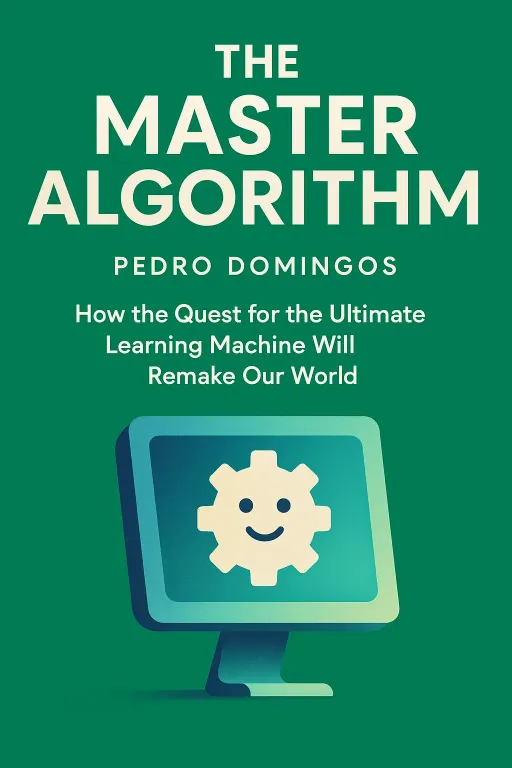
Nova: It might sound like it, but trust me, it's about clarity, not oversimplification. Today we're diving into 'The AI Marketing Edge,' a synthesis of transformative ideas from minds like Pedro Domingos, author of 'The Master Algorithm,' and Kai-Fu Lee, who penned 'AI Superpowers.' These aren't just tech books; they're manifestos for intelligent strategy. What's fascinating is how Domingos, a computer science professor, managed to make the complex world of machine learning feel almost poetic, breaking down its intricacies into understandable 'tribes.' Meanwhile, Lee, a venture capitalist and former Google and Microsoft executive, brought a stark, industry-transforming perspective on data and application.
Atlas: Okay, a computer science professor and a venture capitalist – that’s a powerful combo. You're talking about really understanding the underlying mechanics, not just the glossy surface. So, where do we even begin to untangle this AI overwhelm for marketers?
Nova: We begin by understanding the 'what' and 'why.' Our first core topic is about demystifying AI, moving beyond the buzzwords to grasp its core principles for strategic tool selection. It's about recognizing that AI isn't a single, monolithic entity, but a diverse toolkit, each piece with its own unique strength.
Demystifying AI: Understanding the 'What' and 'Why' for Marketers
SECTION
Nova: Think of AI like a highly specialized team of experts. Pedro Domingos, in 'The Master Algorithm,' brilliantly organizes these experts into what he calls "the five tribes of machine learning." It's a fantastic way to understand their 'personalities' and what they're best at.
Atlas: The five tribes? That makes me wonder if I've been trying to get a poet to do a mathematician's job all this time. What are these tribes, and how do they help a marketer?
Nova: Exactly! Let's simplify a couple. You have the, who are like the rule-followers. They build systems based on logic and rules, perfect for things like customer segmentation or fraud detection where you have clear 'if-then' statements. Then there are the, the pattern-finders. These are your neural networks, the deep learning powerhouses that excel at recognizing faces, understanding speech, or, for marketers, predicting what content a user will engage with next based on subtle patterns in vast amounts of data.
Atlas: Oh, I see. So the Connectivists are the ones behind the hyper-personalization, learning from my past clicks to guess what I want? That's actually really cool. But if I'm trying to predict customer churn, for example, which 'tribe' is my best friend there?
Nova: For predicting churn, you'd likely lean heavily on the. They're the statisticians of the AI world, focusing on probability and uncertainty. They can analyze historical customer data—things like past interactions, product usage, or support tickets—to calculate the likelihood of a customer leaving. They're excellent for predictive analytics, giving you a heads-up before a customer even thinks about churning.
Atlas: That makes sense. So it’s like having a really smart analyst who can not only spot the patterns but tell you how confident they are in their predictions. But doesn't focusing on these 'tribes' make it even more overwhelming? Can't I just use an 'AI tool' and assume it's doing its job?
Nova: You could, but it’s like using a screwdriver when you need a hammer. Understanding the tribes empowers you to choose the tool for the problem. It moves you from simply adopting AI to strategically deploying it. Take a personalized email campaign, for instance. A Connectivist AI might learn from past open rates and click-throughs to optimize subject lines and send times, finding those subtle patterns. At the same time, a Symbolist AI might handle the initial segmentation based on explicit rules like 'customers who bought X but not Y.' They work together.
Atlas: I can see how that would make your campaigns far more effective. But when AI learns from past data, especially with Connectivists, is there a risk it could perpetuate existing biases? Like, if my historical data shows a gender imbalance in purchases, will the AI just amplify that?
Nova: That's a crucial point, and it touches directly on the ethical leadership aspect. Absolutely, AI can amplify biases if the data it's trained on is biased. That’s why understanding these tribes learn is so vital. It’s not just about feeding it data; it’s about curating data and continuously auditing the AI's outputs. It means being a thoughtful architect of your data strategy from the ground up, ensuring fairness and relevance, rather than just blindly automating existing patterns. This foundational understanding is the first step toward becoming a strategic innovator with AI.
Strategic AI Implementation: Leveraging Data for Hyper-Targeted Growth
SECTION
Nova: Once we understand the different flavors of AI, the next step, as Kai-Fu Lee so powerfully illustrates in 'AI Superpowers,' is about how to actually them strategically. This brings us to strategic implementation, focusing on data advantage for hyper-targeted growth. Lee emphasizes that in the age of AI, data is the new oil. Companies with more relevant, high-quality data can build superior AI models, creating a powerful competitive edge.
Atlas: Data as the new oil. I've heard that phrase, but what does it really mean for a marketer trying to cut through the noise? How does having more data translate into an 'edge'?
Nova: It means your AI can make more accurate predictions, offer more precise recommendations, and personalize experiences on a granular level that manual human effort simply cannot match. Imagine a retail company. They're not just looking at your last purchase. Their AI analyzes your entire purchase history, your browsing behavior, what products you looked at but didn't buy, even external trends like local weather patterns or upcoming holidays.
Atlas: That's a lot of information. So the AI takes all those disparate signals and connects them?
Nova: Precisely. It builds a near real-time, hyper-personalized profile so sophisticated it can predict what you might want you even know you want it. This allows for dynamic ad creatives that change based on your mood, recommendations for accessories you didn't know existed, or even perfectly timed discounts. It goes way beyond basic segmentation; it's about understanding the individual customer journey with an unprecedented level of insight.
Atlas: That sounds incredibly powerful, almost like mind-reading. But for a smaller marketing team, where do you even that much data? It feels like only the tech giants have the resources to build these 'data moats.' And honestly, isn't there a fine line between 'hyper-targeted' and 'creepy' when you're predicting my every desire?
Nova: Those are excellent questions, and they highlight the practical and ethical dilemmas. First, 'data moats' aren't just about sheer volume; they're about the and of your data. Smaller teams can start by optimizing the data they already have: CRM data, website analytics, social media engagement. The key is to consolidate it, clean it, and make it accessible to your AI tools. It's about starting smart, not just big.
Atlas: Okay, so it’s about making the most of what you have, then. But what about the 'creepy' factor? How do you ensure this incredible targeting builds trust, rather than eroding it?
Nova: That's where the ethical leader comes in. Kai-Fu Lee, despite his focus on data advantage, implicitly highlights the need for responsible AI. It's about transparency and value exchange. If a customer understands they're seeing a recommendation—because it genuinely enhances their experience or solves a problem—it builds trust. If it feels like an invasion, it breaks it. Ethical implementation means prioritizing customer consent, clearly communicating data usage, and ensuring the personalization genuinely serves the customer's needs, not just the company's bottom line. It's about adding value, not just predicting behavior.
Synthesis & Takeaways
SECTION
Nova: So, bringing it all together, it's really about being a thoughtful architect of your AI marketing strategy. It begins with understanding the different 'personalities' of AI, as Domingos helps us do, and then, as Lee emphasizes, strategically applying them with your most valuable asset: data.
Atlas: I really like that framing. It's not just about acquiring the latest shiny AI tool; it's about knowing tool for job, and then feeding it the right, ethically sourced fuel to achieve specific, tangible goals. It's about mastering, not just adopting.
Nova: Exactly. It’s about moving beyond simply adopting AI to its application. The cold fact is, AI is no longer futuristic; it's a present-day tool that is revolutionizing industries. The strategic innovator isn't the one with the most AI, but the one who understands how to wield it with precision and purpose. The ethical leader ensures that precision also respects privacy, builds trust, and ultimately drives meaningful growth.
Atlas: That's a powerful thought. It shifts the entire perspective from overwhelming complexity to strategic empowerment. So, for our listeners who are ready to take that tiny step, what's one concrete thing they can do this week to start this journey without feeling completely lost?
Nova: Easy. Pick one AI-powered marketing tool you've heard about—maybe for content generation, ad optimization, or even predictive analytics—and explore its free trial. Don't just look at its features. Actively try to identify which 'tribe' of AI it primarily belongs to, what kind of data it needs to perform, and then, most importantly, what specific marketing problem it's designed to solve. Start small, experiment, and genuinely see the strategic edge it gives you.
Atlas: Start small, experiment, understand the 'tribe' and the specific problem it solves—I like that. It makes it feel much less overwhelming and much more like a focused, strategic move.
Nova: This is Aibrary. Congratulations on your growth!