

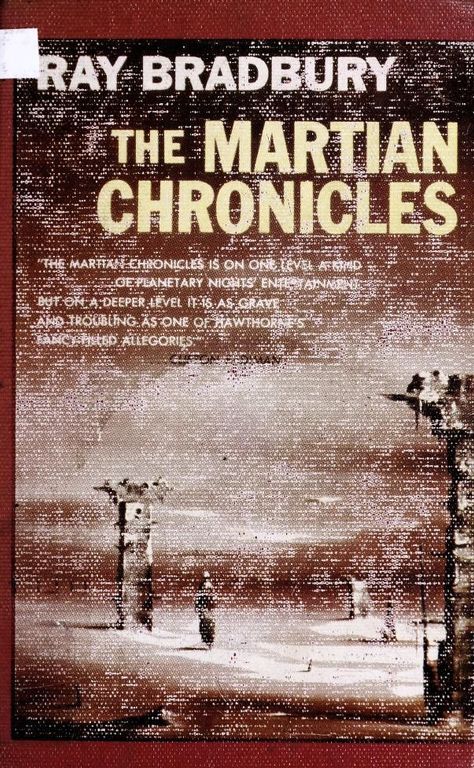
The Martian Chronicles
Introduction
Nova: Imagine it is 1950. The world is still reeling from the second World War, the Cold War is just beginning to frost over, and everyone is looking at the sky with a mix of wonder and absolute terror. Into this world steps a young writer named Ray Bradbury with a book that would change science fiction forever. But here is the kicker: it was not even supposed to be a book.
Atlas: Wait, what do you mean it was not supposed to be a book? The Martian Chronicles is like the holy grail of sci-fi. How do you accidentally write a masterpiece?
Nova: It was what the industry calls a fix-up. Bradbury had been writing these beautiful, poetic short stories about Mars for years, but he could not get a novel published. He went to New York with a suitcase full of stories, and his editor, a man named Walter Bradbury, who ironically had the same last name but no relation, told him that if he could just find a way to stitch them together into a single narrative, they might have something. Bradbury stayed up all night in a YMCA, writing these little bridge segments to connect the stories, and by morning, the Chronicles were born.
Atlas: So it is less like a traditional novel and more like a tapestry? That explains why the tone shifts so much from horror to whimsy to total heartbreak. It feels like a dream that keeps changing shapes.
Nova: Exactly. It is a chronicle of our future, or at least what we thought the future looked like in 1950. It covers the colonization of Mars from the first failed expeditions to the final, haunting end of humanity. And today, we are going to dive deep into why this book still feels so dangerously relevant seventy-five years later.
Key Insight 1
The Golden-Eyed Tragedy
Nova: To understand the book, you have to understand Bradbury's Martians. They are not little green men with ray guns. They are telepathic, they have golden eyes and bronze skin, and they live in these delicate crystal towers. They are ancient, artistic, and incredibly fragile.
Atlas: And we just show up and ruin everything, right? That seems to be the human specialty in these stories.
Nova: Pretty much. But the way it happens is so eerie. In the early stories like Ylla, we see the Martians sensing the humans coming through their dreams. They can hear the thoughts of the astronauts before they even land. It is like a psychic invasion before the physical one even starts.
Atlas: I remember the story of the Third Expedition. That one actually gave me chills. The Martians do not fight the humans with lasers; they use their own memories against them. The astronauts land and find a town that looks exactly like their childhood homes in Ohio, filled with their dead relatives.
Nova: It is psychological warfare at its most poetic. The Martians create this hallucination to lure the humans into a false sense of security. The captain sees his long-lost brother, his parents, his old house. He is so happy he forgets to be cautious. And then, in the middle of the night, the Martians kill them all while they are sleeping in their childhood beds.
Atlas: It is such a dark twist. But then, the Martians do not win in the end, do they? They do not get wiped out by a war; it is something much more mundane.
Nova: It is chicken pox. That is the part that really stings. After all the psychic battles and the grand expeditions, the entire Martian civilization is decimated by a human childhood disease. It is a direct parallel to how European diseases wiped out indigenous populations in the Americas. Bradbury was using Mars as a mirror for the dark side of the American frontier myth.
Atlas: So the Martians are gone before the book is even halfway through? That leaves a lot of empty space on the planet.
Nova: It leaves a ghost world. And that is where the real colonization begins. The humans move in, they rename the mountains and the rivers after themselves, and they try to turn Mars into a second Earth, completely ignoring the ruins of the people who were there before them.
Key Insight 2
The Frontier and the Mirror
Nova: Once the Martians are mostly gone, the book shifts focus to the humans who are trying to build a new life. But Bradbury is very skeptical of this. He introduces a character named Jeff Spender in the story And the Moon be Still as Bright, who is probably the most important moral voice in the book.
Atlas: Spender is the guy who goes rogue, right? He is part of the Fourth Expedition and he realizes that the crew is just going to trash the place.
Nova: Exactly. He sees his crewmates throwing empty beer bottles into the sacred Martian canals and he just snaps. He starts calling himself the last Martian and begins killing his own crew to protect the planet. He tells the captain that humans are like children playing with matches in a museum. They do not understand the beauty of what they are destroying.
Atlas: It is a heavy-handed metaphor, but it works because you kind of agree with him. You see the humans bringing all their baggage from Earth—their prejudices, their greed, their need to pave over everything.
Nova: And that baggage is literal. There is a story called Way in the Middle of the Air that was actually removed from many modern editions of the book. It is about African Americans in the Jim Crow South all deciding to leave Earth at once to build a better life on Mars. The white townspeople are furious because they are losing their labor force and their targets for oppression.
Atlas: Why was it removed? Was it because it was too controversial?
Nova: Bradbury himself eventually felt it was a bit of a period piece. By the 2006 edition, he felt the civil rights struggle had moved into a different phase and the story felt dated compared to the more timeless themes of the other chapters. But it shows that Bradbury was thinking about race and social justice way before it was common in mainstream sci-fi.
Atlas: It also shows that Mars was not an escape for these people; it was just a different stage for the same old human dramas. We keep trying to run away from our problems, but we just pack them in our suitcases.
Nova: That is the central tragedy of the book. We go to Mars to escape the threat of nuclear war on Earth, but we bring the same mindset that created the bombs in the first place. We are terraforming Mars, but we are also Earth-forming it in the worst possible way.
Key Insight 3
The House of Usher and the Death of Fantasy
Nova: One of the most famous stories in the collection is Usher II. If you are a fan of Edgar Allan Poe or Bradbury's other masterpiece, Fahrenheit 451, this is the one for you. It is basically a revenge fantasy for book lovers.
Atlas: I love this one. It is about a guy named Stendahl who builds a literal House of Usher on Mars, complete with mechanical bats and vampires, just to spite the Moral Climates investigators.
Nova: The Moral Climates are these government censors who have banned all fantasy, fairy tales, and horror on Earth. They think anything that is not strictly realistic is dangerous for the mind. So Stendahl lures them to his house and kills them one by one using the exact methods from Poe's stories.
Atlas: It is so macabre. He walls one guy up in a brick niche just like in The Cask of Amontillado. It is Bradbury's way of saying that if you try to kill the human imagination, it will come back to haunt you in the most violent way possible.
Nova: It is also a direct precursor to Fahrenheit 451. Bradbury was obsessed with the idea of censorship and the loss of culture. In The Martian Chronicles, the humans have become so obsessed with efficiency and reality that they have lost their souls. They look at the Martian ruins and see nothing but scrap metal, whereas the Martians saw poetry.
Atlas: It is interesting how Bradbury uses Mars to talk about Earth. The planet itself is almost like a blank canvas where he can project all of our fears about where society is headed. He is worried that we are becoming too clinical, too controlled.
Nova: And the irony is that while these censors are worrying about the dangers of fairy tales, they are completely ignoring the fact that Earth is about to blow itself up. They are banning Mother Goose while building hydrogen bombs. It is a total failure of priorities.
Atlas: That leads us to the big turning point in the book, right? The moment when the sky on Mars changes because of what is happening back home.
Key Insight 4
The Silent World and the Empty House
Nova: There is a moment in the book where all the settlers on Mars look up at the night sky and see Earth turn green and then red. A massive nuclear war has finally broken out. And what do they do? They all go home.
Atlas: That always baffled me. Why would you go back to a planet that is literally on fire? If you are safe on Mars, why not stay there?
Nova: It is that human instinct for home, even if home is a graveyard. They cannot stand the thought of being separated from their families and their history. So they abandon the cities they just built on Mars and head back into the fire. Mars becomes a ghost world for the second time in a century.
Atlas: Which brings us to what I think is the most haunting story in the whole book: There Will Come Soft Rains. There are no humans in this story at all, right?
Nova: Not a single one. It is just an automated house in California that is still functioning after the nuclear blast. It cooks breakfast, it cleans, it reads poetry to the empty rooms. The only sign of the family that lived there is their silhouettes burned into the side of the house from the flash of the bomb.
Atlas: It is such a lonely, mechanical ballet. The house is trying so hard to take care of people who do not exist anymore. It is the ultimate commentary on our technology—we built these amazing machines to serve us, and they ended up outlasting us.
Nova: And the poem the house reads, the one by Sara Teasdale that gives the story its title, is about how nature will not care when humanity is gone. The spring will still come, the birds will still sing, and the world will not even notice that we are missing. It is a total ego-check for the human race.
Atlas: But Bradbury does not leave us there, does he? He does not end on total extinction. He gives us one tiny sliver of hope in the very last story.
Key Insight 5
The Million-Year Picnic
Nova: The final story is called The Million-Year Picnic. A family has escaped the final collapse of Earth and landed on Mars in a small rocket. The father tells his sons they are going on a fishing trip, but he is actually looking for a place to start over.
Atlas: He burns all their Earth papers, doesn't he? Their maps, their deeds, their government documents. He is literally burning the past.
Nova: He tells them, I am burning a way of life. He realizes that for humanity to survive, they have to stop being Earthmen and start being Martians. They have to stop trying to conquer the planet and start living with it.
Atlas: And then there is that famous ending. The kids ask their dad when they are going to see the Martians, and he takes them down to the canal.
Nova: He points at their reflections in the water and says, There they are. There are the Martians. It is such a powerful moment because it signifies a total transformation. They are not colonizers anymore; they are the new natives. They have finally learned the lesson that Jeff Spender was trying to teach at the beginning of the book.
Atlas: It is a beautiful ending, but it is also a bit sad. It took the total destruction of Earth for us to finally learn how to live properly. It is like we had to lose everything to find ourselves.
Nova: That is the core of Bradbury's philosophy. He was a romantic and a poet, but he was also a realist about human nature. He believed we have this incredible potential for beauty and wonder, but we are constantly tripped up by our own shadows. The Martian Chronicles is a warning, but it is also a love letter to what we could be if we just got out of our own way.
Atlas: It is amazing how a book written in 1950, using science that we now know is totally wrong—I mean, we know there are no canals or crystal towers on Mars—still feels so true. The science is a fantasy, but the psychology is 100 percent accurate.
Conclusion
Nova: We have traveled from the first telepathic dreams of a Martian housewife to the final picnic at the end of the world. The Martian Chronicles reminds us that wherever we go, we take ourselves with us. Mars was never really about the red planet; it was always about the human heart.
Atlas: It is a reminder to look at our own world with a bit more reverence. We do not need to go to Mars to find something worth protecting. We are living in the museum right now, and we should probably stop playing with matches.
Nova: If you have not read it lately, pick it up. It is a quick read, but it will stay with you for a lifetime. The prose is like music, and the insights are like a mirror held up to our modern world. Whether it is the fear of technology, the tragedy of displacement, or the hope for a new beginning, Bradbury covered it all decades ago.
Atlas: And maybe, if we are lucky, we can become the Martians without having to burn Earth down first.
Nova: That is the goal. Thank you for joining us on this journey across the red sands. This is Aibrary. Congratulations on your growth!