

Von Neumann's Ghost
Content
Content
Narrator: Introduction
In his final days, as cancer spread to his brain, the smartest man of the 20th century was sequestered by the United States military. High-ranking officials, from the Secretary of Defense to the Chairman of the Atomic Energy Commission, sat by his bedside, hanging on his every word. This man, John von Neumann, had birthed the modern computer, written the equations for the atomic bomb, and fathered the game theory that would define the Cold War. Even as his mind unraveled, they waited for one last spark of genius, one more idea from the intellect that had reshaped the world. How does a mind like this come to be, and what happens when its "mad dreams of reason" are finally unleashed?
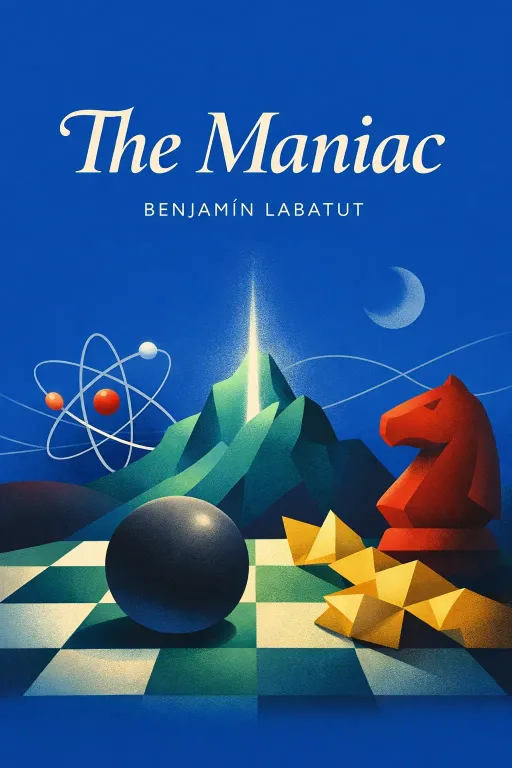
Benjamín Labatut’s book, "The Maniac," explores this very question. It traces a terrifying and exhilarating lineage of scientific thought, from the philosophical crises of early quantum mechanics to the digital gods of artificial intelligence, all centered around the brilliant, enigmatic, and deeply unsettling figure of John von Neumann.
Key Insights
Key Insight 1: The Discovery of the Irrational
The book begins not with triumph, but with tragedy. In 1933, the physicist Paul Ehrenfest, a man known as the "conscience of physics," walked into an institute in Amsterdam, shot his disabled son, and then killed himself. Ehrenfest was a brilliant mind, a friend to Einstein and Bohr, but he was plagued by a lifelong depression. This despair was amplified by two forces he could no longer comprehend. The first was the rise of Nazism, a political madness that threatened his world. The second was the new quantum mechanics, a scientific revolution he saw as a "mathematical plague."
Ehrenfest believed in physical intuition, in understanding the "leaping point" of an idea. But quantum mechanics felt abstract, filled with contradictions and uncertainties that defied common sense. He felt that reason itself had become untethered, a "drunken mule" leading humanity astray. In a haunting letter to his friends, he confessed his inability to understand modern physics and the unbearable burden of his life. Ehrenfest’s tragic end serves as a dark overture, introducing the book's central theme: the immense psychological cost of confronting the limits of reason and the "irrational" forces that lurk beneath the surface of our world.
Key Insight 2: The Forging of a Mathematical Weapon
Out of this era of uncertainty emerges John von Neumann, a child prodigy whose intellect was so profound that it left his teachers in awe. The mathematician George Pólya once presented a difficult, unproven theorem to a class of gifted students. After a moment of silence, a young von Neumann walked to the blackboard and, with no apparent effort, delivered a stunningly elegant proof. Pólya, a seasoned mathematician, was left with a single thought: "I was afraid of von Neumann."
This almost alien intelligence was not content with abstract proofs. Von Neumann’s mind was a weapon, and the world was about to provide him with a target. Recruited into the Manhattan Project, he became a key figure in the development of the atomic bomb. While other scientists grappled with the moral implications, von Neumann was fascinated by the sheer power of the problem. His wife, Klari Dan, recalled Albert Einstein’s assessment of her husband as a "mathematical weapon." This was proven when von Neumann, with cold logic, calculated the optimal altitude for the bombs to detonate over Hiroshima and Nagasaki to maximize their destructive impact. His journey from pure mathematics to applied destruction embodies the book's exploration of how abstract logic, when wielded by a powerful mind, can become a terrifying force in the real world.
Key Insight 3: The Ghosts in the Machine
Von Neumann's work on the bomb required computational power far beyond human capability. This led him to his next obsession: the computer. He spearheaded the creation of the MANIAC, one of the first stored-program computers, a machine that became the blueprint for our digital universe. But von Neumann had a second, more secret goal for this machine. He wanted to use it to create life.
He hired a "mad scientist" named Nils Aall Barricelli to run experiments on the MANIAC. Barricelli seeded the computer's memory with random numbers and gave them rules for interaction, hoping to witness a form of digital evolution. He watched as his numerical "organisms" fused, mutated, and preyed on each other in a tiny digital universe. However, Barricelli’s work ended in failure and obscurity after a falling out with von Neumann, who he claimed stole and buried his ideas.
Yet, von Neumann had already theorized the key to this process. In a little-known paper, he laid out the logical rules for a self-reproducing automaton, a machine that could build copies of itself. His model, which required a blueprint of instructions and a mechanism to copy and insert that blueprint, perfectly prefigured the function of DNA and RNA, years before the double helix was discovered. He was, as one scientist called him, a "true prophet," one who dreamed of digital life and self-replicating machines colonizing the galaxy.
Key Insight 4: The God of Go
The final section of the book brings von Neumann's legacy into the 21st century with the story of AlphaGo, the AI that took on the ancient and profoundly complex game of Go. For centuries, Go was considered an art form, a game of intuition and abstract strategy that could never be conquered by brute-force computation. Its complexity is staggering; there are more possible games of Go than atoms in the known universe.
In 2016, AlphaGo challenged Lee Sedol, a legendary human champion. The world watched as the AI, which had taught itself to play by analyzing millions of games, began to make moves that were beyond human comprehension. In the second game, it played Move 37, a move so counterintuitive that every human expert on Earth thought it was a mistake. But it was a stroke of genius, a move that Lee Sedol later described as "a thing of beauty, not of this world." It revealed a new, alien form of creativity.
Though Lee Sedol managed to win a single game with a brilliant "divine move" of his own—a move so rare it had a one-in-ten-thousand chance of being played, causing the AI to "go mad"—the match was a turning point. Lee Sedol eventually retired, stating that AI had become an "entity that cannot be defeated." The game had changed forever. DeepMind then created AlphaZero, an AI that learned Go, chess, and shogi with no human data at all, only the rules. It became the strongest player the world had ever known, a true "God of Go" born from pure logic.
Conclusion
The single most important takeaway from "The Maniac" is that progress is a relentless and amoral force. The pursuit of pure reason, as embodied by figures like John von Neumann, unleashes powers that are both creative and destructive, often at the same time. The same logic that built computers capable of simulating life also optimized the destruction of cities. The book offers no easy answers, only a chilling portrait of the human minds that walk this knife's edge. As one of von Neumann's colleagues, Eugene Wigner, somberly concludes, "For progress there is no cure."
The book leaves us with a profound and unsettling question. In our relentless drive to build these new forms of intelligence, to create, as von Neumann put it, our own gods, are we prepared for what they might become? What happens when the logic we have unleashed evolves beyond our control and no longer reflects human values, or even human understanding?