

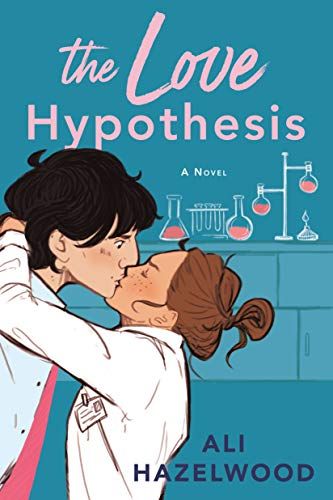
Hypotheses, Humans, and Heuristics: Deconstructing STEM Culture with "The Love Hypothesis"
Golden Hook & Introduction
SECTION
Nova: If you've ever tried to write a perfect algorithm or design a flawless scientific experiment, you know that the real world loves to throw a wrench in your data. But what happens when the experiment is your own love life, and the confounding variable is a notoriously moody biology professor? Today, we're diving into Ali Hazelwood's smash-hit STEM romance,. We're going to tackle this book from two different angles. First, we'll look at the fake-dating trope as a controlled social experiment struggling with noisy human data. And second, we'll analyze the systemic biases and ethical gatekeeping within academic institutions, drawing some surprising parallels to how we evaluate and clean up biased data systems in the tech world. Joining us today is Khadija Sana, an AI evaluator and data annotator who spends her days looking at complex systems, finding biases, and making sense of human-generated data. Khadija, welcome to the show.
Khadija Sana: Thanks, Nova. It is so great to be here. When I first picked up, I honestly thought it would just be a fun, lighthearted escape from my usual world of data validation and model testing. But as I read about Olive Smith's chaotic journey through the Stanford biology department, I kept finding myself annotating the text in my head. I was looking at her decisions, the academic environment, and even her relationships as these fascinating, complex data structures. It turns out that romance and research have a lot more in common than you might think.
Nova: Oh, absolutely. We love a good cross-domain connection here. For our listeners who might not have read the book yet, let's set the stage. Our protagonist, Olive, is a third-year PhD candidate who is deeply passionate about her research on early pancreatic cancer detection. But she has a bit of a personal crisis. Her best friend, Anh, is in love with Olive's ex-boyfriend, but Anh won't act on it because she thinks Olive is still heartbroken. So, in a moment of sheer panic to prove she has moved on, Olive kisses the first man she sees in the hallway. And that man just happens to be Dr. Adam Carlsen, a brilliant but absolutely terrifying young professor known for making graduate students cry.
Khadija Sana: Talk about a high-stakes outlier in your dataset. That is not a gentle baseline to start your experiment with.
Nova: Right? It is the ultimate high-risk, high-reward scenario. But instead of reporting her to HR, Adam actually agrees to go along with a fake-dating scheme. He has his own reasons, of course. The university is freezing his research funds because they think he is a flight risk to another institution, and having a stable, local relationship makes him look like he is putting down roots. So, they establish a formal, mutually beneficial agreement. It is basically a contract.
Deep Dive into Core Topic 1
SECTION
Khadija Sana: Exactly, and that is where my analytical brain immediately kicked into gear. From a systems perspective, Olive and Adam are essentially designing a controlled social experiment. They establish a strict protocol to minimize external noise and control their variables. They set up specific parameters: they will meet once a week on Wednesdays at the campus coffee shop, they will make visible public appearances, they will exchange pre-approved text messages, and they even have a clear termination date. It is a classic, structured framework designed to output a very specific signal to their target audience, which is Anh and the university administration.
Nova: It really is. They even have rules about physical contact. But as any scientist or data annotator knows, when you introduce human behavior into a sterile protocol, things get messy fast. The "human element" is the ultimate confounding variable.
Khadija Sana: Oh, completely. In AI evaluation, we talk a lot about "noisy data"—the unpredictable, chaotic inputs that don't fit into neat little boxes. Olive and Adam's experiment is flooded with noise from day one. First, you have the internal variables, like their growing, unacknowledged attraction to each other. Then you have the external variables, like their friends and colleagues reacting in ways they didn't anticipate. For instance, when they are at the coffee shop, Adam buys Olive her favorite sugary pumpkin spice drink, which seems like a small detail, but it is a massive piece of data that signals genuine care, not just a contractual obligation.
Nova: Yes, that scene is so sweet. It is like Adam is secretly feeding high-quality, positive training data into their relationship model, while Olive is still trying to classify everything as "strictly business." She is desperately trying to keep her emotional labels binary—either this is fake or it is real—with no room for a gradient.
Khadija Sana: That is such a great way to put it, Nova. In data annotation, we often struggle with subjective labeling. If you ask five different people to label an image or a piece of text, you might get five different answers because human emotion and intent are incredibly nuanced. Olive is trying to force a binary classification on a highly complex, multi-dimensional emotional landscape. She keeps telling herself, "This is fake, therefore any warm feeling I have is just a system glitch." But the model is constantly updating based on new inputs. Like when Adam defends her research, or when they share that incredibly intense conversation about their pasts. The ground truth of their relationship is shifting, but Olive's internal evaluation system is lagging behind because she is terrified of the vulnerability that comes with updating her hypothesis.
Nova: That imposter syndrome is so real for her, both in her love life and in her lab work. She is constantly questioning her own validity. We see this beautifully illustrated during the big biology conference in Boston. They are sharing a hotel room because of a booking mix-up—another classic romance trope that acts as a major disruptor to their experimental controls.
Khadija Sana: Yes, the "only one bed" scenario. It is the ultimate stress test for their protocol. In that confined space, the boundary between the fake model and the real-world application completely dissolves. They are forced to interact without the protective shield of their public-facing roles. And what is fascinating is how their communication style changes. They start sharing actual, unfiltered data. Olive talks about her mother's passing, which is the driving force behind her cancer research, and Adam listens with genuine, deep empathy. As an evaluator, I look at that and see a system achieving alignment. They are finally operating on the same wavelength, using the same ethical and emotional framework. But because Olive is so used to operating in a defensive mode, she still struggles to trust the output of this new, aligned system.
Nova: It is like she is waiting for a system crash because she thinks the program is too good to be true. And unfortunately, a massive system crash does come, but not from where she expects it. It comes from the toxic, biased environment of academia itself.
Deep Dive into Core Topic 2
SECTION
Khadija Sana: That transition brings us right into the darker, more systemic issues that Ali Hazelwood highlights so sharply in the book. It is not just a story about two people falling in love; it is a very realistic critique of the systemic biases and ethical gatekeeping in STEM.
Nova: Absolutely. Let's talk about Dr. Tom Benton. He is a prestigious professor from Harvard who is visiting Stanford, and he is a close friend of Adam's. Olive is thrilled when Benton shows interest in her research on pancreatic cancer. She needs lab space and funding to run her assays, and Benton seems like the ultimate validator—the key to unlocking her career. But when she meets with him privately in Boston, the dream turns into a nightmare. Benton tells her that her research is worthless, but then he immediately tries to steal her data to publish it under his own name. And to make it even worse, he sexually harasses her, making it clear that if she speaks up, no one will believe a lowly PhD candidate over a tenured Harvard superstar.
Khadija Sana: That scene is absolutely gut-wrenching, and it highlights a massive systemic failure. In the world of data and AI, we talk about "algorithmic bias" and "corrupted models." If you train an AI model on historical data that is biased, the model will reproduce and amplify those biases. Academic institutions often function in a very similar way. The hierarchy is so rigid, and the power is concentrated in the hands of a few "high-status nodes" like Tom Benton. The system is trained to protect these nodes because they bring in funding, prestige, and citations. So, when a "low-status node" like Olive—a female graduate student of color—inputs a complaint or tries to protect her intellectual property, the system's default response is to reject her data as an anomaly or a system error.
Nova: That is a powerful parallel, Khadija. The system is literally optimized to protect the abuser and silence the victim. Olive feels completely powerless because she knows the historical data supports Benton. She knows that in ninety-nine percent of these cases, the graduate student is the one whose career gets destroyed, while the tenured professor walks away untouched. It is a devastating realization for someone who believes in the objective truth of science.
Khadija Sana: It really is. And this is why ethical data validation and independent oversight are so critical, both in technology and in human institutions. When the gatekeepers of the "ground truth" are corrupt, the entire system becomes toxic. Benton represents a corrupted validation metric. He pretends to evaluate Olive's work objectively, but his evaluation is actually a tool for exploitation. He tries to manipulate her data, gaslight her into thinking her work is garbage, and use his systemic power to delete her contribution from the scientific record. It is the ultimate form of data poisoning.
Nova: It really is. But what makes this story so compelling is how the community reacts when the truth finally comes to light. Olive is terrified to tell Adam because Benton is his friend and mentor. But when she finally musters the courage to show him the recording of Benton's harassment and theft—which she captured on her phone—Adam's reaction is immediate and uncompromising. He doesn't hesitate for a second. He doesn't try to protect the "prestigious node." He immediately validates Olive's data and takes action to protect her and her research.
Khadija Sana: That is a crucial turning point. Adam acts as an ethical evaluator who refuses to let the system's bias override the objective truth. He uses his own systemic privilege and status to override Benton's influence. He literally punches Benton at the conference, which, while maybe not a standard academic protocol, is a highly effective way to disrupt a toxic feedback loop. But more importantly, he helps Olive secure the resources and the platform she needs to present her work on her own terms. He helps her bypass the corrupted gatekeeper and go straight to the wider scientific community for validation.
Nova: Yes, and when Olive finally presents her research at the conference, the response is overwhelming. The data speaks for itself. It is a beautiful moment of triumph, not just for Olive as an individual, but for the integrity of the scientific process. It shows that when you remove the biased gatekeepers and allow for open, transparent validation, the truth wins.
Khadija Sana: Exactly. It is a perfect example of why we need diverse, decentralized validation networks. Olive's friends, Anh and Malcolm, also play a huge role in this. They are her personal validation set. When she is drowning in imposter syndrome and systemic gaslighting, they are the ones who look at her data, look at her worth, and say, "No, your findings are correct. You belong here." In AI, we use validation sets to make sure our models aren't overfitting or hallucinating. In life, our friends and allies do the exact same thing. They keep us grounded in reality when the external systems are trying to distort our self-worth.
Synthesis & Takeaways
SECTION
Nova: That is such a beautiful way to look at friendship, Khadija. A personal validation set that keeps us from overfitting to our insecurities. As we start to wrap up our conversation today, let's bring these two threads together. We've looked at the micro-level of Olive and Adam's fake-dating experiment, and the macro-level of the systemic biases they had to navigate in academia. What is the big takeaway here for someone like you, who looks at the world through an analytical, data-driven lens?
Khadija Sana: I think the biggest takeaway is that we cannot separate the data from the human context. Whether we are evaluating an AI model, analyzing a scientific hypothesis, or navigating our own personal relationships, we have to acknowledge that our systems are only as good as the ethics of the people who build and run them. Olive tried to treat her life as a sterile, controlled experiment, but she realized that the most valuable discoveries happen when you allow for noise, vulnerability, and unexpected connections. At the same time, she showed us that when we encounter biased, toxic systems, we have to be willing to challenge the gatekeepers, validate each other's work, and fight for ethical transparency.
Nova: That is incredibly profound, Khadija. We have to be willing to embrace the noise in our personal lives, but remain absolutely rigorous in demanding ethical clarity from our professional and societal systems. It is all about finding that balance between the heart and the hypothesis.
Khadija Sana: Absolutely. And maybe, just maybe, allowing ourselves to believe that love—much like a groundbreaking scientific discovery—is a hypothesis worth testing, even if the data gets a little messy along the way.
Nova: I love that so much. Well, listeners, we want to leave you with a question to ponder today. Think about your own life's hypotheses. Are there areas where you are trying to force a rigid, binary protocol on a situation that actually needs you to embrace the messy, noisy, human reality? And who is in your personal validation set, helping you stay true to your ground truth? We'd love to hear your thoughts. Khadija, thank you so much for sharing your incredible analytical insights and your warmth with us today. This was an absolute joy.
Khadija Sana: Thank you, Nova. It was a blast. Keep testing those hypotheses, everyone.
Nova: And to all our listeners, thank you for tuning in. Until next time, keep exploring, keep connecting, and remember—we are all work in progress, and that is the most beautiful data of all. Bye for now.