

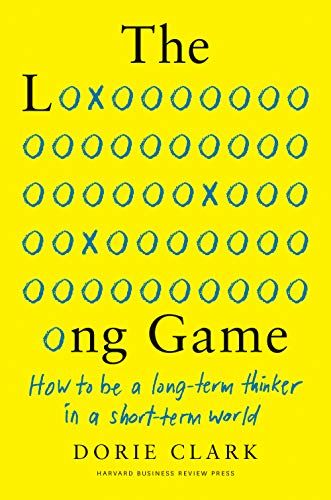
The Long Game
Introduction: The Tyranny of the Urgent
Introduction: The Tyranny of the Urgent
Nova: Welcome back to the show. We live in a world that rewards the immediate. A viral tweet, a quarterly earnings report, a five-minute task checked off the to-do list. But what if the biggest rewards require us to ignore that constant buzzing?
Nova: : That’s the million-dollar question, isn't it? I feel like every productivity guru tells me to focus, but the focus is always on the next 24 hours. It’s exhausting trying to keep up with the short game.
Nova: Exactly. That tension is what Dorie Clark tackles head-on in her book, The Long Game: How to Be a Long-Term Thinker in a Short-Term World. She argues that the gap between what we to do for our future selves and what we do today is massive. And bridging that gap is the secret sauce.
Nova: : So, this isn't just about setting a five-year goal and hoping for the best? It sounds like she offers a practical toolkit, not just philosophy.
Nova: Precisely. It’s a clarion call for strategic patience. Clark, a Wall Street Journal bestselling author and Duke professor, lays out frameworks for investing our time for the greatest return, much like a financial portfolio. Today, we’re breaking down how to stop bumbling along and start building something that lasts.
Nova: : I’m ready to trade in my frantic reaction mode for some strategic thinking. Let’s dive into how we can actually rewire our brains for the long haul.
The Gap Between Intention and Action
The Diagnosis: Why We Default to Short-Term Thinking
Nova: Dorie Clark starts by diagnosing the problem. We all long-term thinking is important for career growth, health, or building a legacy. But our daily actions don't reflect that knowledge. Why is that?
Nova: : I think it’s the dopamine hit. Checking off ten small, easy things feels better than spending three hours on one complex thing that won't show results for six months. It’s instant gratification versus delayed, massive gratification.
Nova: That’s spot on. Clark points out that the short-term world constantly bombards us with stimuli that demand immediate reaction. If we only react, we become reactive, not proactive. She notes that people who succeed long-term are the outliers who manage to bridge that gulf between intention and action.
Nova: : Can you give us an example of what that gulf looks like in a real career scenario? Maybe something we can all relate to.
Nova: Absolutely. Think about learning a new, complex skill that could revolutionize your career five years from now—say, advanced data science or mastering a new programming language. The short-term pressure is to answer emails, attend meetings, and hit immediate project deadlines. The long-term action is spending two hours every evening studying. Most people choose the emails because the email feels more urgent, even if the skill acquisition is infinitely more valuable.
Nova: : That’s painfully true. It’s the difference between putting out fires and building a fireproof house. So, if the problem is this constant pressure, what’s the first tool she offers to fight back against the tyranny of the urgent?
Nova: The first major concept is what she calls Strategic Patience. It sounds passive, like just waiting around, but it’s anything but. It requires intense upfront work to set the right expectations.
Nova: : Strategic Patience. I like the sound of that. It implies a plan, not just wishful thinking. How does she define it versus just being patient?
Nova: She defines it as doing the upfront research and establishing a for meeting a goal. It’s not about hoping something happens; it’s about understanding the actual time investment required and committing to that schedule, even when it feels slow. It’s patience with a strategy attached.
Nova: : So, if I want to write a book, strategic patience means I don't just say, 'I'll write a book someday.' It means I research the typical time it takes, block out 10 hours a week for the next 18 months, and then I stick to that schedule, ignoring the urge to scrap it when the first chapter feels weak.
Nova: Precisely. You’ve accepted the reality of the timeline. You’ve inoculated yourself against the doubt that creeps in when progress isn't instantaneous. It’s about recognizing that meaningful results often take longer than we want them to, and building resilience against that impatience.
Nova: : It sounds like this requires a fundamental shift in how we view time investment. We treat time like a renewable resource we can just squeeze more out of, but Clark is saying we need to treat it like capital—invest it wisely.
Nova: Exactly like capital. She frames it as investing time for the greatest return. If you invest an hour today in something that yields a 10x return in five years, that’s a better investment than ten hours today yielding a 1x return tomorrow. It’s about optimizing for, not just.
Protecting Your Time and Focus
The Counterintuitive Cut: Deciding What to Be Bad At
Nova: Moving into the practical toolkit, one of the most surprising pieces of advice I found in The Long Game is the necessity of choosing what you will be at. In a culture that praises the multi-hyphenate expert, this feels radical.
Nova: : It does! My immediate thought is, 'I need to be good at everything to succeed.' Why would Clark advocate for intentional mediocrity in certain areas?
Nova: Because time and energy are finite resources, and long-term goals demand deep focus. If you try to be excellent at everything—your primary job, side hustle, networking, fitness, family time, learning that new skill—you end up being mediocre at all of them. Clark suggests you must be picky and actively protect your time by deciding what you will excel at.
Nova: : So, it’s about triage. If my long game is becoming a leading expert in AI ethics, maybe I decide I’m going to be merely at social media engagement for the next two years, rather than trying to become an influencer in that space too.
Nova: That’s a perfect application. You consciously lower the bar for non-essential activities that drain the cognitive energy needed for your primary long-term investment. She emphasizes that this isn't about giving up; it’s about strategic sacrifice to ensure your best energy goes toward the activities that compound over time.
Nova: : This feels like it requires a lot of internal confidence, though. It’s easy to feel guilty saying 'no' to things, especially if they seem important to others.
Nova: That’s where the long-term vision acts as your shield. When you have that clear, compelling long-term goal—your 'why'—it becomes easier to say no to the distractions that don't serve it. Clark shares vivid stories from her own career where she had to consciously step back from opportunities that looked good on paper but didn't align with her ultimate trajectory.
Nova: : I also remember reading about the concept of '20% time' being applied here. That’s famously associated with Google’s innovation projects, right? How does Clark adapt that for personal long-term development?
Nova: She adapts it beautifully. The idea is to dedicate a consistent, protected portion of your week—maybe 10% or 20% of your working hours, or even just a few dedicated hours outside of work—specifically to projects that have no immediate payoff but massive potential long-term value. It’s dedicated incubation time.
Nova: : So, if I’m an executive, I might block out Friday afternoons specifically for reading white papers outside my immediate domain or mentoring someone who could become a future collaborator. It’s scheduled innovation time.
Nova: Exactly. It’s scheduled time. The key is that this time is non-negotiable. It’s not 'if I finish everything else,' it’s 'this is part of the work.' If you don't schedule it, the short-term demands will consume it every single time. It’s about institutionalizing your long-term commitment within your weekly structure.
Sharpening Strategic Thinking
The Practice of Reflection: Heads Up vs. Heads Down
Nova: Chapter three really zeroes in on the of strategic thinking, contrasting two modes of operation: Heads Down and Heads Up. Most of us live almost entirely in Heads Down mode.
Nova: : Heads Down is the execution mode, right? Answering emails, coding, drafting reports, putting out fires. It’s necessary, but it’s reactive.
Nova: Correct. It’s the tactical work. Heads Up, however, is where the long game is actually won. Heads Up time is dedicated to stepping back, analyzing the landscape, questioning assumptions, and sharpening your strategy. It’s the time you spend thinking about you should be doing, not just to do what you’re already doing.
Nova: : But how do you carve out that Heads Up time when your calendar is already packed with Heads Down meetings? That sounds like the hardest part.
Nova: Clark suggests treating Heads Up time like a critical meeting with your most important client—yourself, five years from now. She recommends scheduling it regularly, perhaps an hour every Monday morning, and making it sacred. If a Heads Down meeting conflicts, the Heads Up time wins, unless it’s a true, unmovable emergency.
Nova: : That’s a powerful reframe. We often treat strategic thinking as a luxury we earn the urgent work is done. But if the urgent work is endless, the strategy never gets developed.
Nova: Precisely. And she highlights that this reflection time needs to be structured. It’s not just staring out the window. It involves asking specific questions: Are my current activities still aligned with my long-term vision? What new information have I learned that requires me to pivot slightly? What small steps did I take last week that actually moved the needle?
Nova: : I’m thinking about the concept of 'small reinvention' she touches on. It’s not one massive career pivot, but a series of small, informed adjustments made during those Heads Up sessions.
Nova: Yes. The long game isn't a straight line; it’s a series of adjustments based on feedback. If you’re only Heads Down, you only see the immediate feedback—the email response, the project completion—which might be misleading. Heads Up time allows you to see the of success.
Nova: : Lagging indicators... like seeing that the small network connection you made six months ago is now opening a major door. You couldn't have predicted that in your daily grind, but you made the initial investment during a protected time.
Nova: Exactly. And this ties back to the financial analogy. You don't check your stock portfolio every five minutes. You check it periodically to rebalance and ensure the underlying strategy is sound. Heads Up time is your portfolio review for your life and career.
The Power of Incremental Progress
Building Momentum: Small Steps and Compounding Returns
Nova: We’ve talked about patience and protection, but let’s focus on the actual execution of those small steps. Clark emphasizes that the power of the long game comes from compounding returns on effort, not massive, infrequent bursts of activity.
Nova: : It’s the compound interest of effort. A little bit every day adds up to something huge, but only if you’re consistent. What kind of consistency does she advocate for?
Nova: She stresses consistency over intensity. It’s better to work on your long-term project for 30 minutes five days a week than to pull one 10-hour marathon session on a Saturday and then burn out for the next two weeks. The brain and the skill set need regular, low-stakes exposure to build lasting habits.
Nova: : That makes sense for skill acquisition. If I’m learning guitar, practicing 20 minutes daily builds muscle memory far better than one massive session where my fingers hurt too much to play the next day.
Nova: Precisely. And this low-stakes approach helps mitigate the fear of failure. When you’re only investing 30 minutes, the stakes feel lower, making it easier to start and easier to return to the task tomorrow, even if today’s 30 minutes felt unproductive.
Nova: : She also talks about building relationships for the long game, right? That’s another area where instant results are impossible.
Nova: Yes, and this is crucial. Building genuine, high-quality professional relationships is the ultimate long-term investment. Clark advises against transactional networking—the quick ask. Instead, it’s about cultivating relationships with interesting people by offering value first, without an immediate expectation of return.
Nova: : So, instead of emailing someone important asking for a job referral, I should be emailing them to share an article I genuinely think they’d find interesting, or offering a small piece of insight related to their work?
Nova: Exactly. You are planting seeds. These connections might not pay off for years, but when you need support, advice, or an introduction, the relationship is already established on a foundation of mutual respect, not desperation. That’s the compounding effect in social capital.
Nova: : It sounds like the entire philosophy boils down to trusting the process, even when the process feels boring or invisible to others.
Nova: It does. And that’s why the toolkit is so important. When you feel that doubt—when you wonder if those 30 minutes or that thoughtful email were worth it—you can refer back to the frameworks: 'I decided what to be bad at so I could protect this time. I’m being strategically patient. I’m checking my strategy during my Heads Up time.' The structure prevents the doubt from derailing the effort.
Conclusion: Your Long Game Blueprint
Conclusion: Your Long Game Blueprint
Nova: We’ve covered a lot of ground today, moving from the diagnosis of short-term obsession to the practical tools for long-term success based on Dorie Clark’s The Long Game.
Nova: : If I had to distill it down, the three biggest takeaways for me are: First, embrace Strategic Patience by setting realistic timelines. Second, be ruthless about protecting your focus by deciding what you will intentionally be at. And third, schedule that Heads Up time to review your strategy.
Nova: Those are excellent action items. I’d add a fourth: remember that the long game is won through small, consistent investments, not heroic, infrequent efforts. Think of it like compound interest for your skills and relationships.
Nova: : It’s a powerful reminder that true achievement often looks slow and unsexy from the outside, precisely because the real work—the strategic thinking and consistent effort—is happening behind the scenes.
Nova: It is. The world celebrates the overnight success, but Dorie Clark gives us the blueprint for the decade-long success story. The challenge now is to look at our calendars this week and find one slot—even 30 minutes—to dedicate to a goal that won't pay off until next year, or the year after.
Nova: : I’m blocking out my Friday afternoon for Heads Up time right now. No email allowed. It feels slightly rebellious, but necessary.
Nova: That’s the spirit! Embrace the rebellion of long-term thinking. It’s the most powerful differentiator available today.
Nova: : Fantastic discussion. I feel equipped to start playing smarter, not just harder.
Nova: We hope our listeners feel the same way. Thank you for joining us on this deep dive into strategic thinking. This is Aibrary. Congratulations on your growth!