

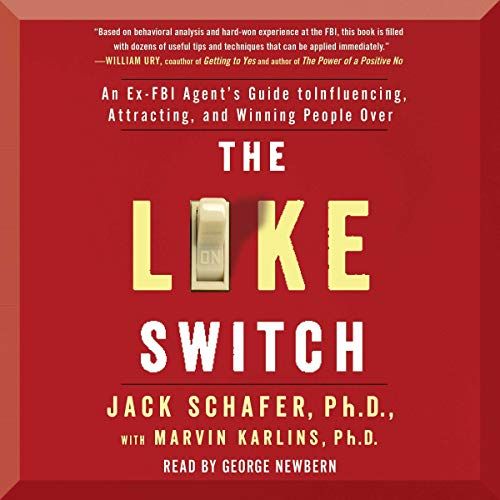
The Like Switch
Introduction: The Secret Language of Trust
Introduction: The Secret Language of Trust
Nova: Welcome back to the show. Today, we are diving into a book that promises to unlock one of the most powerful, yet elusive, human skills: making people genuinely like you, fast. We’re talking about "The Like Switch" by Dr. Jack Schafer.
Nova: : Wait, a 'Like Switch'? That sounds like something out of a bad 90s self-help seminar. What makes this one different? Is this just about smiling more?
Nova: That’s the perfect place to start! It is absolutely not just about smiling more. This book comes from a place of serious, high-stakes psychology. Dr. Schafer isn't just a life coach; he’s a retired FBI Special Agent who spent fifteen years in counterintelligence, specializing in behavioral analysis and recruiting assets. He had to figure out, under immense pressure, how to turn a complete stranger into a trusted confidant, often in minutes.
Nova: : An FBI agent? That changes everything. So, this isn't about charming your way into a cocktail party; it’s about establishing trust when the stakes are national security? That’s intense.
Nova: Exactly. He took the techniques used to build rapport with potential spies—where failure meant disaster—and distilled them into accessible, ethical, and highly effective strategies for everyday life: sales calls, job interviews, even dating. The core premise is that influence flows directly from liking, and liking is a skill you can learn to activate.
Nova: : So, we’re not learning manipulation; we’re learning how to broadcast genuine safety and interest? I’m intrigued. Where does he even begin to break down this complex process of human connection?
Nova: He starts by establishing the foundation, which he calls the Golden Rule of Friendship, and then moves into the subtle, almost invisible non-verbal cues that signal to another person's subconscious mind: 'I am safe, and I like you.' Get ready, because the next few chapters are packed with actionable intelligence you can use today.
Key Insight 1: The Golden Rule and Credibility
The FBI Foundation: Liking as the Currency of Influence
Nova: Let’s talk about the bedrock of the entire book. Schafer posits that liking is the fundamental prerequisite for influence. If someone doesn't like you, they won't listen to your pitch, accept your advice, or trust your intentions.
Nova: : That makes intuitive sense, but it’s easy to forget when you’re focused on the technical details of what you’re selling or saying. What is his 'Golden Rule of Friendship' that underpins this?
Nova: It’s deceptively simple, but profound. The Golden Rule of Friendship, as he frames it, is: People like you when they believe you like them. It flips the script. Most people walk into an interaction thinking, 'How can I get this person to like me?' Schafer says you should focus entirely on making feel liked, and the liking will naturally flow back to you.
Nova: : That’s a massive mental shift. It moves the focus from self-consciousness to outward observation. But how do you signal that you like someone without sounding desperate or insincere?
Nova: That’s where his FBI training shines. You can’t just say, 'I like you.' You have to it through non-verbal communication. He emphasizes that our brains are wired to detect authenticity in body language far faster than in spoken words. If your words say 'I’m interested,' but your posture screams 'I’m ready to bolt,' the subconscious wins every time.
Nova: : So, if I’m in a meeting, and I want the client to trust my proposal, I need to first make the client feel personally valued, not just professionally respected. Is that the application here?
Nova: Precisely. Think about the context of his work. He was often dealing with individuals who were inherently suspicious. To gain their trust, he couldn't use standard sales tactics. He had to create an environment of psychological safety. He mentions that when you make someone feel liked, you are essentially telling their primal brain, 'This person is not a threat; they are an ally.'
Nova: : And I imagine this is where the FBI stories become so compelling. Are there examples where a simple shift in perceived intent changed the entire dynamic of an interrogation or recruitment?
Nova: Absolutely. He details situations where focusing on establishing that initial, non-threatening connection—making the subject feel seen and understood—was the key that unlocked cooperation. It’s about demonstrating that you are paying attention to, not just what they can do for you. It’s a powerful lesson in empathy as a strategic tool.
Nova: : It sounds like the first step is abandoning the agenda for a moment and prioritizing the human connection. If I walk in thinking I need to extract information, I’m already signaling threat. If I walk in thinking I need to make this person feel good about themselves for the next five minutes, the information extraction becomes a byproduct of trust.
Nova: That’s the essence of it. And this foundation sets up the next layer, which is the actual physical toolkit he provides. Because once you accept the Golden Rule, you need the tools to execute it physically. It’s the difference between knowing you need to build a house and actually having the blueprints and the hammer.
Nova: : I’m ready for the blueprints. Let’s move from the philosophical foundation to the tactical execution. I want to know what specific physical signals he identified that trigger this 'like' response in others.
Key Insight 2: The Subconscious Triggers
The Non-Verbal Trifecta: Eyebrows, Head Tilts, and Genuine Smiles
Nova: This is where the book gets really fascinating, because Schafer isolates three specific, almost instantaneous non-verbal cues that signal friendliness and safety. He calls this the Non-Verbal Trifecta.
Nova: : Okay, I’m leaning in. Hit me with the first one. I’m guessing one of them is the smile, but I suspect it’s not just any smile.
Nova: You are absolutely right about the smile. It must be a genuine, or Duchenne, smile. A fake smile only engages the mouth muscles. A real smile, one that signals true pleasure, engages the muscles around the eyes, creating those little crinkles we call crow's feet. Schafer stresses that people can instantly detect the difference between a social smile and a genuine one. If you fake it, you look insincere.
Nova: : So, practice in the mirror, but only the eye crinkles? That feels like advanced acting school. What are the other two signals that are less obvious than a smile?
Nova: The second is the. This is a lightning-fast raising and lowering of the eyebrows—lasting maybe a quarter of a second. It’s an ancient, primal signal that says, 'I see you, and I acknowledge you as friendly.' It’s so fast that the conscious mind often misses it, but the subconscious registers it as a positive greeting.
Nova: : A quarter of a second! That’s why we never consciously notice it. If I’m trying to meet someone new, I need to train myself to do this almost reflexively when I make initial eye contact?
Nova: Exactly. It’s a micro-expression that bypasses skepticism. And the third piece of the trifecta is the. When you tilt your head slightly while listening, it exposes your neck—a vulnerable area—which subconsciously signals trust and openness to the other person. It’s a physical manifestation of curiosity and receptivity.
Nova: : That’s brilliant. So, the trifecta is: Genuine Smile, Eyebrow Flash, and Head Tilt. If I combine those three when I first approach someone, I’m essentially sending a high-bandwidth signal of non-aggression and interest.
Nova: You are. And Schafer provides context for this. He explains that these cues are often innate responses to seeing someone we already like. By consciously deploying them, we are essentially reverse-engineering the feeling of liking. We trigger the physical response, and the brain often follows suit with the associated emotion.
Nova: : I’m thinking about a recent networking event where I felt awkward. I probably stood there with my arms crossed and a tight-lipped expression, signaling 'Do Not Approach.' This trifecta seems like the ultimate antidote to social anxiety.
Nova: It is. And it’s powerful because it’s subtle. If you overdo it, it becomes creepy. But when done naturally, it’s incredibly disarming. He contrasts this with the negative signals—the hard stare, the closed posture—which are evolutionary flags for danger. We are, at our core, wired to react to these tiny signals of safety or threat.
Nova: : This feels like the secret sauce. If I can master these three micro-expressions, I’ve essentially learned how to turn on the 'Like Switch' before I’ve even said a full sentence. What about the rest of the body? Does posture and mirroring play a role in reinforcing this initial signal?
Key Insight 3: Applied Psychology in Action
Building Rapport: Mirroring, Openness, and Saving Face
Nova: The trifecta gets the initial connection going, but to sustain it and build real rapport, we move into broader body language and conversational tactics. Schafer dedicates significant time to, or isopraxism. This is subtly adopting the posture, gestures, or even speech cadence of the person you are interacting with.
Nova: : Mirroring is something I’ve heard of, but it always sounds manipulative, like something a bad salesperson would do to trick you into buying a used car.
Nova: That’s the key distinction Schafer makes: the difference between conscious mimicry and subconscious alignment. If you overtly copy someone’s every move, it’s jarring. But subtle, delayed mirroring—matching their energy level, leaning back when they lean back—creates a feeling of shared experience. It signals, 'We are on the same wavelength.' It’s about creating unconscious synchronicity.
Nova: : So, if they’re speaking slowly and deliberately, I slow my pace. If they’re using their hands a lot, I allow my gestures to become slightly more animated, but only after they’ve initiated the movement. It’s about following their lead, not leading them.
Nova: Precisely. And this works in tandem with. We touched on it briefly, but Schafer hammers home the importance of uncrossed arms and legs, and keeping your torso visible. An open posture is the physical manifestation of the Golden Rule: 'I am open to you, and I have nothing to hide.' It’s the opposite of defensive.
Nova: : What about when things go wrong? In the FBI context, I imagine people sometimes get defensive or hostile. How does Schafer advise handling that moment when the 'Like Switch' threatens to flip off?
Nova: This leads to one of his most valuable concepts for conflict resolution:. This is crucial, especially in high-stakes negotiations or even heated disagreements with a partner. Saving face means allowing the other person to maintain their dignity and self-respect, even when they are wrong or have made a mistake.
Nova: : Can you give me a concrete example of 'saving face' in a non-FBI setting? Say, a colleague misses a deadline.
Nova: Instead of saying, 'You missed the deadline, and now we are late,' which attacks their competence, you might say, 'I know you’ve been juggling a lot, and I appreciate the effort you put in. Let’s look at this report together and see what the next immediate step is to get us back on track.' You address the, not the. You validate their effort while correcting the outcome.
Nova: : That’s powerful. You’re validating their worth while solving the issue. It prevents them from becoming defensive, which is when real communication breaks down. It keeps the 'Like Switch' engaged even during friction.
Nova: Exactly. Schafer notes that when someone feels their self-worth is attacked, they will fight back, regardless of the logic you present. By saving face, you maintain the alliance. It’s a sophisticated application of empathy that keeps the door open for future influence.
Nova: : This whole framework—the Golden Rule, the Trifecta, Mirroring, and Saving Face—it feels like a complete operating system for social interaction. It’s less about tricks and more about a fundamental shift in how you view engagement with others. I feel like I need to go practice the eyebrow flash immediately.
Conclusion: Ethical Influence for Everyday Life
Synthesis and The Modern Application
Nova: We’ve covered a lot of ground today, moving from the high-stakes world of FBI behavioral analysis to the subtle art of making a great first impression. If we distill everything Dr. Jack Schafer offers in "The Like Switch," what are the three biggest takeaways for our listeners?
Nova: : For me, the biggest takeaway is the complete reorientation of focus. It’s not about being interesting; it’s about being. The Golden Rule—People like you when they believe you like them—is the philosophical anchor. Everything else is just the tactical execution of that belief.
Nova: I agree completely. And the second major takeaway has to be the power of the non-verbal. The Trifecta—the Eyebrow Flash, the Head Tilt, and the Genuine Smile—are like secret handshake codes that tell the subconscious mind you are safe. They are low-effort, high-impact signals that can instantly disarm suspicion.
Nova: : And the third, which is vital for long-term success, is the concept of 'Saving Face.' It’s the ethical guardrail. It ensures that even when you need to correct behavior or disagree, you do so in a way that preserves the other person’s dignity, thereby preserving the relationship and your ability to influence them later.
Nova: It’s a remarkably ethical approach to influence. Schafer isn't teaching you to be a phony; he’s teaching you how to leverage your own genuine desire for connection by broadcasting it in a way the human brain is hardwired to receive positively. It’s about making your positive intentions visible.
Nova: : It makes me reconsider every awkward interaction I’ve ever had. I was probably broadcasting threat signals when I was just trying to be polite. This book gives us the tools to ensure our internal state matches our external message.
Nova: Indeed. Whether you are trying to build a new team, land a major client, or simply make new friends in a new city, the principles of rapport building remain universal. Start by looking for opportunities to make the other person feel liked, and then reinforce that feeling with the subtle, powerful language of the body.
Nova: : It’s a masterclass in applied social psychology disguised as a relationship guide. It’s practical, it’s rooted in real-world observation, and it’s something we can all start testing tomorrow.
Nova: Absolutely. Go forth, practice that eyebrow flash, and start building genuine connections based on mutual respect and perceived liking. This is Aibrary. Congratulations on your growth!