

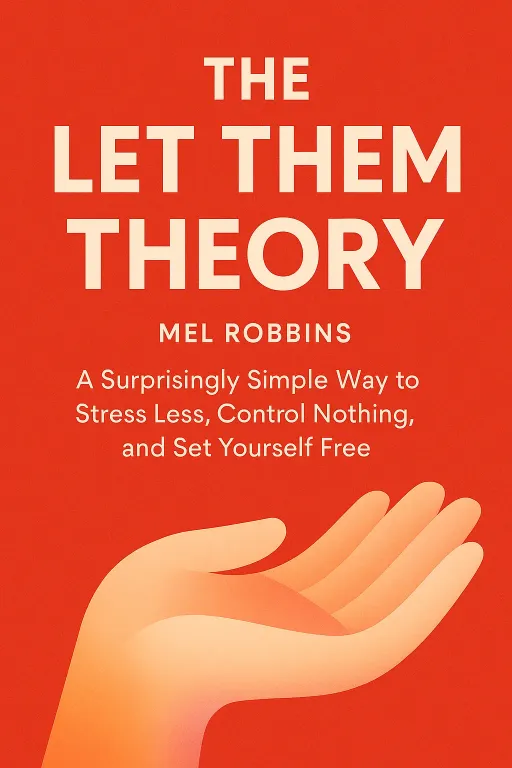
The Physics of Freedom: Deconstructing 'The Let Them Theory'
Golden Hook & Introduction
SECTION
Albert Einstein: Imagine for a moment, yt, that your daily mental energy is a full battery. How much of that charge, do you suppose, is spent trying to control things you simply can't? The opinions of others, the choices of a loved one, the mood of a colleague. What if there was a simple, two-part theory, almost like a law of emotional physics, to reclaim that lost energy?
yt: That's a fascinating thought experiment, Albert. The idea of our emotional energy as a finite resource is something we rarely quantify, but we feel its depletion viscerally. Framing it as a law of physics suggests there's a predictable, systematic way to manage it, which is incredibly appealing to an analytical mind.
Albert Einstein: Precisely! And that's exactly what we're exploring today through Mel Robbins' book, "The Let Them Theory." It proposes a surprisingly simple way to stress less and control nothing. Today we'll dive deep into this from two perspectives. First, we'll explore the liberating act of 'Letting Them'—what it means to stop controlling the uncontrollable.
yt: And then, the crucial second step.
Albert Einstein: Yes! Then we'll discuss the empowering act of 'Let Me,' which is all about taking back your power and responsibility. It’s a beautiful, balanced equation.
Deep Dive into Core Topic 1: The 'Let Them' Equation
SECTION
Albert Einstein: So, let's start with the first part of this equation, the 'Let Them.' It sounds deceptively simple, but its power lies in a very specific, almost comical, moment of realization Mel Robbins had. Picture this: It's the week of her son Oakley's high school prom. Unlike with her daughters, where prom was a massive, planned-out production, Oakley is nonchalant. Then, at the last minute, he decides to go.
yt: Ah, the introduction of chaos into a system. I can already feel the potential for wasted energy.
Albert Einstein: Exactly. The family scrambles. A tuxedo, specific sneakers, a date, pre-prom photos. Mel is stressed, reliving the anxieties of her daughters' proms. She feels this immense pressure to make everything perfect. The day of the prom arrives, and she's in the kitchen, a bundle of nerves. She’s made a corsage for Oakley's date, even though Oakley told her the date didn't want one.
yt: She's trying to impose her own variable—the corsage—onto a system that has already rejected it. This can't end well.
Albert Einstein: It gets better. They get to the pre-prom photo location, and Mel sees that Oakley's date a corsage from her own mother. But Mel, unable to let it go, presents her corsage anyway, creating this terribly awkward moment. Then, she discovers the group of kids has no dinner reservations. Her stress skyrockets. She starts frantically calling restaurants, trying to solve a problem that isn't hers to solve.
yt: She's caught in a classic feedback loop. Her anxiety is fueling her need to control, which is creating more awkwardness and stress, which in turn must be fueling even more anxiety.
Albert Einstein: A perfect description! And just as she's about to force them all into a minivan to go to a restaurant she found, her college-aged daughter, Kendall, steps in. She looks at her frantic mother and says, "Mom, if Oakley and his friends want to go to a taco bar for pre-prom, LET THEM."
yt: A command to break the loop.
Albert Einstein: It was a system interrupt! In that moment, Mel Robbins realized she was the source of her own stress. She was applying a force that was only creating resistance. She let them go to the taco bar, in the rain, and felt an incredible wave of relief. She stopped trying to control the uncontrollable.
yt: And in doing so, she didn't just gain peace. She reclaimed her own emotional state. She effectively decoupled her happiness from the outcome of her son's prom experience. From an analytical standpoint, it's a profound shift in where she places her locus of control—from the external, which is chaotic and unpredictable, to the internal, which is the only thing she truly commands.
Albert Einstein: Wonderfully put. She stopped trying to manage the weather and instead decided what coat she would wear. But that realization, that release, is only half the story.
Deep Dive into Core Topic 2: The 'Let Me' Corollary
SECTION
Albert Einstein: Exactly, a shift in the locus of control. And that brings us to the brilliant, and absolutely essential, second half of this theory. Because 'Let Them' on its own can lead to a feeling of powerlessness or isolation. That's where the 'Let Me' comes in. It's the action that follows the release.
yt: So if 'Let Them' is about ceasing a negative action—like trying to control—then 'Let Me' must be about initiating a positive one.
Albert Einstein: Precisely. Let me give you another of Mel's stories. She's at home, scrolling through social media, and sees photos of a group of her friends on a weekend getaway. A trip she wasn't invited to. The immediate reaction, as you can imagine, is a spiral.
yt: The fear of being excluded. It's a powerful, primal trigger. The analytical mind immediately starts searching for a cause, a reason. 'What did I do wrong?'
Albert Einstein: That's just what she did. She felt rejected, went into what she calls 'full stalker mode,' scrutinizing their posts, trying to figure out why. Her mind is racing, trying to 'fix' the situation, maybe by sending a text, by making her presence known. Her first instinct is to try and control their perception of her. But then she remembers the theory. First, she tells herself, "Let Them. Let them go on a trip without me. Let them not invite me."
yt: Okay, so that's Step 1. She's stopped the downward spiral of trying to manage their actions or feelings. But as you said, that alone could just leave her feeling sad and lonely on her couch.
Albert Einstein: This is where the magic happens. She moves to the second part of the equation. She says, "Let ME ask myself why this bothers me so much. Let ME be honest that I haven't really invested time in these friendships lately. Let ME take responsibility for my own social life and reach out to someone I want to connect with."
yt: Ah, I see. So 'Let Them' is the passive, observational step that creates space, and 'Let Me' is the active, introspective step that uses that space for productive action. It transforms the theory from a simple coping mechanism into a genuine tool for personal growth. Without 'Let Me,' you're just a bystander to your own life.
Albert Einstein: A bystander! I love that. It's the difference between watching the world happen you and participating it. The book warns that if you only 'Let Them,' you'll just feel lonely. The 'Let Me' is the antidote. It’s the part where you take back the controls of your own ship.
yt: It's an algorithm, really. A two-step process. Step 1: Observe an external event you can't control and apply the 'Let Them' principle to disengage your emotional energy from it. Step 2: Turn that energy inward, ask what you control, and then apply the 'Let Me' principle to take a specific, constructive action. It's an elegant and logical system for managing personal agency.
Albert Einstein: Elegant is the perfect word. It’s not about blaming others or yourself. It’s about recognizing the reality of a situation and then choosing your next move with intention.
Synthesis & Takeaways
SECTION
Albert Einstein: So, we have this beautiful, balanced system. 'Let Them' frees you from the unwinnable battle of controlling others, conserving that precious battery of mental energy. And 'Let Me' gives you the map for what to do with that newfound freedom and energy: focus it entirely on yourself and the life you want to build.
yt: It really is a powerful mental model. It forces you to delineate between your circle of influence and your circle of concern. So much of our stress comes from trying to operate in that outer circle of concern, where we have no real power. This theory is a practical guide for retreating back to our circle of influence, where we are sovereign.
Albert Einstein: And it makes you wonder, doesn't it?
yt: It does. As we think about our own lives, the question posed in the book becomes very personal. Where are you exhausted from trying to control someone else's choices? What futile feedback loops are you stuck in? And what incredible things could you accomplish if you just... 'Let Them,' and then, most importantly, gave yourself the full and unapologetic permission to 'Let Me'?
Albert Einstein: A profound question to ponder. And on that thought, our time today is up. Thank you, yt, for helping us deconstruct this fascinating theory.
yt: The pleasure was all mine, Albert. It's a framework worth thinking about.









