Let Them: A 20-Something's Guide to Reclaiming Your Power
Golden Hook & Introduction
SECTION
Albert Einstein: Picture this, Madison: You’re scrolling through Instagram on a Friday night, and suddenly, there it is. A photo of your friends, all out together, laughing, having the time of their lives… without you. That knot in your stomach, that spiral of questions—'Why wasn't I invited? Did I do something wrong?'
Madison : Ugh, that feeling is the worst. It's so specific and so universal, especially I think for my generation. Your mind just races, trying to find a reason, trying to fix something you don't even know is broken.
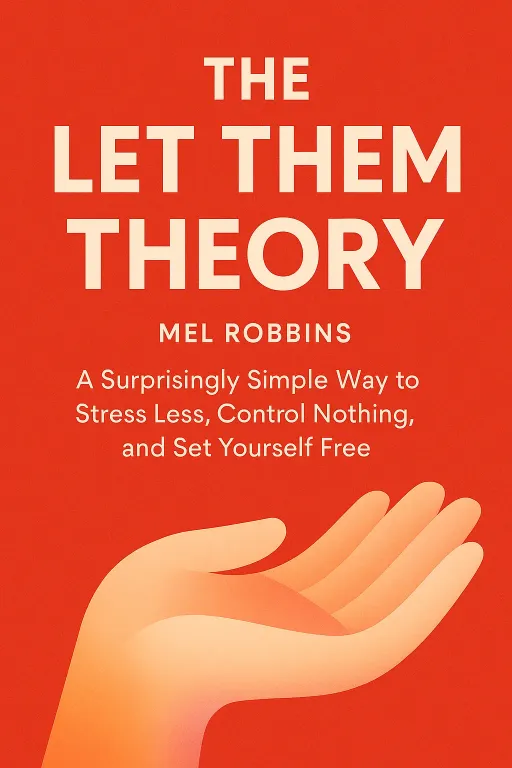
Albert Einstein: Exactly. It's a perfect storm of modern anxiety. But what if I told you the solution to that entire painful spiral is just two simple words? That's the power of Mel Robbins' 'Let Them Theory,' a concept so simple it feels like a cheat code for life.
Madison : Two words? That seems almost too simple for such a complex feeling. I'm intrigued.
Albert Einstein: It is simple, but as we know, the simplest ideas often contain the most profound truths. Today we'll dive deep into this from three perspectives. First, we'll explore the liberating moment of realizing you can just 'Let Them'. Then, we'll uncover the powerful second step: 'Let Me,' which is all about taking your power back. And finally, we'll apply this directly to the confusing world of modern dating.
Madison : Okay, I'm ready. A cheat code for managing emotions, relationships, and dating? That sounds like something everyone needs.
Deep Dive into Core Topic 1: The Freedom of 'Let Them'
SECTION
Albert Einstein: It all started, as many great discoveries do, with a moment of parental panic. Mel Robbins and her son's prom. The scene she paints is one of pure chaos. Her son, Oakley, decides to go to prom at the very last minute.
Madison : Oh no, I can feel the stress already.
Albert Einstein: Precisely. Mel goes into overdrive. She's scrambling to find a tuxedo, the right sneakers, a date. But the real flashpoint, the moment the theory is born, is over a corsage. Oakley tells her his date doesn't want one. But Mel, in her mind, has a script for how prom is to go. A girl have a corsage. So she makes one anyway.
Madison : She's trying to control the experience, to make it match her expectations.
Albert Einstein: Exactly! Then they get to the pre-prom photos, it's raining, and she finds out the group of 16 kids has no dinner reservations. Mel starts frantically calling restaurants, trying to solve this "problem." Her stress is through the roof. And in that moment, her college-aged daughter, Kendall, looks at her and says the magic words. She says the kids want to go to a taco bar, and Mel is horrified—they'll get their dresses wet! And Kendall just says, "Mom... if they want to go to a taco bar for pre-prom, LET THEM."
Madison : Wow. So the theory was born from a moment of being told to back off. It's fascinating because her stress wasn't really about her son's happiness, but her of what his happiness should look like. She was trying to control the narrative.
Albert Einstein: Precisely! She was trying to control the narrative, to force reality into the shape of her expectations. It's like trying to command the tides, Madison. You can stand on the shore and shout, but the moon and the ocean have their own plans. In that moment, she realized she was the source of her own stress. By letting them go to the taco bar, she wasn't failing; she was setting herself free.
Madison : And that's where self-confidence comes in, right? Believing your way is the only right way is often a sign of insecurity. 'Letting them' is an act of trust—trust in them to handle their own lives, and maybe more importantly, trust in to be okay with an outcome you didn't orchestrate.
Albert Einstein: That is the heart of it. You stop being the frantic director of everyone else's play and you realize you can just be a member of the audience. Or better yet, the star of your own. Imagine the energy saved!
Madison : It's not just saved energy, Albert, it's energy. You can now invest it in your own growth, your own goals, your own happiness. That's a game-changer.
Deep Dive into Core Topic 2: The Power Duo: 'Let Them' + 'Let Me'
SECTION
Albert Einstein: Exactly. And that trust in yourself, that reallocation of energy, is the second, and perhaps more powerful, part of the equation. It's not just 'Let Them.' It's 'Let Them, so I can Let Me.' This is where the theory moves from a defensive tool for managing stress to an offensive strategy for building your life.
Madison : I love that framing. It's not passive; it's proactive.
Albert Einstein: Let's go back to that social media scenario. In the book, Mel describes seeing photos of a girls' weekend away that she wasn't invited to. She feels that familiar sting of rejection, the spiral of 'what did I do wrong?' Her first instinct is to try and 'fix' it, to text someone, to figure it out. But instead, she applies the first part of the theory. She tells herself, "Let them go on a trip without me. Let them not invite me."
Madison : Okay, so that stops the immediate emotional spiral. It creates a bit of space. But you can still feel hurt and lonely.
Albert Einstein: Ah, but that's where the second part comes in. So she says 'Let Them go.' But then what?
Madison : That's the 'Let Me' part. 'Let Me ask myself why this bothers me so much.' 'Let Me be honest about my own behavior.' In the book, she has this moment of clarity where she realizes she hasn't actually been investing in those friendships. She's been busy, she hasn't reached out. So 'Let Me' becomes 'Let Me be a better friend.' 'Let Me initiate the next plan.' It turns the focus inward and makes the solution something she can control.
Albert Einstein: It transforms you from a victim of circumstance to the architect of your own social life. You stop waiting for the invitation and you start building the party. You're no longer at the mercy of what other people do; you are responsible for what do.
Madison : That's so empowering. It takes the sting out of rejection because it reframes it as information. The information isn't 'they don't like me.' The information is 'this friendship dynamic has changed.' And the question becomes, 'What do I want to do with that information?' 'Let Me' is the answer to that question.
Albert Einstein: Beautifully put. It's the difference between saying "Why me?" and "What now?". One is a prison, the other is a doorway.
Deep Dive into Core Topic 3: Decoding Modern Love
SECTION
Albert Einstein: And this idea of being the architect, not the waiter, is nowhere more critical, I think, than in the perplexing universe of modern dating.
Madison : Tell me about it. It feels like a full-time job as a detective sometimes. Trying to figure out what everything means.
Albert Einstein: Mel Robbins offers a beautifully simple law of physics for this. Chapter 18 puts it plainly: "If someone likes you, you’ll know. If they don’t, you’ll be confused." She argues that what we call "mixed signals" are, in fact, a very clear signal.
Madison : A clear signal of what?
Albert Einstein: A clear signal of 'no.' Or at least, 'not enough.' The confusion we feel is the gap between their minimal actions and our hopeful expectations. We're the ones creating the "mixed" part by trying to find a 'yes' in their 'maybe.'
Madison : This is so relevant. We spend so much time trying to 'decode' behavior—the hours between texts, the vagueness of their plans, the fact they watch all your stories but never ask you out. The 'Let Them' theory just cuts through all that noise. Let their —or lack of action—show you their true interest level. If they're not making a real, consistent effort...
Albert Einstein: ... Let them not be interested. Let them be busy. Let them be unsure. Let them be whatever they are, which is clearly not someone who is all-in on you.
Madison : And then, the crucial part: 'Let ME not waste my time.' 'Let ME not invest my emotional energy in someone who is giving me crumbs.' 'Let ME find someone whose actions are as clear as their words.' It's a powerful boundary-setting tool disguised as a letting-go tool.
Albert Einstein: It's the ultimate act of self-care in dating. You're essentially saying, "My time, my energy, and my peace of mind are more valuable than the possibility of this person maybe, someday, deciding they like me." You stop auditioning for a role in their life and start casting for the lead role in your own.
Madison : It's like an emotional and relational financial strategy. You stop investing in a stock that has shown zero growth and is full of volatility. Instead, you 'Let Me' invest in blue-chip stocks, or better yet, in myself. You take that energy and put it into your own habits, your own confidence, your own life. Which, ironically, makes you a much more attractive and interesting person to begin with.
Albert Einstein: The beautiful paradox of letting go! The less you try to control their interest, the more you control your own value.
Synthesis & Takeaways
SECTION
Albert Einstein: So, we have this beautiful, simple loop. A two-step dance for the mind. 'Let Them' be who they are, which frees your energy from the impossible task of controlling others.
Madison : And 'Let Me' use that newly freed energy to take responsibility for my own life—to build the habits, the friendships, and the love that I actually want. It's a fundamental shift from focusing on external control to building internal responsibility.
Albert Einstein: It's the difference between being a thermometer, which merely reflects the temperature of the room, and being a thermostat, which sets it. The 'Let Them Theory' is about deciding you're the thermostat of your own life.
Madison : I love that analogy. It's about creating your own weather.
Albert Einstein: So, Madison, and to everyone listening, here is a small experiment. A thought experiment. Think of one person or one situation you're trying to control right now. Maybe it's a friend you wish would be more supportive, a partner you wish would be tidier, or a career path you're trying to force. Just one thing.
Madison : Got one.
Albert Einstein: Now, what would it feel like, just for a moment, to drop the rope? To stop pulling, to stop pushing, to stop managing. To simply... let them?
Madison : It feels... quiet. A little scary, but mostly quiet. There's a space that opens up.
Albert Einstein: Exactly. And the final question is the most important one. In that quiet space, what will you let do with all that freedom?
Madison : That's where the magic begins.