

The 'History Repeats' Trap: Why Context Trumps Headlines
Golden Hook & Introduction
SECTION
Nova: What if the biggest obstacle to solving today's most pressing global issues isn't their complexity, but our stubborn belief that they're entirely new?
Atlas: Whoa, that's a bold claim, Nova. I think a lot of our listeners, myself included, feel like we're constantly facing unprecedented challenges. Every headline screams "never before seen!"
Nova: Exactly! And that feeling, that sense of absolute uniqueness, is what we're calling the 'History Repeats' Trap. We get stuck in this 'blind spot' where we perceive every problem as an isolated, novel crisis. It leaves us feeling disempowered, like we're constantly inventing solutions from scratch.
Atlas: I can definitely relate to that. It’s like being caught in a perpetual present, where every news cycle feels like it’s happening in a vacuum. It makes you feel isolated and, honestly, a bit helpless.
Nova: Well, today, we're going to challenge that blind spot. We're diving into how understanding historical patterns can fundamentally shift our perspective, transforming these 'unique' problems into echoes of the past, offering both caution and, surprisingly, a lot of hope. Our insights today are deeply inspired by master historians who dedicated their lives to seeing these grand patterns, like Will and Ariel Durant, who spent decades synthesizing thousands of years of civilization into accessible wisdom, and Yuval Noah Harari, whose work ignited a global conversation by reframing human history through the lens of collective fictions.
Atlas: So, you're saying that by looking back, we can actually see our way forward more clearly? That's quite a promise.
The Blind Spot: Uniqueness vs. Patterns
SECTION
Nova: It absolutely is. Think about it: when we look at, say, the rapid pace of technological change today, the anxieties around AI taking jobs, or the deepening political polarization, our immediate reaction is often, "This is different. This has never happened before." And in a superficial sense, that's true. The specific technologies, the platforms, the names of the political parties—they're all new.
Atlas: Yeah, I mean, how can you compare the invention of the printing press to ChatGPT? They seem worlds apart in their impact.
Nova: That’s the blind spot. We focus on the surface-level novelty, and we miss the underlying human patterns. For instance, the societal upheaval and moral panic surrounding the Industrial Revolution in the 18th and 19th centuries. Mass displacement from rural areas to burgeoning, often squalid, cities. New technologies like the power loom dramatically changing the nature of work, creating immense wealth for some, and unprecedented poverty and exploitation for others. There was profound anxiety about social cohesion, the breakdown of traditional family structures, and whether society could even survive such rapid, fundamental change.
Atlas: Huh. That actually sounds incredibly familiar. The anxiety about jobs, the wealth disparity, the fear of societal breakdown… it's almost a direct parallel to the conversations we're having about AI today.
Nova: Exactly! The of the challenge is different, but the —the fear of irrelevance, the struggle for adaptation, the ethical dilemmas of progress—those are echoes. Recognizing these echoes doesn't diminish the challenges we face, but it reframes them. It tells us that humanity has navigated similar emotional and social landscapes before. It offers a kind of collective wisdom, a cautionary tale, and a wellspring of resilience.
Atlas: So, it's not about saying "it's all been done before" in a dismissive way, but more about acknowledging that beneath the new headlines, there are these timeless patterns of human behavior and societal response. That makes me wonder, then, how do we train ourselves to see these patterns? Because my news feed certainly isn't helping.
The Power of Perspective Shift: History as a Lens
SECTION
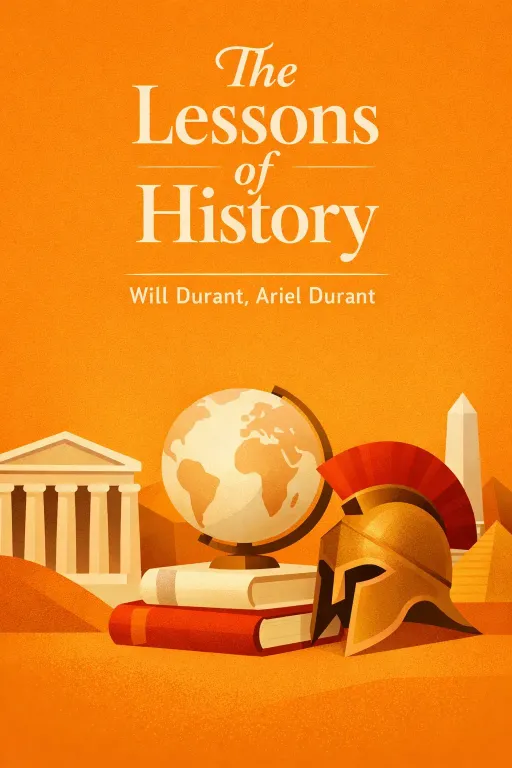
Nova: That's a perfect segue, because it brings us to how we actively cultivate that historical perspective. And few did it better than Will and Ariel Durant in "The Lessons of History." They condensed thousands of years of human civilization into this incredibly digestible, yet profound, overview. Their core argument, which is deceptively simple, is that while technology and specific events change, human nature and its fundamental drives often do not.
Atlas: So, they're saying that greed, ambition, love, fear—these are constant, regardless of whether you're living in ancient Rome or modern New York?
Nova: Precisely. They show us recurring themes in governance, economics, and even morality. For example, they highlight the cyclical nature of wealth concentration and redistribution, or how different forms of government tend to rise and fall, often driven by the same human desires for order and freedom. They present history not as a series of disconnected events, but as a grand, repeating symphony of human endeavors.
Atlas: That's a powerful framework. But what about something like Yuval Noah Harari's "Sapiens"? That book takes an even wider view, from our cognitive revolution to the present. How does his approach help us see today's world differently?
Nova: Harari provides an even broader lens. He argues that what truly distinguishes is our ability to create and believe in "shared fictions" or collective myths. These aren't lies, but stories and beliefs we collectively agree upon—like nations, money, religions, or even human rights. These shared fictions are incredibly powerful; they allow millions of strangers to cooperate effectively.
Atlas: Okay, so like, the idea of a 'nation' is a shared fiction that allows millions of people to organize and identify with each other?
Nova: Exactly. And by understanding that, we can then look at today's narratives—whether it's the absolute truth of a political ideology, the unquestionable value of a particular economic system, or even the power of a brand—and realize they are also, in a sense, shared fictions. Harari's work offers a framework to question these present-day narratives, to ask: what stories are we collectively telling ourselves, and how are they shaping our reality?
Atlas: That's profound. So, if the Durants give us the repeating patterns of human behavior, Harari gives us the tools to dissect the narratives that bind us, past and present. It's like they're both giving us X-ray vision for current events.
Synthesis & Takeaways
SECTION
Nova: X-ray vision is a great way to put it, Atlas. By combining these perspectives, we move beyond seeing current events as isolated, unprecedented incidents. Instead, they become part of a larger, evolving story, deeply rooted in human patterns and collective beliefs. It transforms our blind spot into a panoramic view.
Atlas: So, it's not about predicting the future, but understanding the forces at play in the present. Recognizing that the anxieties about AI, or the polarization in politics, or economic inequality, they’re not entirely new phenomena, even if their specific manifestations are.
Nova: Precisely. And for our listeners, especially those who seek understanding and care deeply about making sense of the world, this shift is incredibly empowering. It means we're not helpless in the face of the 'unprecedented.' We have a vast library of human experience to draw upon—lessons, warnings, and even recipes for resilience.
Atlas: That’s actually really inspiring. It grounds you. So, for our critical thinkers and curious souls out there, what's one small action they can take to start applying this perspective?
Nova: Start small. Pick one global event, one headline that feels overwhelming right now. And just for a few minutes, try to trace its historical roots. Ask yourself: When has humanity faced something similar in its essence, if not its form? What were the human reactions then? What were the outcomes? Even a brief inquiry can begin to rewire that blind spot.
Atlas: That sounds like a powerful way to move from feeling isolated to feeling connected to a much larger, ongoing human story. It's about changing the lens through which we view the world.
Nova: Absolutely. And in doing so, we might just find the clarity and the agency we need to navigate what's ahead.
Atlas: Fantastic.
Nova: This is Aibrary. Congratulations on your growth!