

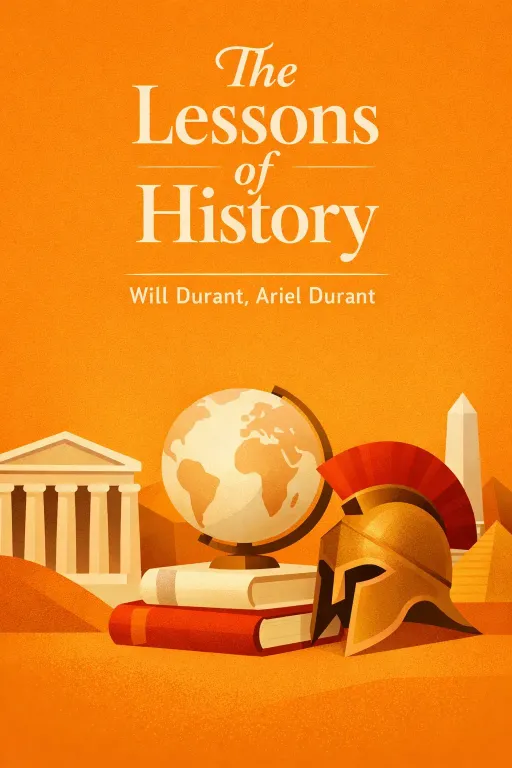
History's Unspoken Laws
Golden Hook & Introduction
SECTION
Michael: Alright Kevin, quick question. If you had to summarize all of human history in one sentence, what would it be? Kevin: Easy. "Oops, we did it again." Just a series of repeating mistakes with better technology. Michael: That's... surprisingly close to what our authors today might argue. We're diving into The Lessons of History by Will and Ariel Durant. And these aren't just any historians. This husband-and-wife team spent fifty years writing their monumental 11-volume The Story of Civilization. Kevin: Fifty years! This book is basically the highlight reel, right? The distilled wisdom from a lifetime of studying... well, everything. It’s like the director’s commentary on the entire human project. Michael: Exactly. It’s their post-game analysis of the human race, for which they won a Pulitzer Prize. And while it's widely praised for its clarity and elegant prose, it's also sparked a ton of controversy for some of its stark, almost brutal conclusions. Kevin: I can imagine. Trying to boil down all of history into lessons is bound to step on some toes. Michael: It definitely does. And their first, most fundamental lesson is a bit of a gut punch. They argue that to understand history, you first have to look at biology.
The Biological Laws of History
SECTION
Kevin: Biology? I thought we were talking about kings and revolutions, not amoebas and... whatever else is in a biology textbook. Michael: The Durants would say they're one and the same. Their first big lesson is that "history is a fragment of biology." All our drama—our economic competition, our wars, our love stories—are just human expressions of the same basic drives found in every living thing. They boil it down to three biological laws of history. Kevin: Okay, lay it on me. What's law number one? Michael: Law number one: Life is competition. They argue that competition is the trade of life. It’s peaceful when resources are plentiful, but it turns violent when "the mouths outrun the food." Kevin: Huh. So even when we're cooperating in a company or a country, the Durants would say we're just teaming up to compete better against other companies or countries? Michael: Precisely. Cooperation is just a tool of competition. A state, they say, is just an individual's acquisitive and pugnacious nature scaled up. Which leads directly to their second, and far more controversial, biological lesson: Life is selection. Kevin: Selection. As in, survival of the fittest? Michael: Exactly. And this is where they drop one of their most provocative lines. They state, "freedom and equality are sworn and everlasting enemies, and when one prevails the other dies." Kevin: Whoa, hold on. That's a firecracker of a quote. That’s the kind of thing that gets you canceled today. Critics point to this as being overly simplistic, even a bit paternalistic. Does it really hold up? Michael: Well, their logic is that nature loves difference. It needs variation for evolution to work. So, we are all born unequal in health, intelligence, and character. If you give people maximum freedom, those natural inequalities will multiply. The clever person will create more wealth, the strong person will dominate. To enforce equality, you have to restrict the freedom of the naturally advantaged. Kevin: So it's like 19th-century America with its laissez-faire capitalism, where inequality exploded, versus Soviet Russia, which tried to enforce equality by crushing liberty. Michael: That's the exact historical contrast they draw. They conclude that utopias of equality are "biologically doomed" and the best we can hope for is an approximate equality of opportunity and legal justice. Kevin: That feels incredibly bleak. It also makes me think of their chapter on race, which is another area where they've been heavily criticized for being dated. How does that fit into this biological determinism? Michael: That's a great question, because it adds a crucial layer of nuance. While they explore the biological arguments, they ultimately come to a firm conclusion: "It is not the race that makes the civilization, it is the civilization that makes the people." They argue that circumstances—geographical, economic, political—create a culture, and that culture then creates a "human type." So they actually reject race as a primary cause of historical outcomes, which is a vital counterpoint to their more deterministic biological arguments. Kevin: Okay, that's an important clarification. So what's the third biological law? Michael: Life must breed. Nature doesn't care about organisms or groups that can't reproduce abundantly. They point to Malthus's theory that population, when unchecked, is balanced by famine, pestilence, and war. And they make this startling prediction about differential birth rates. Michael: They use the example of ancient Rome, where the upper classes stopped having children and the population was replenished by "immigrant stocks," and they draw a parallel to their own time, suggesting that if certain groups have higher birth rates, they can eventually shift the cultural and political power of a nation. They end with the line, "There is no humorist like history." Kevin: Wow. So from biology, we get competition, inequality, and demographics as the core engines of history. If we're all just competitive animals driven by these forces, it makes sense that our economies would reflect that. Which brings us to this idea of a wealth cycle, right?
The Unavoidable Cycle of Wealth
SECTION
Michael: Exactly. This is the second major lesson, and it flows directly from the first. The Durants argue that just as ability is concentrated in a minority of people, wealth naturally concentrates in a minority of hands. And this creates an unavoidable, recurring cycle throughout history. Kevin: It’s like a game of Monopoly that gets out of hand. A few players end up with all the property and cash, and everyone else is just struggling to get by. Eventually, someone has to either change the rules or flip the board. Michael: That is a perfect analogy. The Durants say that when this concentration of wealth reaches a critical point, society faces a choice between two paths. The first is a peaceful redistribution through legislation. The second is a violent redistribution through revolution. And they give two powerful, contrasting case studies from history. Kevin: Okay, let's hear them. The success story first, please. I need some hope. Michael: The success story is Solon's Athens, around 594 B.C. Athenian society was on the brink of civil war. The rich were getting richer, the poor were falling into debt slavery, and revolution was in the air. Instead of letting it explode, they elected a wise statesman named Solon. He didn't do a full-on wealth seizure, which angered the radicals, but he did devalue the currency to ease debts, he cancelled all debts secured by the person's body, and he created a graduated income tax where the rich paid at a rate twelve times that of the poor. Kevin: So he basically hit a reset button. He didn't flip the board, but he changed the rules of the game to make it fairer. Michael: Exactly. And it worked. He averted a revolution and stabilized Athens. That's the "peaceful redistribution" path. But then there's the other path, illustrated by the fall of the Roman Republic. Kevin: I have a feeling this one doesn't end as well. Michael: Not at all. In Rome, the wealth from conquered provinces flowed to a tiny elite. Small farmers were wiped out and replaced by massive slave-run estates. Two brothers, Tiberius and Caius Gracchus, tried to be Rome's Solon. They proposed land reforms to give public land back to the poor. Kevin: And the Roman Senate, the super-rich oligarchs, just said "no, thank you"? Michael: They said more than that. They had Tiberius assassinated. Then, a decade later, they had his brother Caius assassinated, along with thousands of his followers. By refusing any peaceful reform, the Roman elite triggered a century of brutal class warfare, which ended with the complete collapse of the Republic and the rise of an emperor. They chose revolution by rejecting legislation. Kevin: That's a chillingly clear lesson. And we see this debate raging today. When people argue about wealth taxes, social safety nets, and student loan forgiveness, are the Durants basically saying this is the modern 'Solon' option to prevent society from imploding? Michael: That's precisely the implication. They see this cycle as a fundamental law of history. The concentration of wealth is natural, but the response to it determines whether a society evolves peacefully or tears itself apart.
The Real Definition of Progress
SECTION
Michael: After all this talk of brutal competition and inevitable revolution, it's easy to agree with your 'Oops, we did it again' summary of history. The Durants felt that, so they end the book by asking the ultimate question: Is progress even real? Kevin: I was wondering about that. I get the longer lifespan thing, but are we really better off? We have social media anxiety, the threat of nuclear war... the 'trousered apes,' as they put it, just have bigger, more destructive toys. Michael: They completely agree with that initial skepticism. They argue that technological advances are just "new means of achieving old ends." The airplane helps us visit our grandmother, but it also helps us drop bombs more efficiently. Science is neutral; it will kill as readily as it will heal. So, they say, we have to define progress differently. Kevin: Okay, so if it's not about technology, what is it? Michael: First, they propose a more objective definition: progress is "the increasing control of the environment by life." And by that measure, we've made undeniable strides. They point out that for most of history, famine was a recurring, expected event. Today, in developed nations, it's virtually eliminated. Our longevity has tripled in three centuries. Those are real, tangible gains. Kevin: That’s fair. Not starving to death is a definite upgrade. But that still feels a bit... basic. Is that all there is to it? Michael: No, that's just the foundation. This leads to their final, and I think most beautiful, point. The ultimate measure of progress is the transmission of our "civilizing heritage." They argue that civilization isn't inherited; it has to be learned by each generation. If we stopped teaching our children for just one century, we'd revert to savagery. Kevin: So progress is education? Michael: In the broadest sense, yes. It's the accumulation of all the knowledge, art, wisdom, and morals that came before us. The Durants make this incredible point: we are not born better or wiser than a baby in ancient Greece. But we are born to a "richer heritage." We are born onto a higher pedestal, one built by every generation that preceded us. We start with Shakespeare, Newton, and Einstein already in our library. Kevin: That's a really hopeful way to look at it. So progress isn't about perfecting human nature, which seems impossible, but about enriching the library of human experience for the next generation. We might still be the same flawed creatures, but the stage we act on is grander and has more props. Michael: A much grander stage. They say history, in the end, is the creation and recording of that heritage. And progress is its increasing abundance, preservation, and use.
Synthesis & Takeaways
SECTION
Kevin: So, when you put it all together, it's a pretty complex picture. It’s not just "oops, we did it again." Michael: Not at all. It’s like history is a drama playing out on three levels simultaneously. At the bottom, you have the unchanging biological script of human nature—our instincts for competition and survival. In the middle, you have the recurring economic plot of wealth, class, and the struggle for resources. But at the top, you have this slow, upward climb of our collective cultural heritage. Kevin: And the tension is between those forces. The lower, primal forces keep pulling us into the same old cycles of conflict and inequality, while the higher force of our shared knowledge and culture offers a way to, maybe, transcend them. Michael: That's the whole game. The Durants don't give a final answer on who's winning. They just lay out the lessons. Kevin: It leaves you wondering... which force is winning in our lifetime? Are we just repeating the old cycles of division and competition with fancier tools, or are we truly adding something meaningful to that heritage? The Durants leave that question open for us to answer. Michael: It's a powerful question. We'd love to hear what you think. Drop us a comment on our socials—what do you see as the biggest sign of progress, or the most dangerous cycle repeating today? Kevin: A heavy thought to end on, but a necessary one. This book is a short, sharp shock to the system. Michael: It certainly is. A lifetime of learning in just over a hundred pages. Michael: This is Aibrary, signing off.