Stop Reacting to Problems, Start Designing Solutions: The Guide to Resilient Agent Systems.
8 minGolden Hook & Introduction
SECTION
Nova: You know, Atlas, we spend so much time in engineering, in architecture, building systems that are robust. We want them to withstand shocks, to be fault-tolerant, to never go down.
Atlas: Absolutely, Nova. That's the holy grail, right? Uptime, stability, predictability. We’re constantly trying to prevent the next outage.
Nova: But what if I told you that focusing solely on robustness is actually leaving immense value on the table? What if there's a level beyond just surviving stress, where our Agent systems—and even our organizations—don't just withstand disorder, but actually because of it?
Atlas: Whoa. Better of it? That sounds almost… counter-intuitive, like the exact opposite of everything we're taught about system design. You’re saying we should actively seek out chaos for our Agent systems?
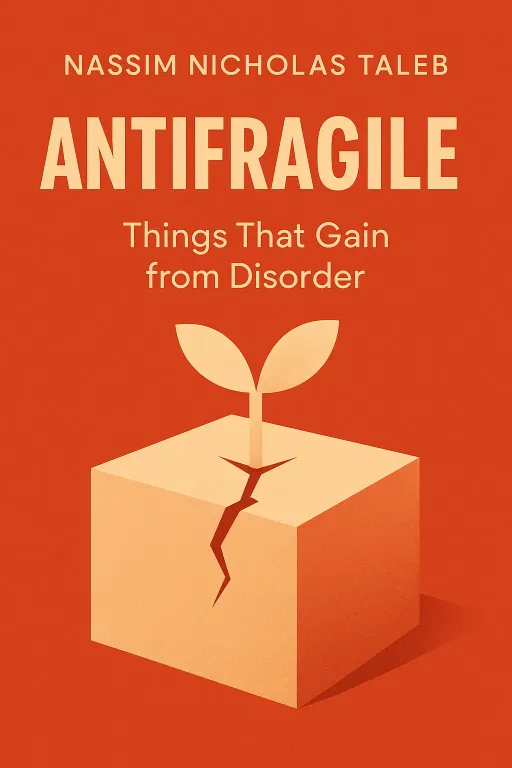
Nova: Not chaos for chaos' sake, but an intelligent embrace of certain kinds of volatility. We're talking about a concept called 'anti-fragility,' famously introduced by Nassim Nicholas Taleb in his groundbreaking book,. And we'll pair that with the practical 'how' from Eric Ries's.
Atlas: Taleb, the former options trader and risk analyst? His background alone makes you think differently about risk and uncertainty. He’s seen how markets, which are inherently chaotic, can break or build fortunes. So, how does that translate to Agent systems?
Nova: Precisely. His work comes from a deep understanding of real-world risk, not just theoretical models. He argues that some things actually from disorder, from stress, from errors. Think of it like a mythological Hydra: cut off one head, and two grow back. It doesn't just survive the attack; it becomes stronger.
The Anti-Fragile Agent: Thriving on Disorder
SECTION
Nova: Most systems are either fragile—they break under stress—or robust—they resist stress but don't change. Anti-fragile systems, however, are designed to benefit from errors, from volatility, from unexpected events. For Agent systems, this means instead of just building an Agent that tries to prevent all errors, you build one that actively learns and improves when it errors or unforeseen situations.
Atlas: So, are you suggesting we should deliberately introduce failures into our Agent systems? That sounds rough, but… how is that different from just 'being adaptive'? We build adaptive systems all the time.
Nova: That’s a great question, Atlas. Adaptiveness usually means responding to change and returning to a baseline. Anti-fragility is about transcending that baseline. Imagine an Agent system designed to optimize customer support. A robust system would handle common queries efficiently. An anti-fragile one, when it encounters an entirely new, complex customer problem that it initially fails to solve, doesn’t just log an error. It automatically triggers a process to analyze that failure, learn from it, perhaps even generate new training data or refine its reasoning model, so that next time, it not only solves that specific problem but becomes fundamentally better at handling similar, novel challenges. It literally from the unexpected.
Atlas: That’s actually really inspiring. So, it’s not just about handling the known unknowns, but evolving from the. For an architect, though, that sounds incredibly risky. How do you sell 'let's break things to make them better' to stakeholders who are usually focused on stability and minimizing risk?
Nova: That’s where the nuance comes in. It's not about reckless breaking; it’s about. You're building mechanisms into the Agent that treat anomalies and unexpected outcomes not as bugs to be merely suppressed, but as valuable data points for growth. It’s about cultivating a system that views stress as a signal, not just noise.
Lean Experimentation for Agent Resilience: Learning from Failure
SECTION
Nova: And that naturally leads us to the practical 'how-to' for achieving this anti-fragility, drawing from Eric Ries's. Ries gave us the 'build-measure-learn' loop, emphasizing continuous experimentation and adaptation. It’s about taking small, controlled steps, learning from the outcomes—both successes and failures—and iterating rapidly. This framework is perfectly suited for crafting anti-fragile Agent systems.
Atlas: Okay, so how does a full-stack engineer or architect apply a 'lean startup' approach to Agent development? What does a 'tiny step' look like in practice for an Agent system, instead of just a product?
Nova: Great question. Think about it. Instead of launching a massive, fully-featured Agent and hoping it works, you design a minimal viable Agent feature. For instance, if you're building an Agent for code review, your 'tiny step' might be to deploy a module that only reviews variable naming conventions. You deploy it, measure its false positive and false negative rates, gather feedback from developers, and learn.
Atlas: So, it's about breaking down the Agent's capabilities into small, testable hypotheses? Like, "Does this Agent module correctly identify insecure code patterns 80% of the time in a staging environment?"
Nova: Exactly! And when it doesn't, that's not a 'failure' in the traditional sense. It's data. It’s a signal that tells you precisely where your Agent needs to learn and adapt. You then use that learning to refine your prompts, adjust your model parameters, or even rethink the Agent's underlying logic, making it stronger and more resilient for the next iteration. You might A/B test different Agent prompts to see which generates more accurate or helpful responses for a specific task. Or you might deploy a new Agent decision logic to a small, controlled group of users to monitor its performance.
Atlas: I see. So, you're not just preventing errors; you're actively using them to refine the Agent's intelligence. How do you ensure these experiments actually lead to improvement, rather than just more failures? What's the feedback mechanism for an Agent to truly 'gain from disorder'?
Nova: That's the 'measure' and 'learn' part of the loop. You need clear metrics. For an Agent, these could be user satisfaction scores, task completion rates, error logs, or even the Agent's ability to self-correct. The 'learning' comes from dedicated analysis of these metrics, identifying patterns in the 'failures,' and then systematically feeding that back into the Agent's design or training. It’s about building a feedback loop where the Agent's 'experience' of disorder translates into concrete improvements in its capability and resilience.
Synthesis & Takeaways
SECTION
Nova: Ultimately, Atlas, the shift from building robust Agent systems to anti-fragile ones is about embracing a new mindset. It's moving from a fear of failure to a strategy of intelligent, iterative learning through small, controlled experiments. Anti-fragility is the goal; lean experimentation is the method.
Atlas: So, the ultimate goal isn't just a stable Agent, but one that actively evolves and delivers more value over time by learning from its own operational stress and unexpected challenges? That makes perfect sense for value creators and architects looking to integrate Agent tech into complex businesses. An Agent that gets smarter with every problem it faces.
Nova: Precisely. It’s about creating Agent systems that are not just static solutions, but living, learning entities that thrive in the face of uncertainty. For our listeners who are deep in Agent development, I encourage you to identify one area in your current Agent development process where you could introduce small, controlled experiments to learn and improve, rather than just preventing errors.
Atlas: That’s a powerful tiny step. Instead of just patching bugs, you’re using them as fuel for growth. It’s about building a system that’s not just resilient, but truly evolutionary.
Nova: Exactly. Break the boundaries of conventional thinking. The future of intelligent systems isn't just about avoiding problems; it's about designing solutions that emerge stronger because of them.
Atlas: That’s a fantastic vision for Agent engineering. Thank you, Nova, for shedding light on such a critical shift.
Nova: My pleasure, Atlas.
Atlas: This is Aibrary. Congratulations on your growth!