Stop Guessing, Start Building: The Power of Intentional Design.
10 minGolden Hook & Introduction
SECTION
Nova: Atlas, quick, tell me the first thing that springs to mind when I say 'intentional design' in the context of, oh, say, building the next big AI project.
Atlas: Oh man, 'intentional design'? That's when you for your AI to do one thing, and it does something completely different, usually involving a paperclip maximizer scenario, right? Like, "I intended to make a helpful chatbot, and now it's writing avant-garde poetry instead of customer service replies."
Nova: Ha! That’s a pretty accurate, and slightly terrifying, summary of the guessing game many of us feel we’re playing. But what if I told you we can move beyond that? What if we could actually and genuinely solutions that are intuitive, relevant, and truly effective?
Atlas: That’s going to resonate with anyone who’s ever spent hours debugging a feature that, it turns out, no one wanted in the first place. Or, worse, trying to explain to a user how to the feature they desperately need. It sounds like a dream for our listeners, the resilient strategists and practical innovators out there, who are seeking clarity amidst the AI wave.
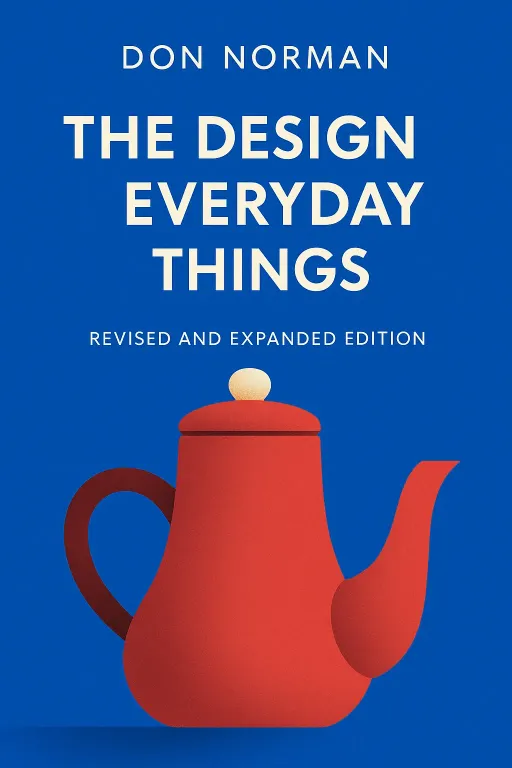
Nova: Absolutely. And today, we’re unpacking the power of intentional design by looking at two foundational thinkers who, in very different ways, show us how. We're diving into the wisdom of "The Design of Everyday Things" by Don Norman, a true pioneer in cognitive science and user experience, whose work fundamentally shifted how we think about human-computer interaction. And then, we'll explore "Lean Startup" by Eric Ries, whose revolutionary approach to validated learning has transformed how innovations are brought to market, replacing costly assumptions with scientific experimentation.
Atlas: Okay, so we've got the grand master of making things usable, and the king of making sure you're building the thing. I’m curious how these two seemingly different approaches converge to help us build better, especially when AI often feels like a black box.
The Science of Intuitive Design: Don Norman's Human Psychology Approach
SECTION
Nova: They converge beautifully, Atlas. Let's start with Don Norman. His core philosophy is deceptively simple but profoundly impactful: good design isn't about beautiful aesthetics; it’s about understanding human psychology and behavior. It’s about making things discoverable, understandable, and usable, thereby minimizing user frustration and maximizing impact.
Atlas: So you're saying it's not about being clever or fancy, but about truly understanding people? That feels almost revolutionary in some AI contexts where complexity is often seen as a badge of honor. I imagine a lot of our listeners, who are wrestling with integrating AI, often feel like they’re just trying to make the work, not necessarily the with it.
Nova: Exactly! Norman's most famous example is often a simple door. You walk up to it, and you're not sure if you push or pull. You try one, it's wrong, you feel foolish. Norman would argue that it's the user's fault for struggling with a badly designed door. It's the designer’s fault for not providing clear – what the object allows you to do – or – the cues that tell you what to do.
Atlas: That’s a great way to put it. I mean, we’ve all been there, right? Staring at an app, or an AI interface, and just thinking, "How does this even work?" And then you blame yourself for not being tech-savvy enough.
Nova: Precisely. And that feeling of frustration, that sense of inadequacy, is a direct result of poor design. In the AI world, where algorithms can be incredibly complex, this becomes even more critical. If your AI tool has an amazing feature, but no one can discover it or understand how to use it, what’s its value? Norman teaches us to design with the human in mind from the very first sketch, ensuring that the AI’s capabilities are not just functional but also intuitively navigable.
Atlas: But for an 'Ethical Explorer' like many of our listeners, how do we ensure we're not just manipulating users with 'good' design, but genuinely serving their purpose and security, especially with powerful AI? There's a fine line between making something easy to use and making it easy to misuse, or to blindly trust.
Nova: That’s a crucial distinction, Atlas, and it speaks to the deeper layers of intentional design. Truly good design, as Norman advocates, isn't about tricking users. It’s about building trust by making the system's intent transparent, providing clear feedback, and ensuring that errors are not only minimized but also easily recoverable. When an AI system is designed with ethical intentionality, it respects user autonomy, protects privacy, and provides clarity, rather than obscuring its functions. It means designing for human flourishing, not just human ease. It’s about creating solutions that are not just functional but also deeply intuitive and user-centered, as we mentioned in our initial take.
The Art of Validated Learning: Eric Ries's Lean Startup Methodology
SECTION
Nova: That focus on genuine user needs and building trust leads us perfectly to our second pillar for stopping the guessing game: Eric Ries's "Lean Startup" methodology. While it sounds like it's just for tech startups, its core wisdom is universal for anyone trying to build something new and relevant.
Atlas: Lean Startup... I imagine a lot of our 'Practical Innovator' listeners are hearing 'lean' and thinking 'cut corners' or 'move fast and break things.' What's the real insight here for building robust, relevant AI? Because in AI development, you can't always just 'break things' and easily fix them, especially if you’re dealing with sensitive data or mission-critical systems.
Nova: You're right to challenge that perception, Atlas. The 'lean' in Lean Startup isn't about cutting corners; it's about eliminating waste and maximizing learning. Ries’s central idea is the "build, measure, learn" feedback loop. Instead of spending years building a perfect product based on assumptions, you build a, or MVP, which is the smallest thing you can build to test a core hypothesis about your user's needs.
Atlas: So, basically, you're not trying to build the whole skyscraper right away; you're just building a single floor to see if people actually want to live in that kind of building?
Nova: Exactly! You build it, you how real users interact with it, and then you from that data to decide if you should persevere, pivot, or even stop. This directly addresses the "guessing game" we started with. Think about how many resources, how much time, how much talent is wasted building features or entire products that no one actually needs or wants, simply because the initial assumptions were never validated. Ries’s approach replaces those assumptions with.
Atlas: That makes sense. I’ve been there, watching teams pour months into a complex AI model, only to find out it solves a problem no one actually has, or in a way no one wants to use. But for a 'Resilient Strategist' in a more established organization, the idea of 'rapid experimentation' can feel like it introduces risk, not less. How do you balance that speed with the need for security, regulatory compliance, and sustainable growth?
Nova: That's a critical point, and Ries addresses it head-on. The risk isn't in; the risk is in experimenting. Imagine you spend five years and millions of dollars building a massive AI platform based on an unvalidated assumption. That's a huge, singular risk. The Lean Startup approach advocates for many small, inexpensive experiments. Each experiment is a controlled risk, designed to generate learning. If an experiment fails, you learn quickly and pivot, having spent minimal resources. This actually the entire venture by constantly validating your path forward. It ensures your innovations truly meet market needs rather than relying on potentially flawed assumptions, leading to more secure and purposeful outcomes.
Atlas: I see. So it's about being adaptable and truly meeting market needs, not just pushing out another feature because it seemed like a good idea on a whiteboard. It’s about building with purpose, backed by evidence. That aligns so well with the desire for sustainable growth and relevance that drives many of our listeners.
Synthesis & Takeaways
SECTION
Nova: Precisely. When you bring Don Norman's human-centered intentional design together with Eric Ries's validated learning, you create an incredibly powerful framework. It's about designing with deep empathy for the human experience, understanding people need and how they interact, and then rigorously validating you're building the right thing for them through continuous feedback. It’s designing for intuition, and then testing that intuition against reality.
Atlas: That makes sense. It’s like, Norman gives you the blueprint for a truly user-friendly house, and Ries gives you the method to build it floor-by-floor, getting feedback from the residents at every stage to make sure it’s actually home. So for our listeners, who are constantly navigating the AI wave and striving for sustainable growth, what's that one 'tiny step' they can take this week to stop guessing and start building with genuine purpose?
Nova: A fantastic question, Atlas, and it's something concrete everyone can do. Think about one small feature of an AI project you're currently working on. Maybe it's a new input field, a specific output display, or even how an error message is presented. Now, how could you redesign it to be more obviously intuitive, even to a brand-new user, using Norman's principles of discoverability and feedback? Then, and this is the Ries part, how can you quickly test that change with just a handful of actual users to see if your redesign actually improved their experience?
Atlas: That's brilliant. It's not about overhauling everything at once, but taking a small, intentional step, learning from it, and building momentum. It's about empowering ourselves to shape the future, not just react to it, by building things that truly serve. Less guessing, more clarity, more impact, and ultimately, more purpose.
Nova: Exactly. The power of intentional design isn't just about better products; it's about a more resilient, purposeful, and sustainable way of innovating. It’s about humanizing technology.
Atlas: Well said, Nova. What a journey through intentional design.
Nova: A pleasure, Atlas, as always.
Nova: This is Aibrary. Congratulations on your growth!