Stop Chasing Trends, Start Building Antifragility: The Guide to Enduring Innovation
11 minGolden Hook & Introduction
SECTION
Nova: Atlas, I'm going to throw out a word, and you hit me with the first thing that comes to mind, no filter. Ready? "Stress."
Atlas: Ugh. Headaches, deadlines, my phone battery at 5%.
Nova: Okay, now "Failure."
Atlas: Mistakes, learning curve, that one time I tried to bake bread and it looked like a brick.
Nova: Exactly! Those are all things we instinctively try to avoid, right? We build systems, processes, even entire lives, to minimize stress and failure. But what if that very avoidance is making us weaker?
Atlas: Wait, are you saying avoiding stress makes us? That sounds… counter-intuitive, to say the least. My entire strategic plan is basically a stress-avoidance roadmap!
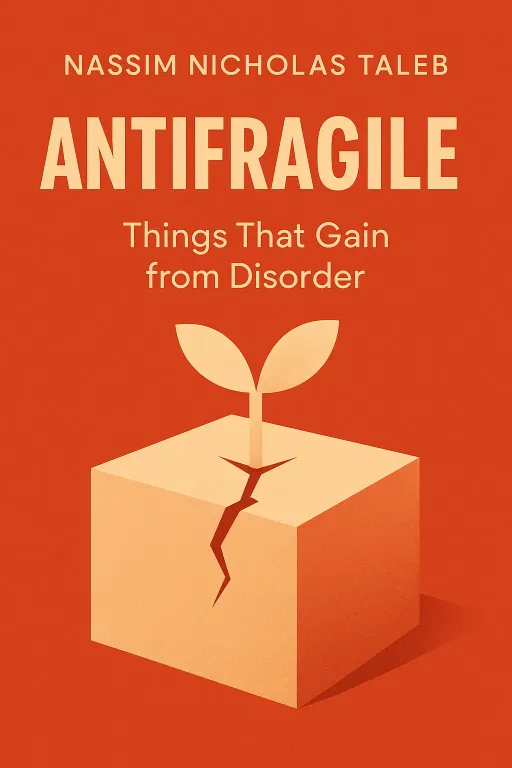
Nova: It sounds wild, I know. But it's the core idea of one of the most paradigm-shifting books I’ve ever read: "Antifragile: Things That Gain from Disorder" by Nassim Nicholas Taleb.
Atlas: Oh, I've heard the term "antifragile" thrown around, but I've always struggled to grasp its full implication. What's Taleb's angle?
Nova: Taleb is fascinating. He's a former options trader and risk analyst, which means he spent his career in the belly of the beast, navigating extreme unpredictability and massive market shocks. He's not just theorizing; he's seen firsthand what breaks and what thrives in chaos. His insights are exceptionally grounded yet revolutionary, challenging our fundamental understanding of strength.
Atlas: So, he’s seen the real-world consequences of things falling apart. That’s a serious pedigree for someone talking about thriving in disorder.
Nova: Absolutely. And he argues that our conventional understanding of strength is often completely misguided. We think of things as either fragile – meaning they break under stress – or robust – meaning they resist stress. But there's a third category, a profoundly powerful one.
Atlas: The antifragile. That’s the concept, right?
Nova: Exactly. Imagine a package. You see "FRAGILE" on it, and you know to handle it with extreme care, because if you drop it, it shatters. That’s fragility. Then you have "ROBUST." Maybe it's a solid wooden crate; you can drop it, and it won't break. It resists the shock.
Atlas: Okay, so robust just means it can take a hit. It endures.
Nova: Precisely. But then Taleb introduces “antifragile.” This isn't just something that resists shocks, or even just bounces back. It’s something that, when you drop it, it doesn't just survive; it actually gets. It improves, grows, or strengthens of the shock.
Atlas: That sounds like something out of a superhero movie. Drop it, and it gets bigger? My strategic planning team needs to bottle that!
Nova: It’s not magic; it’s a property of certain systems. And the more you understand it, the more you start seeing it everywhere.
The Myth of Fragility: Why Stability Can Be a Trap
SECTION
Atlas: But wait, Nova, our entire society, our economies, our personal lives – we're all built on avoiding stress, minimizing risk, seeking predictability. Why would we possibly disorder? That feels like a recipe for disaster for anyone trying to build something lasting.
Nova: That's the crux of it, isn't it? Our natural inclination is to smooth things out, to protect ourselves. But Taleb argues that this relentless pursuit of stability can actually make us profoundly fragile. When you shield a system from small, localized shocks, you prevent it from learning, adapting, and ultimately, strengthening itself.
Atlas: So, the very things we often try to protect from "damage" are the ones that could be getting weaker by that very protection? That’s a truly counter-intuitive idea for anyone in a high-stakes environment trying to build something resilient. Can you give me a clear, real-world example of something that’s actually antifragile?
Nova: Absolutely. Think about your own body. Your muscles, for instance. If you never lift anything, if you completely protect your muscles from any stress, what happens? They atrophy. They get weaker.
Atlas: Right, they waste away.
Nova: But if you intentionally introduce small stressors – lifting weights, pushing yourself – what happens? You cause micro-tears in the muscle fibers. That sounds like damage, right?
Atlas: It does. It feels like damage the next day!
Nova: Exactly! But in response to that "damage," your body doesn't just repair the muscle; it rebuilds it stronger, denser, and more capable than before. Your muscles are antifragile. They gain from disorder.
Atlas: Wow. So, it's not just surviving a workout; it's actively improving because of it. That’s a powerful distinction. And you’re saying this applies to more than just biology?
Nova: It applies everywhere. Consider your immune system. If you live in a completely sterile bubble, never exposed to any pathogens, your immune system wouldn't develop the necessary defenses. It would be incredibly fragile when finally confronted with a real threat.
Atlas: So, a little exposure to germs, a little stress, actually makes you more robust against bigger threats down the line. It's like a training ground.
Nova: Precisely. Taleb extends this to our economic systems, our political structures, our corporations. He argues that by constantly bailing out banks, by protecting large corporations from failure, by creating too many safety nets, we're actually making these systems more fragile. We're preventing them from learning from small failures, which then makes them vulnerable to catastrophic, systemic collapse when a truly massive shock eventually hits.
Atlas: That’s a sobering thought. So, all that effort to create stability might actually be setting us up for a much harder fall. It suggests that the illusion of control can be incredibly dangerous.
Building Antifragile Systems: The Power of Iteration and Small Stressors
SECTION
Nova: If overprotection makes us fragile, then the natural question becomes: how do we intentionally build antifragility into our lives, our projects, our companies? And this brings us to another brilliant mind whose work perfectly complements Taleb's, even if he didn't use the exact term: Eric Ries, and his seminal work, "The Lean Startup."
Atlas: Okay, Eric Ries – I know that name. Lean Startup is all about efficiency and getting products to market faster, right? How does that connect to gaining from disorder?
Nova: It’s more than just efficiency, Atlas. Ries's core concept is "validated learning" through a "build-measure-learn" feedback loop. Instead of spending years perfecting a product in secret, only to launch it and hope it succeeds, Ries advocates for launching a Minimum Viable Product, or MVP, quickly.
Atlas: So, a version with just enough features to satisfy early adopters.
Nova: Exactly. And the crucial part is, you then expose that MVP to the market. You collect data. You measure how users are interacting with it. You learn from that interaction, and then you iterate. You pivot or persevere based on real-world feedback.
Atlas: Okay, so instead of one big, fragile launch that could fail spectacularly, you're saying we should do a bunch of tiny, "fragile" experiments? That sounds like a lot of potential failure, which most companies, and frankly, most people, try to avoid at all costs.
Nova: That's the antifragile genius of it! Each "experiment" is a small, controlled stressor. It’s a potential "failure," yes, but it's a failure. And from that small failure, you gain invaluable information. You don't get shattered; you get smarter. You adapt. You grow stronger because of the shock.
Atlas: That’s a great way to put it. So, it's about making your failures small and frequent, rather than large and rare. Can you give an example of this in action? How did a company actually do this?
Nova: Think about Dropbox in its early days. Cloud storage was a new concept, and building a robust, fully functional product would have required massive investment and time. Instead of building it all out first, the founder, Drew Houston, created a simple video demonstrating how Dropbox would work.
Atlas: A video? Not even a prototype?
Nova: Just a video. He showed the user experience, explained the problem it solved. Then, he put it online and measured the response. This tiny "stressor"—putting a concept out there for public judgment—allowed him to validate massive demand, get thousands of sign-ups for a product that barely existed, and understand what features truly resonated, all before writing significant lines of code.
Atlas: Wow. So, he exposed his idea to the market's "shocks" in the smallest, least fragile way possible, and it allowed him to learn and adapt with minimal risk. That’s a brilliant example of a 'tiny step' that leads to massive growth because it embraced small stressors.
Nova: It is. It’s designing for learning, not just for success. It’s deliberately introducing small, controlled risks to gain information and improve. This applies not just to startups, but to personal habits, creative endeavors, even how you structure your daily work. If you're always trying to make one perfect, grand plan, you're building a fragile system. But if you're constantly experimenting, gathering feedback, and adjusting, you're building an antifragile one.
Atlas: So, the goal isn't to create a foolproof plan; it’s to create a plan that gets smarter every time it hits a snag. That’s a profound shift in perspective for anyone who's used to meticulously planning everything out. It's about designing for evolution, not just survival.
Synthesis & Takeaways
SECTION
Nova: So, when we bring Taleb and Ries together, the message becomes clear: antifragility isn't about avoiding problems; it's about designing systems—whether it’s your immune system, your muscles, your startup, or your career path—to learn and improve from those problems. It's about turning every setback, every bit of disorder, into an opportunity for growth.
Atlas: This really shifts the mindset from 'how do I protect myself from chaos' to 'how do I use chaos to make myself stronger?' That's a profound reframe, especially for anyone navigating complex, unpredictable environments. It's about building things that truly last and improve. So, what’s the tiny step our listeners can take today?
Nova: My challenge, straight from the spirit of antifragility, is this: Identify one area in your work or life where you can intentionally introduce small, controlled stressors. It could be launching a small, experimental project that you're okay with failing, seeking critical feedback on something you've just started, or trying a new workout routine that challenges your body in an unfamiliar way.
Atlas: So, don't just endure the chaos; invite it in, in small, manageable doses. That's powerful. It’s like stress-testing your own life or your own innovations. What an idea.
Nova: Exactly. Embrace the small shocks. They’re not just bumps in the road; they're opportunities for you to grow, adapt, and ultimately, become stronger. It’s about designing for evolution, not just survival, ensuring you benefit from the future's inevitable surprises.
Atlas: That’s a challenge I think many of our listeners, the strategic innovators and impactful builders, will really resonate with. It’s about creating meaningful innovation that truly lasts and improves. I love that.
Nova: Absolutely. And we want to hear from you! What small stressors are you introducing into your life or work to build antifragility? Share your insights with us.
Nova: This is Aibrary.
Atlas: Congratulations on your growth!