Navigating Markets: The Psychology of Smart Investing
Golden Hook & Introduction
SECTION
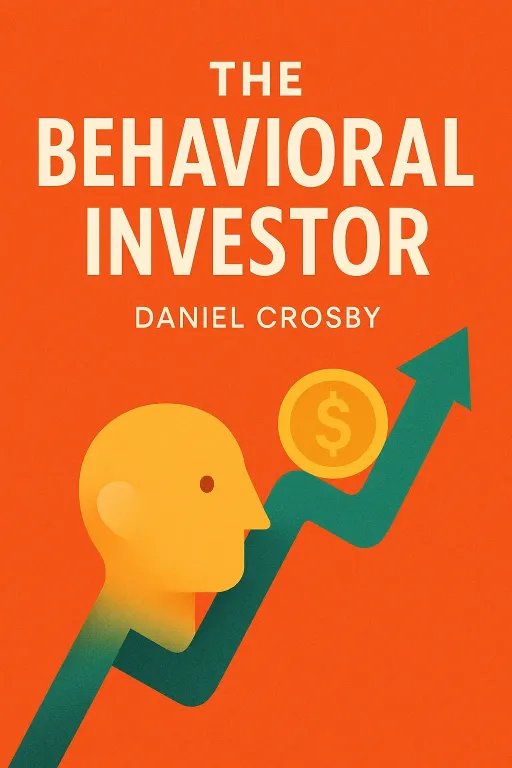
Nova: Atlas, I’ve got a challenge for you. Five words. Summarize Daniel Crosby’s and. Go.
Atlas: Ooh, five words. Let’s see… Your brain: richest, dumbest, portfolio manager.
Nova: Wow. Ouch. But also… incredibly accurate. That’s probably the most succinct, and slightly brutal, summary you could give for the profound insights Daniel Crosby brings to the table in both and.
Atlas: I mean, it captures the essence, right? We all think we're these rational titans of industry, making calculated moves. Then the market blips, and suddenly we're selling everything at the worst possible moment.
Nova: Exactly. And that’s precisely why Crosby’s work is so vital. He’s not just another finance guru; he’s a financial psychologist. He holds a Ph. D. in psychology, and that unique background allows him to bridge the often-gaping chasm between academic behavioral finance theory and the practical, messy reality of making investment decisions. His books are highly regarded for making these complex psychological principles incredibly accessible and, more importantly, actionable for everyday investors. He makes the case that understanding your own mind is far more impactful than trying to predict market movements or pick the next hot stock.
Atlas: That’s a bold claim, Nova. Because for a lot of our listeners, especially those who are strategic builders and optimizers, the whole game is about data, analysis, and finding those market edges. Are you really saying that all that strategizing is secondary to… our feelings?
The Dominance of Investor Psychology
SECTION
Nova: Not secondary, Atlas, but often by our feelings, or more precisely, by our inherent cognitive biases. Crosby’s core thesis, which I find so compelling, is that financial success isn't primarily determined by market timing or stock picking. It's determined by investor psychology. Think about it: two investors get the exact same market information, they have access to the same tools, the same research. Yet, one makes a fortune, and the other loses their shirt. What’s the difference?
Atlas: Their decision-making process, obviously. But I assumed that was about skill or experience. You’re suggesting it’s something deeper, almost innate?
Nova: Precisely. It’s about how they that information, how they to market fluctuations, and how they manage their own impulses. Let me give you a classic scenario. Imagine a market correction hits. The news is full of doom and gloom, headlines scream about impending recession. Investor A, let's call her Sarah, sees her portfolio dip significantly. She feels a primal fear – the pain of loss. Her brain, wired for survival, screams, "Get out! Protect what’s left!" So, she sells everything, locking in her losses, convinced the market is going to zero.
Atlas: And then, of course, the market recovers, and she’s left on the sidelines. We’ve all seen that movie.
Nova: We have. Now, Investor B, David, experiences the exact same market dip and the same internal fear. But David has trained himself to recognize that fear as a signal, not a directive. He understands concepts like "loss aversion" – the idea that the psychological pain of losing a dollar is far more intense than the pleasure of gaining a dollar. He also understands "herding behavior" – the impulse to follow the crowd, even when the crowd is panicking. So, instead of selling, David might even see it as an opportunity, or at the very least, he holds steady.
Atlas: So you're saying the market isn't the enemy; our own internal operating system is? That's a pretty humbling thought for someone who prides themselves on optimizing systems. How does someone who builds and strategizes based on objective data even begin to grapple with something as subjective as their own psychology?
Nova: That’s the beauty of behavioral finance, Atlas. It's not about becoming emotionless robots. It's about understanding that these biases are hardwired into us. Crosby emphasizes that we're all susceptible. It's not a sign of weakness; it's a feature of human cognition. The goal is to identify these systematic errors in thinking – these cognitive biases – and then build frameworks, or "laws" as Crosby calls them, to counteract their negative influence. It’s about building a more robust system for investing.
Atlas: Okay, so it’s less about fighting your nature and more about building guardrails around it. I can get behind that. But what are some of these insidious biases that are actively sabotaging our financial well-being? Give me an example of how my natural strategic drive could actually work against me.
Navigating Biases: Behavioral Finance in Action
SECTION
Nova: Excellent question, and it brings us directly to the practical application of Crosby’s work. He doesn't just point out the problems; he offers solutions. Let's take one bias that I think resonates with many strategic, growth-oriented individuals:. This is our tendency to seek out, interpret, and remember information in a way that confirms our existing beliefs or hypotheses.
Atlas: Oh, I know that feeling. You get an idea, you think it's brilliant, and suddenly every article, every conversation, every data point you encounter seems to validate it. It feels like you're just being smart and discerning.
Nova: Exactly! And in investing, this can be incredibly dangerous. Imagine an entrepreneur, passionate about the future of AI, who becomes convinced that a specific AI startup is going to be the next big thing. They read every positive news story, follow every glowing analyst report, and dismiss any cautionary tales or potential competitors as "noise." Their initial belief becomes a self-reinforcing echo chamber. They invest heavily, maybe even over-concentrate their portfolio in this single stock, ignoring the fundamental principle of diversification.
Atlas: So my natural drive to validate a strategic vision, which is great for building a company, becomes a blind spot when it comes to investing my personal capital. That’s a powerful trap. How does Crosby suggest we counter that specific bias?
Nova: Crosby offers principles like "The Law of Diversification" and "The Law of Humility." The Law of Diversification isn't just about spreading risk; it's a behavioral antidote to overconfidence and confirmation bias. It forces you to acknowledge that you don't know everything, and that even your best ideas might not pan out. The Law of Humility is about recognizing the limits of your own knowledge and foresight. It encourages you to actively seek out evidence, to listen to the dissenting voices, and to understand that the world is far more complex than any single narrative.
Atlas: That’s fascinating. It’s almost like building in a mandatory "devil's advocate" into your investment process. What about another common one? I often hear people talk about holding onto losing stocks for too long, hoping they'll "come back."
Nova: Ah, that’s a classic example of combined with the. Loss aversion, as we touched on, means the pain of a loss is psychologically about twice as powerful as the pleasure of an equivalent gain. The sunk cost fallacy is the irrational belief that because you've already invested time, money, or effort into something, you should continue, even if it's clearly a losing proposition.
Atlas: That sounds like a recipe for disaster for anyone trying to optimize their financial trajectory. You're bleeding money, but you can't let go because of what you've already put in.
Nova: Precisely. Crosby would address this with principles like "The Law of Temperance" – controlling your impulses, and "The Law of Patience," but perhaps even more powerfully, by advocating for. The idea is to make rational decisions your emotions are triggered. For example, setting clear, objective rules like "If this stock falls by 15%, I will sell it, no questions asked." Or rebalancing your portfolio regularly, regardless of how individual assets are performing. This systematizes your decision-making, taking the emotional heat out of the moment.
Atlas: So it's about building a system that bypasses your emotional brain when it’s most likely to lead you astray. That’s a tangible action step, which I appreciate. For someone who thrives on building efficient systems, this makes sense. It’s like designing a more resilient financial architecture.
Synthesis & Takeaways
SECTION
Nova: Exactly. And that’s the profound insight Crosby offers. He acknowledges that investing emotionally taxing. It's filled with uncertainty, fear, and greed. But instead of telling us to suppress those emotions, he encourages us to understand them and build robust frameworks around them. His "Laws of Wealth" aren't about becoming a perfectly rational automaton, which is impossible. They’re about creating a disciplined process that guides you through the inevitable emotional turbulence of the market.
Atlas: So it’s about acknowledging that emotional "tax" on investing, as our initial takeaway suggested, and then building those small, consistent steps – those "laws" – into our financial strategy. It's not about being perfect; it's about being aware and having a system.
Nova: Absolutely. That awareness is the first, most crucial step. And it doesn't have to be a painful, self-critical exercise. As Crosby suggests, it’s a "healing moment" – a chance to review a past financial decision, without judgment, and just try to identify any emotional biases that might have influenced it. That simple act of recognition is incredibly powerful.
Atlas: That’s a really accessible and actionable piece of advice. Instead of beating yourself up for a past mistake, you use it as a learning opportunity to build a better system for the future.
Nova: Precisely. It's about making peace with the human element of finance, rather than fighting it. It's about understanding that the biggest determinant of your financial success isn't out there in the market; it's right here, between your ears.
Atlas: That’s a powerful thought to leave our listeners with. If you want to sharpen your business edge and optimize your financial impact, start with the psychology behind your decisions.
Nova: Indeed. For anyone looking to make more informed decisions and avoid common pitfalls, Daniel Crosby’s and are essential reading. They offer a clear, actionable path to smarter investing by understanding yourself first.
Nova: This is Aibrary. Congratulations on your growth!