

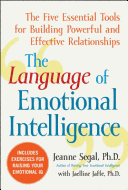
The language of emotional intelligence
The Five Essential Tools for Building Powerful and Effective Relationships
Introduction: Beyond IQ to the Language of Connection
Introduction: Beyond IQ to the Language of Connection
Nova: Welcome to the show. We spend our lives talking, but how often do we truly feel heard? We talk about feelings, but do we speak the actual language of emotion? Today, we are diving deep into a foundational text that reframes emotional intelligence not as a soft skill, but as a critical, learnable dialect: Dr. Jeanne Segal’s "The Language of Emotional Intelligence."
Nova: That’s the perfect place to start. Dr. Jeanne Segal wasn't just another management consultant dabbling in psychology. Our research shows she was a genuine pioneer. She held a Master's in Psychology and a Ph. D. in Sociology, specializing in Holistic Health. She devoted her life to exploring the intersection of emotional intelligence, trauma, and physical well-being. She saw EI as the key to repairing health and strengthening relationships, which gives her work a weight that goes far beyond the boardroom.
Nova: The book promises to equip you with the five essential tools for building powerful and effective relationships. It’s not about managing your own feelings in a vacuum; it’s about using emotional understanding as a bridge to others. It’s about moving from simply having emotions to actively them to communicate effectively and build lasting bonds. It’s about becoming a master translator between your inner world and the outer world of others.
Key Insight 1: Internal Regulation as the First Vocabulary Word
The Five Tools: Establishing Safety with 'The Elastic'
Nova: Segal structures her approach around five distinct, actionable tools. The first one she calls 'The Elastic.' This is foundational. It’s about creating a state of high safety and low stress, both within yourself and in the interaction space.
Nova: Exactly. Segal is suggesting that before you can effectively 'read' someone else—before you can even attempt the next tool—you must be able to absorb pressure without immediately reacting defensively or shutting down. Think of it as building your internal shock absorber. She emphasizes techniques for calming the nervous system first. This isn't about ignoring the stress; it’s about managing the physiological response so your higher brain functions—the ones needed for empathy and complex communication—stay online.
Nova: Absolutely. The book is packed with what they call 'proven calming techniques.' While we won't list them all, the underlying principle is conscious, immediate self-soothing. It might be a specific breathing pattern, a mental reframing exercise, or a physical check-in. The goal is to shorten the time between feeling the emotional trigger and choosing a measured response. It’s about creating space.
Nova: Precisely. And this concept is vital because it ties directly into her background in holistic health. She understood that emotional dysregulation isn't just a mental state; it’s a physical one. When your Elastic is too tight, your body is in fight-or-flight, and you are incapable of the nuanced listening required for deep connection. It’s the first step in moving from survival mode to relational mode.
Key Insight 2: The Power of Authentic Emotional Exchange
The Glue: Exchanging Primary Emotions for Connection
Nova: Tool Number Two is called 'The Glue.' This is where the real language exchange happens. The Glue is defined as an exchange based on primary emotions. Segal argues that superficial conversation is like weak adhesive; it doesn't hold.
Nova: Because they are the truth! Secondary emotions—like frustration, annoyance, or embarrassment—are often just reactions the primary emotion we aren't acknowledging. If you feel frustrated, the primary emotion underneath might be fear of failure or anger about being disrespected. Segal wants you to go straight to the source. When you share a primary emotion authentically, you invite the other person to do the same, creating a powerful, sticky bond.
Nova: It defuses conflict by short-circuiting the argument cycle. Arguments often happen when both parties are expressing secondary emotions defensively. If you can name the primary emotion—'I feel deeply hurt by that comment' or 'I feel angry because my boundaries were crossed' —you stop attacking the other person’s actions and start communicating your internal state. It shifts the dynamic from 'You vs. Me' to 'Us vs. The Problem.'
Nova: Exactly. The tools build on each other. You need The Elastic to safely deploy The Glue. And the research showed that when people use this approach, they are much better at the next crucial step: understanding what isn't being said at all.
Key Insight 3: Reading the Unspoken Language of the Body
The Pulley: Mastering Wordless Communication
Nova: Tool Number Three is 'The Pulley,' and this is Segal’s deep dive into nonverbal cues. She argues that wordless communication—body language, tone, facial expressions—is the lever that moves the entire relationship. It’s the 'pulley' because it allows you to lift heavy emotional truths with minimal verbal effort.
Nova: She does, and she stresses that the nonverbal signal almost always trumps the verbal one. The Pulley is about developing sensitivity to micro-expressions and posture shifts. For instance, she details how shifts in eye contact, changes in breathing rate, or even the speed of a gesture can signal underlying anxiety or deception far more accurately than the spoken sentence. It’s about cross-referencing the spoken word against the body’s truth.
Nova: Precisely. And this skill is crucial for the fourth tool, which is repairing wounded feelings. You can’t effectively repair a wound if you misread the depth of the injury, and the depth is often communicated nonverbally. Segal provides exercises to heighten this awareness, often suggesting people watch interactions without sound, or record themselves to see how their own nonverbal language is betraying their intended message.
Nova: They are essential. Segal’s approach is highly experiential. She doesn't just tell you to be aware; she gives you the tools—the quizzes, the exercises—to measure your current fluency. Mastering The Pulley means you stop taking verbal statements at face value and start reading the entire emotional document presented by the person in front of you.
Key Insight 4: Moving Beyond Blame to Mutual Repair
Repairing Wounds and Defusing Conflict: The Art of Recovery
Nova: That brings us to the latter half of the five tools, which focus on maintenance and recovery. If The Elastic keeps you from breaking, and The Glue builds the connection, the next tools are about fixing the inevitable cracks. Segal focuses heavily on defusing arguments and repairing wounded feelings.
Nova: It goes back to naming the primary emotion, but with a specific intent: de-escalation. Instead of defending your position, you validate the emotional experience, even if you disagree with their facts. For example, instead of saying, 'I didn't mean it that way,' which invalidates their feeling, you might say, 'I can see that what I said caused you real pain, and I regret that.' That’s a direct application of emotional language.
Nova: It is. Repairing feelings requires genuine empathy, which is only possible once you have The Elastic secure. Segal suggests that effective repair involves a three-part process: Acknowledging the impact, expressing genuine remorse for the impact, and then collaboratively establishing a boundary or agreement to prevent recurrence. It’s a complete cycle of accountability.
Nova: That’s a perfect analogy. And this entire system—The Elastic, The Glue, The Pulley, and the repair mechanisms—is designed to help us move past the surface-level politeness that keeps us isolated. It forces us to engage with the messy, vital core of human interaction. It’s about building bonds that last a lifetime, as one summary noted, because they are built on truth, not just convenience.
Key Insight 5: Why Anger and Fear Are Necessary for Connection
Reclaiming Primordial Emotions: The Core Vocabulary
Nova: Let's dedicate a moment to that radical idea. Segal explicitly states that we need to 'recover and restore our primordial emotions, such as anger, sadness, fear, joy, and disgust.' In a culture that often values emotional suppression, this is a bold stance.
Nova: Because they are informational signals that have been evolutionarily hardwired for survival and boundary setting. Anger, for example, is often the signal that a boundary has been crossed or an injustice has occurred. If you suppress the anger signal, you allow the boundary violation to continue unchecked. Segal argues that when anger is expressed using The Glue—as a statement of boundary violation rather than an attack—it becomes a powerful tool for self-respect.
Nova: Fear, in this context, is the signal that something important to you is at risk. If you can articulate your fear—'I am afraid of losing this opportunity'—you invite collaboration from others to protect what matters. If you mask it with anxiety or avoidance, you just look paralyzed. Segal is essentially saying these raw emotions are the vocabulary words we need to stop censoring if we want to speak fluently.
Nova: Exactly. And the beauty is that because she provides these step-by-step programs, exercises, and self-quizzes, the listener isn't left guessing. They have a roadmap to practice this literacy until it becomes second nature. It’s about moving from knowing emotional intelligence to actually it through practiced dialogue and nonverbal awareness.
Conclusion: Fluency for a Fulfilling Life
Conclusion: Fluency for a Fulfilling Life
Nova: We’ve covered a tremendous amount today, Alex, unpacking Dr. Jeanne Segal’s masterful approach in "The Language of Emotional Intelligence." The core takeaway is that emotional intelligence is not innate; it is a language we must learn, practice, and refine.
Nova: Ultimately, Segal challenges us to reclaim our full emotional vocabulary, including those 'primordial' feelings like anger and fear, seeing them not as liabilities but as vital informational signals necessary for self-respect and deep connection. This book is a powerful reminder that the quality of our relationships directly correlates with the fluency of our emotional language.
Nova: If you want to start practicing today, look for those simple exercises and self-quizzes Segal built into the text. Start by noticing your own Elasticity before your next tough call. That small shift in awareness is the first word in your new language.
Nova: My pleasure, Alex. This is Aibrary. Congratulations on your growth!