

The Ganbatte Startup: Building Consistency, Content, and Code with Roseline
Golden Hook & Introduction
SECTION
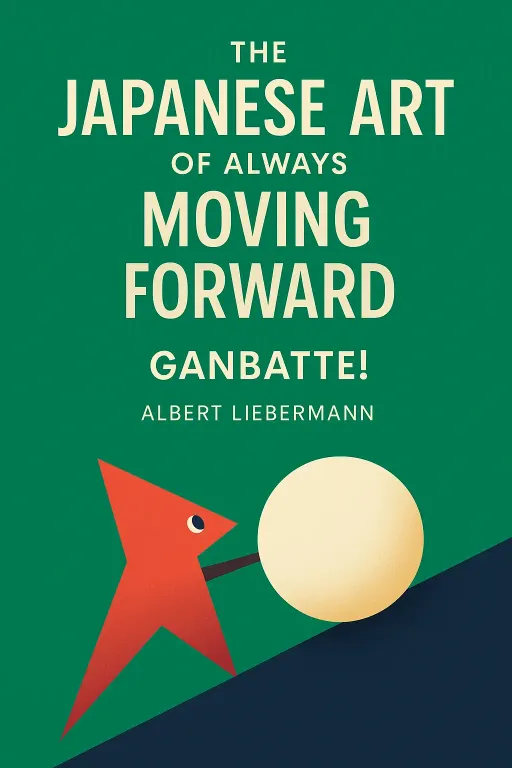
Nova: Imagine you are standing at the edge of a massive launch. You have got the data, the business plan, the content strategy—but you are paralyzed by the sheer scale of what is ahead. Do you wait for a stroke of good luck, or do you tap into an internal engine that guarantees you keep moving, no matter what? Today, we are looking at the Japanese concept of Ganbatte—not as a passive wish, but as an active, relentless commitment to doing your best and always moving forward. Today, we are going to tackle this book from three different angles. First, we will explore how Kaizen and Shuhari can optimize our creative and analytical workflows. Then, we will discuss the psychological mechanics of starting and committing fully without a safety net. And finally, we will focus on the art of reinvention, finding that sweet spot between constant movement and deep, valuable growth. Joining us today is Roseline, a data science and business administration student who is on a mission to become a powerhouse content entrepreneur. Roseline, welcome!
Roseline: Thanks, Nova! I am so excited to be here. You know, when I first picked up Albert Liebermann's book on Ganbatte, I immediately started drawing connections to my world. In data science, we talk a lot about optimization and iterative loops, and in business, it is all about execution and market validation. This book feels like the ultimate philosophical operating system for anyone trying to build a startup or a content empire from scratch.
Nova: Oh, I love that! An operating system for execution. Because let's be honest, we have all been there—staring at a blank document or an empty code repository, waiting for inspiration to strike. But Ganbatte tells us that inspiration is a luxury; effort is the baseline. We often wish people 'good luck,' but Ganbatte is different. It is entirely internal. It says, 'Whatever happens depends on the effort you make.' How does that land with you as someone balancing tech and business?
Roseline: It is incredibly empowering, Nova. In the startup world, relying on 'good luck' is a quick way to fail. Investors don't fund luck; they fund traction and resilience. Ganbatte shifts the focus from external variables—which we can't control—to our internal resources. It is the ultimate growth mindset. It is about saying, 'I might not know how to solve this complex data problem right now, but I am going to make the effort to learn, step by step, day by day.'
Deep Dive into Core Topic 1
SECTION
Nova: Step by step, day by day. That brings us perfectly to our first core topic: the mechanics of consistency. The book introduces two massive concepts here: Kaizen and Shuhari. Let's start with Kaizen. Most people know it as 'continuous improvement,' but Liebermann really highlights how it is about focusing on the process rather than just the end result. The motto is: 'Today better than yesterday, tomorrow better than today.' And we see this in how Toyota revolutionized manufacturing by eliminating waste, or muda, and involving every single employee in making tiny, daily improvements. Roseline, how does this process-over-outcome mentality apply to data science and building a business?
Roseline: It is actually the exact way we train machine learning models! Think about it: we don't just write a piece of code and instantly get a perfect predictive model. We run the data through epochs. In each epoch, the algorithm calculates the error, makes a tiny adjustment to the weights—what we call gradient descent—and tries again. It is a mathematical Kaizen! Each iteration makes the model slightly better than the last until it reaches optimal performance. If you apply that to content creation, you realize you don't need your first video or blog post to be a masterpiece. You just need to publish, analyze the feedback, make a one percent improvement, and do it again tomorrow.
Nova: That is a brilliant analogy! Gradient descent as Kaizen. We are literally optimizing our lives through tiny adjustments. And the book also talks about the 5S process within Kaizen—sorting, systematizing, shining, standardizing, and sustaining. It is about clearing the clutter so you can focus. If your workspace or your digital desktop is a mess, your mind is going to be a mess too, right?
Roseline: Absolutely. In data science, we say 'garbage in, garbage out.' If your data is messy and unorganized, your model will be useless. The same goes for our daily routines. If we don't standardize our habits, we waste precious cognitive energy just trying to decide what to do next. Standardizing—the fourth S—is what allows us to enter a state of flow. It is about creating a system where the default action is the productive one.
Nova: Yes! And once you have that system, you can start climbing the ladder of mastery, which brings us to Shuhari. This is a three-stage philosophy originating from martial arts. First is Shu, where you strictly obey and master the fundamentals. Then Ha, where you start to experiment, question tradition, and break the rules. And finally Ri, where you transcend the rules and create something entirely new. Liebermann uses the example of Picasso, who spent years mastering traditional, realistic drawing techniques—the Shu stage—before he ever dared to innovate with Cubism in the Ha and Ri stages. Roseline, as an aspiring content entrepreneur, how do you see yourself navigating these stages?
Roseline: This is so critical for content creators. A lot of beginners want to jump straight to the Ri stage. They want to be completely unique and revolutionary on day one. But if you don't understand the fundamentals of storytelling, hook writing, editing, and SEO—which is the Shu stage—your unique voice won't find an audience. You have to learn the algorithms and the formats first. You copy what works, not to be a plagiarist, but to train your muscles. Once you have that foundation, you move to Ha—you start mixing genres, experimenting with different visual styles. And eventually, you reach Ri, where your personal brand becomes so distinct that you are defining the trends rather than following them.
Nova: We love that progression! It takes the pressure off having to be a genius right away. You just have to be a good student first. But the book warns us that skipping stages leads to massive frustration. Like a piano student trying to play a complex Beethoven sonata before they can even read sheet music. They just end up feeling defeated and quitting.
Roseline: Exactly. It is about respecting the timeline of mastery. Jiro Ono, the legendary sushi master featured in the book, is the ultimate example of this. His apprentices have to work for ten years just to be recognized as chefs! They spend years just learning how to press the rice or massage the octopus. It sounds extreme, but that level of dedication to the Shu stage is why his tiny subway station restaurant earned three Michelin stars. It is about falling in love with the micro-details of your craft.
Deep Dive into Core Topic 2
SECTION
Nova: Falling in love with the details. But to do that, you have to actually start, which brings us to our second core topic: overcoming the procrastination trap. The book has this beautiful Japanese proverb: 'Senri no michi mo ippo kara'—even the longest journey begins with a single step. It sounds simple, but taking that first step is often the hardest part because we get overwhelmed by the sheer scale of our goals. Roseline, how do you handle that overwhelm when you are looking at a massive project, like launching a new startup idea?
Roseline: Honestly, I have to trick my brain. If I think about building a whole startup, I freeze. The scope is too big. But if I tell myself, 'I am just going to write one line of code,' or 'I am just going to buy the domain name,' the friction disappears. Once you take that tiny first step, you build momentum. It is like static friction versus kinetic friction in physics—it takes way more energy to get an object moving than it does to keep it moving.
Nova: That is so true! We need to focus on the immediate step right in front of us, rather than staring at the mountain peak. But there is another concept in the book that I think is a game-changer for execution, and that is 'getting rid of the second arrow.' This comes from a fourteenth-century story about an archery student. He was practicing with two arrows in his hand, and his master, Yoshida Kenkō, told him that a beginner should never carry a second arrow. Why? Because knowing you have a backup plan makes you careless with your first attempt. You subconsciously think, 'Oh, if I miss this one, I have got another shot.' Roseline, as someone interested in startups, what do you think about this 'no safety net' approach?
Roseline: Oh, this is a fascinating debate in the business world! On one hand, traditional business schools teach you to mitigate risk, have a Plan B, and build a safety net. But on the other hand, some of the most successful entrepreneurs succeeded precisely because they had no other choice. It is the classic 'burn the boats' strategy. When you have no second arrow, your focus becomes razor-sharp. You cannot afford to procrastinate or make careless mistakes because failure means bankruptcy.
Nova: It really forces a level of presence and dedication that you just can't replicate when you are comfortable. It reminds me of the story of Jordi Campoy, the novelist mentioned in the book. He spent ten years revising his manuscript, working with a literary guide who actually made him discard half of his book and rewrite it! He kept pushing forward, doing the difficult work every day, because he was entirely committed to that one goal. He didn't have a second arrow; he just had his dream of becoming a published novelist.
Roseline: And that is the difference between an amateur and a professional. An amateur waits for the perfect conditions and keeps their options open so they never have to fully commit. A professional commits to the process, accepts the risk of failure, and puts all their energy into making the first arrow hit the target. In content creation, if you always have one foot out the door thinking, 'Well, if this content thing doesn't work, I will just do something else,' you will never put in the hours of editing, outreach, and scripting required to actually stand out.
Nova: Exactly. We have to train our 'backside'—which is a hilarious but true quote from the book! The author mentions that the main muscle a writer, or any creator, needs to exercise is the one they use to sit in the chair and do the work, even when they don't feel like it.
Roseline: I love that! 'Train your backside.' It is so true. Consistency isn't about feeling inspired every day; it is about showing up at your desk at 2:30 PM, pouring your tea, and writing or coding for two hours, regardless of your mood. It is about turning effort into a non-negotiable ritual.
Deep Dive into Core Topic 3
SECTION
Nova: A non-negotiable ritual. But while consistency is key, we also have to avoid getting stuck in a rut, which leads us to our third core topic: the art of reinvention and resilience. The book explores the famous proverb, 'A rolling stone gathers no moss.' In the West, we usually use this to mean that if you keep moving, you avoid stagnation. But in Japan, moss, or koke, is highly valued! It symbolizes longevity, tranquility, and the beauty of age. It is even in the Japanese national anthem! So, the Japanese interpretation is beautifully ambiguous—it can mean that constant movement prevents you from growing 'bad moss' like stagnation, but settling down allows you to grow 'beautiful moss' like deep expertise and lasting relationships. Roseline, how do you balance being a 'rolling stone' with growing 'beautiful moss' in your career and personal brand?
Roseline: This is such a beautiful paradox, Nova. As a content entrepreneur, you have to be a rolling stone to stay relevant. The digital landscape changes so fast—algorithms shift, new platforms emerge, and you have to be ready to pivot. If you stand still, you grow 'bad moss' and become obsolete. But at the same time, if you are constantly rolling from one trend to another without ever settling down to build deep expertise, you will never grow 'beautiful moss.' You won't have any authority or substance. People won't trust you. So, the key is to have a solid, unchanging core—your 'beautiful moss' of deep knowledge in data science and business—while being flexible and adaptable in how you present and package that knowledge to the world.
Nova: That is a masterclass in personal branding right there! Keep your core values and expertise deep and stable, but let your execution be fluid. It reminds me of Miyamoto Musashi's philosophy of transforming your mind into water. Water is formless and adaptable; it takes the shape of whatever container it is poured into. If it encounters a rock, it doesn't crash against it in frustration; it simply flows around it.
Roseline: Yes! And Bruce Lee popularized that same idea: 'Be water, my friend.' In business, we call this the pivot. Look at Soichiro Honda, the founder of Honda. He started out in 1937 making piston rings, and his first batch was rejected by Toyota because they didn't meet quality standards! He didn't give up. He went back to school, refined his process, and eventually got the contract. Then, during World War II, his plants were destroyed by air raids. Did he stop? No. He founded Honda Motor Company in 1946, saw a need for cheap transportation in post-war Japan, and began attaching tiny surplus engines to bicycles. He reinvented the wheel—literally! And today, Honda makes everything from motorcycles to cars to private jets. That is the water mentality in action.
Nova: What an incredible story of resilience! He just kept flowing around the obstacles. And that connection between resilience and adaptability is also at the heart of Stoicism, which the book compares to Ganbatte. Both philosophies tell us to focus entirely on what is within our control and to let go of what isn't. If a storm destroys your factory, or an algorithm change drops your views, that is out of your control. What is in your control is how you respond. Do you freeze, or do you apply Ganbatte and take the next step?
Roseline: Exactly. In data science, we look at setbacks as data points. A failed experiment or a rejected proposal isn't a tragedy; it is just feedback. It tells you what didn't work so you can optimize your next attempt. When you look at life through that analytical lens, failure loses its emotional sting. It just becomes part of the iteration process.
Synthesis & Takeaways
SECTION
Nova: It is all just data for the next iteration. We have covered some incredible ground today, Roseline. From the iterative loops of Kaizen and the stages of Shuhari, to the absolute commitment of the first arrow, and finally, the fluid resilience of being like water. If you had to synthesize all of this into one actionable takeaway for our listeners who are struggling to find their motivation and take that first step, what would it be?
Roseline: I would say: stop waiting for the perfect moment, and stop waiting for 'good luck.' Your success doesn't depend on external factors; it depends on your daily, consistent effort. If you have a project or a dream that has been on your mind, get rid of your second arrow. Commit to it fully. Take one tiny, imperfect step today—even if it is just for five minutes. Remember, 'Today better than yesterday, tomorrow better than today.' Just start, and let the momentum of Ganbatte carry you forward.
Nova: Beautifully said, Roseline! The prize isn't just reaching the destination; it is the wisdom, strength, and resilience we build along the journey. To everyone listening out there: whatever challenge you are facing, whatever dream you are building—don't give up. Look at your feet, look at the horizon, and keep moving. Ganbatte! Roseline, thank you so much for sharing your brilliant insights with us today.
Roseline: Thank you, Nova! This was an absolute blast.
Nova: And to our listeners, thank you for tuning in. Now go out there, sit in the chair, train your backside, and make today slightly better than yesterday. We will see you in the next episode!









