

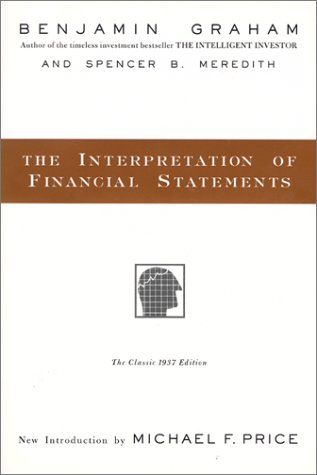
The interpretation of financial statements
Introduction
Nova: Imagine it is 1937. The world is still reeling from the Great Depression, and the stock market feels less like a financial engine and more like a high-stakes casino where the house always wins. In the middle of this chaos, a man named Benjamin Graham, the mentor to Warren Buffett, decides to write a handbook. Not a massive textbook, but a slim, practical guide called The Interpretation of Financial Statements.
Nova: It is a fair question, Leo. But here is the thing: while the industries have changed, the language of business—accounting—has stayed remarkably consistent. Graham wrote this book with Spencer B. Meredith specifically for students at the New York Stock Exchange Institute. He wanted to give regular people a flashlight to see through the fog of corporate reporting.
Nova: Exactly. It is about stripping away the hype and looking at the cold, hard numbers. Today, we are going to break down Graham's timeless rules for reading a balance sheet and an income statement, and see if his 1930s wisdom still holds up in our high-speed digital world.
Key Insight 1
The Snapshot and the Motion Picture
Nova: Graham starts with a brilliant analogy that I think every investor should memorize. He says that a company's financial health is told through two main documents: the Balance Sheet and the Income Account. He calls the Balance Sheet a snapshot and the Income Account a motion picture.
Nova: Precisely. It tells you exactly what the company owns and what it owes on one specific day, usually the last day of the quarter. It is the company's financial position. The Income Account, on the other hand, shows the flow of money over a period of time—how much came in, how much went out, and what was left over.
Nova: That is a great way to put it. Graham argues that many investors get blinded by the motion picture—the earnings growth—and forget to check the snapshot to see if the company actually has the foundation to survive a bad year. In 1937, he was seeing companies report great earnings right before they went bankrupt because their balance sheets were a mess.
Nova: He points us straight to Working Capital. This is the lifeblood of a business. You take the Current Assets—cash, inventory, accounts receivable—and subtract the Current Liabilities, which are the bills due within a year. If that number is not healthy, the company is essentially living paycheck to paycheck.
Nova: He did. He was famous for his 2-to-1 rule. He believed a solid industrial company should have at least twice as many current assets as current liabilities. If you owe a million dollars this year, you better have two million in the bank or in stuff you can sell quickly.
Nova: You are right, and that is where the debate starts. But Graham’s point was about safety. He wanted to make sure that even if the movie stopped playing for a few months, the company wouldn't lose the house.
Key Insight 2
The Skeptic's Eye on Intangibles
Nova: One of the most fascinating parts of the book is Graham's deep skepticism toward what he called intangible assets. We are talking about things like Goodwill, patents, and trademarks.
Nova: Graham wouldn't disagree that they have value, but he would argue that you can't reliably measure that value on a balance sheet. In his day, companies used to pad their books with something called watered stock. They would list Goodwill at some massive, arbitrary number just to make the company look like it was worth more than it actually was.
Nova: Exactly. Graham’s rule was simple: when you are calculating the real value of a company—what he called the Book Value—you should ignore the intangibles entirely. He wanted to know what the company was worth if you had to shut it down and sell all the physical stuff—the factories, the trucks, the raw materials.
Nova: And that is the biggest hurdle for modern investors using Graham’s 1937 logic. Back then, the economy was driven by steel, railroads, and manufacturing. Today, the most valuable assets are often invisible. However, Graham’s underlying warning is still vital: don't pay for air. If a company has ten billion dollars in Goodwill on its balance sheet because it overpaid for a bunch of acquisitions, that is not a sign of strength. It is a sign of potential future write-downs.
Nova: Right. He even suggested looking at the Net Quick Assets—which is basically just cash and receivables minus all debt. He wanted to find companies selling for less than their cash in the bank. He called these net-nets, and it was like finding a dollar bill on the sidewalk for fifty cents.
Key Insight 3
The Truth About Earnings Power
Nova: Now, let's move from the snapshot to the motion picture—the Income Account. Graham has a very specific warning here: never trust a single year's earnings.
Nova: Graham thought that was madness. He argued that earnings are incredibly volatile and easily manipulated by accounting tricks. A company might sell off an old factory and count that as profit, making it look like they had a great year when their actual business is dying.
Nova: He looked for Earnings Power. To find it, he insisted on looking at an average of earnings over a long period—usually seven to ten years. He wanted to see how the company performed through a full business cycle, including the recessions.
Nova: It depends on the industry, but the principle of normalization is what matters. Graham was trying to filter out the noise. He also looked closely at Interest Coverage. He wanted to see that a company’s earnings were many times higher than the interest they had to pay on their debt.
Nova: Exactly. If a company earns ten million dollars but has to pay nine million in interest, they are one bad month away from disaster. Graham wanted that coverage to be at least three or four times the interest cost. It is all about the Margin of Safety—a term he made famous. You don't build a bridge that can only hold the exact weight of the cars; you build it to hold ten times that weight just in case.
Key Insight 4
The Hidden Traps in the Footnotes
Nova: One of the most practical takeaways from the book is Graham's insistence on reading the fine print. He was one of the first to really emphasize that the most important information is often buried in the footnotes of a financial statement.
Nova: Graham did. And he taught his students that this is where companies hide the skeletons. He looked for things like contingent liabilities—lawsuits or guarantees that might cost the company a fortune later—and changes in depreciation methods.
Nova: It might be boring, but it is a powerful tool for manipulation. If a company decides their machines will last ten years instead of five, their annual depreciation expense drops, and suddenly their profit looks much higher on paper, even though nothing actually changed in the real world.
Nova: Precisely. Graham wanted his readers to be financial detectives. He says in the book that the goal of the analyst is not to determine the exact value of a stock, but to determine if the value is sufficient to justify the investment. You don't need to know a man's exact weight to know that he is overweight.
Nova: Right. He also warned about the trend. If earnings are going up, that is great, but why are they going up? Is it because they are selling more, or because they are cutting research and development to the bone? One is sustainable; the other is a death spiral disguised as progress.
Conclusion
Nova: As we wrap up our look at The Interpretation of Financial Statements, it is clear that while the 1937 edition might seem like an antique, its core message is more relevant than ever. In an age of meme stocks and overnight crypto billionaires, Graham’s call for discipline, skepticism, and a focus on tangible value is a necessary anchor.
Nova: That is the perfect takeaway. Graham’s biggest lesson is that when you buy a stock, you aren't just buying a ticker symbol that moves on a screen; you are buying a piece of a business. And if you wouldn't buy the whole business based on its balance sheet, you shouldn't buy a single share.
Nova: You’ve got it. If you want to dive deeper, pick up a copy of the 1937 edition. It is short, punchy, and will change the way you look at your portfolio.
Nova: This is Aibrary. Congratulations on your growth!