

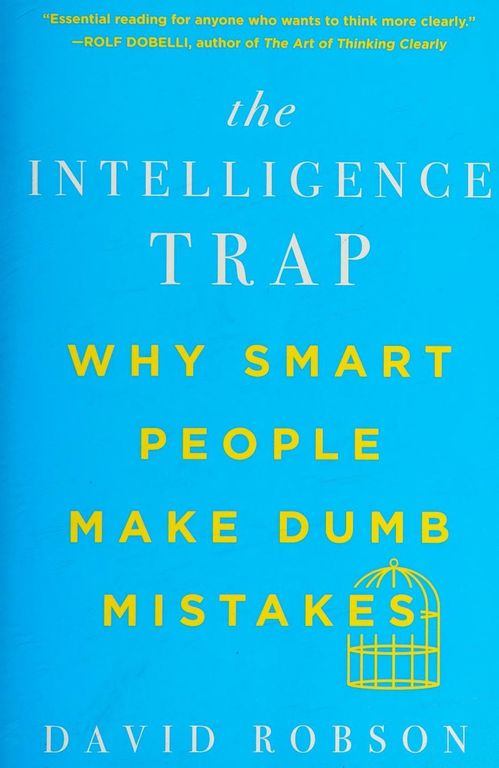
The Intelligence Trap
Why Smart People Make Dumb Mistakes
Introduction
Nova: Imagine you are one of the most brilliant minds in history. You created the most famous detective in literature, a man defined by cold, hard logic and deductive reasoning. You are Sir Arthur Conan Doyle, the father of Sherlock Holmes. And yet, in your private life, you are convinced that tiny winged fairies are living in a garden in Yorkshire. You even spend a fortune trying to prove it to the world.
Atlas: Wait, the guy who wrote Sherlock Holmes believed in fairies? That sounds like a punchline, not a biography. How does someone that smart fall for something so obviously fake?
Nova: That is exactly the question David Robson explores in his book, The Intelligence Trap. It is a deep dive into why high IQ, elite education, and professional expertise do not just fail to protect us from stupidity, but in many cases, they actually make us more vulnerable to it.
Atlas: So you are saying being smart is actually a liability? That feels like a very dangerous thing to tell people. I have spent my whole life trying to get smarter, and now you are telling me I am just building a better trap for myself?
Nova: Not exactly a liability, but it is a double-edged sword. Robson argues that our traditional measures of intelligence, like IQ tests, only measure a very specific set of cognitive skills. They do not measure wisdom, and they certainly do not measure our ability to see our own flaws. Today, we are going to break down why geniuses do dumb things and, more importantly, how we can avoid the same pitfalls.
Key Insight 1
The IQ Myth and Dysrationalia
Nova: To understand the intelligence trap, we first have to look at what we actually mean by intelligence. Most of us think of it as a general mental horsepower. If you have a high IQ, you are supposed to be better at everything involving a brain, right?
Atlas: Right. That is the assumption. If you are a rocket scientist, I am probably going to trust your opinion on more than just rockets. I assume that brainpower carries over.
Nova: But Robson introduces a term called dysrationalia. It was coined by a psychologist named Keith Stanovich. It describes the phenomenon where people can have a very high IQ but still act and think quite irrationally. Think of it like a high-end computer running buggy software. The hardware is fast, but the output is still a mess.
Atlas: So the IQ test is just measuring the hardware? It is checking how fast the processor is, but it is not checking if the computer is actually doing anything useful?
Nova: Exactly. IQ tests measure things like pattern recognition, short-term memory, and mathematical ability. But they do not measure things like your tendency to seek out information that contradicts your beliefs, or your ability to weigh evidence objectively.
Atlas: That is wild. So you could be a literal member of Mensa and still be a total sucker for a pyramid scheme or a conspiracy theory?
Nova: Absolutely. In fact, Robson points out that people with higher IQs are sometimes more likely to fall for certain types of misinformation because they are better at rationalizing why they believe it. They have more mental tools to build a sophisticated defense for a bad idea.
Atlas: It is like they are using their high-powered engine to drive off a cliff faster than the rest of us.
Nova: That is a perfect analogy. Robson cites studies showing that there is almost zero correlation between IQ and things like life satisfaction or the ability to avoid common gambling fallacies. Being smart helps you solve puzzles, but it does not necessarily help you live a better life or make better choices.
Atlas: So if IQ is not the answer, what is missing? Why is the Sherlock Holmes creator out there looking for fairies while his character is looking for footprints?
Nova: It comes down to how we use that intelligence. Robson argues that we have focused so much on raw intelligence that we have ignored the qualities of the mind that actually lead to truth, like intellectual humility and cognitive reflection.
Key Insight 2
The Logic Toolkit of Self-Deception
Nova: One of the most fascinating and terrifying concepts in the book is called motivated reasoning. This is the idea that we use our intelligence not to find the truth, but to reach the conclusion we already want to be true.
Atlas: I feel like I see this every day on social media. People just cherry-picking facts to win an argument.
Nova: It is universal, but here is the kicker: the smarter you are, the better you are at it. Robson explains that highly intelligent people have a larger logic toolkit. When they encounter a fact that contradicts their worldview, they are much more skilled at finding a clever reason to dismiss it.
Atlas: So my intelligence is actually helping me lie to myself? That is depressing.
Nova: It is called the bias blind spot. We are very good at spotting biases in other people, but we are almost totally blind to our own. And studies show that people with higher cognitive ability actually have a larger bias blind spot. They think they are too smart to be biased, which makes them even more susceptible to it.
Atlas: It is the ultimate irony. The more you think you are immune to being wrong, the more likely you are to be wrong because you have stopped checking your work.
Nova: Precisely. Robson uses the example of Kary Mullis, who won a Nobel Prize for inventing PCR, a foundational technology in modern biology. He was undeniably a genius. But later in life, he became a climate change denier and even claimed to have encountered a glowing green raccoon that he believed was an alien.
Atlas: A glowing green raccoon? From a Nobel Prize winner? That is a huge leap from DNA sequencing.
Nova: It shows that expertise in one area can lead to a sense of intellectual invincibility. This is what Robson calls earned dogmatism. Because you have been right so many times in your field, you start to believe that your intuition is infallible in every field.
Atlas: I guess that explains why you see famous actors or tech billionaires giving medical advice. They think their success in one area gives them a master key to all knowledge.
Nova: And because they are smart, they can construct these incredibly elaborate, scientific-sounding arguments to support their fringe beliefs. Their intelligence becomes a shield that protects their delusions from reality.
Case Study
The Curse of Expertise and Team Failure
Nova: The intelligence trap does not just affect individuals; it can take down entire organizations. Robson spends a lot of time looking at NASA, specifically the Challenger and Columbia disasters.
Atlas: Those were some of the smartest people on the planet. How did they miss the warning signs?
Nova: It was a classic case of what Robson calls functional stupidity. Within these high-pressure, high-expertise environments, people often stop asking difficult questions because they want to maintain harmony or because they trust the system too much.
Atlas: So it is like groupthink, but for geniuses?
Nova: Exactly. In the case of the Challenger, there were engineers who had concerns about the O-rings in cold weather. But the management, who were also highly trained and intelligent, used their sophisticated reasoning to downplay the risks. They created a culture where being a team player was more important than being a critical thinker.
Atlas: It sounds like their expertise actually blinded them. They had so much data and so many models that they convinced themselves they had accounted for everything, even when the reality was staring them in the face.
Nova: That is the curse of expertise. When you become an expert, your thinking can become rigid. You rely on established patterns and stop looking for anomalies. Robson mentions that in some medical fields, highly experienced doctors are actually more likely to make certain diagnostic errors than residents because they jump to conclusions based on past experience.
Atlas: That is terrifying. You would think you would want the doctor who has seen everything.
Nova: You do, but you want the doctor who has seen everything and still maintains the curiosity of a beginner. Robson suggests that we need to build red teams into our decision-making. These are groups specifically tasked with finding flaws in the plan, no matter how smart the people who made the plan are.
Atlas: So you basically need a professional devil's advocate to keep the geniuses from accidentally blowing things up.
Nova: Essentially, yes. It is about creating a system that compensates for the natural blind spots that come with high intelligence and expertise.
Key Insight 3
The Wisdom Toolkit
Nova: So, we have talked about the trap. Now let's talk about the escape. How do we actually become wiser, not just smarter? Robson points to a few specific strategies, and the first one is intellectual humility.
Atlas: Intellectual humility. That sounds like just admitting you are wrong, which is something most people hate doing.
Nova: It is more than that. It is the active recognition that your knowledge is limited and that you are prone to error. It is about being more interested in finding the truth than in being right. Research shows that people who score high in intellectual humility are better at evaluating evidence and are less likely to be swayed by fake news.
Atlas: Okay, so how do I actually practice that? Is there a trick to it?
Nova: One very cool technique Robson discusses is called self-distancing, or illeism. It is the practice of talking about yourself in the third person when you are facing a difficult decision or an emotional conflict.
Atlas: Wait, like saying, What should Atlas do in this situation? That feels a bit weird, like I am a character in a movie.
Nova: It feels weird, but it works. By using the third person, you create a psychological distance from your own ego. It allows you to look at your situation more objectively, as if you were giving advice to a friend. Studies have shown that this simple shift in language can significantly increase your wise reasoning.
Atlas: I can see that. It is always easier to see the obvious solution to a friend's problem than it is to your own. You are basically tricking your brain into being your own consultant.
Nova: Exactly. Another tool is emotional awareness, specifically something called interoception. This is your ability to sense your body's internal signals, like your heartbeat or that gut feeling. Robson explains that people who are more in tune with their physical sensations are often better at making decisions because they can sense when they are becoming overly emotional or stressed before it clouds their judgment.
Atlas: So it is not just about cold logic. It is about knowing when your emotions are trying to hijack your logic.
Nova: Precisely. Wisdom is the integration of intelligence, experience, and emotional regulation. It is about knowing when to trust your gut and when to question it. Robson also suggests a technique called pre-mortem. Before you start a project, imagine it has already failed and then work backward to figure out why. It forces you to look for the flaws you would normally ignore because you are excited about the idea.
Conclusion
Nova: We have covered a lot of ground today. From Sir Arthur Conan Doyle's fairies to the tragic mistakes at NASA, it is clear that intelligence alone is not a safeguard against folly. In fact, without the right mindset, it can be a trap.
Atlas: It is a bit of a wake-up call. I think I am going to be a lot more careful about how I use my logic from now on. It is easy to feel smart when you are winning an argument, but that does not mean you are actually right.
Nova: That is the most important takeaway. The intelligence trap is something we all face, regardless of our IQ. But by cultivating intellectual humility, practicing self-distancing, and being aware of our own biases, we can start to turn our intelligence into true wisdom.
Atlas: I like that. It is not about how much brainpower you have; it is about how you steer it. If you are driving a Ferrari but you are looking in the rearview mirror the whole time, you are still going to crash.
Nova: Exactly. David Robson's book is a fantastic guide for anyone who wants to stop crashing and start thinking more clearly. It is a reminder that the most important thing you can do with a brilliant mind is to keep it open.
Atlas: Well, I am definitely going to try the third-person thing. Atlas thinks this was a great conversation.
Nova: Nova agrees. Thank you for joining us as we explored the fascinating world of the intelligence trap. Remember, being smart is just the beginning; being wise is the goal.
Nova: This is Aibrary. Congratulations on your growth!