

The Innovation Trap: Rethinking Progress Through History.
Golden Hook & Introduction
SECTION
Nova: What if our collective fascination with "progress" is actually a trap, subtly sabotaging our understanding of true innovation?
Atlas: Whoa, that sounds like heresy in a world that can't stop innovating and iterating. You're telling me our relentless pursuit of the next big thing might be leading us astray? Explain, because that challenges pretty much everything I've been taught.
Nova: Absolutely, Atlas. And that's precisely the provocative argument at the heart of the book we're exploring today: "The Innovation Trap: Rethinking Progress Through History" by Dr. Evelyn Reed. What's fascinating about Dr. Reed is her background – she's a historian of science, but she's spent years consulting with some of the biggest tech firms. That unique blend of academic rigor and boardroom reality gives her insights a rare depth, showing us the patterns that keep repeating.
Atlas: So, she's seen the cycles up close, not just in dusty archives. That's a powerful combination. It makes me wonder, what's this "trap" we're falling into? And how does it relate to, say, the current AI boom?
The Illusion of Linear Progress & The Blind Spot
SECTION
Nova: Exactly. Dr. Reed’s central idea is what she calls "The Blind Spot." We tend to view innovation as this smooth, linear, almost inevitable march forward. Like a timeline where each new invention neatly builds on the last, always improving, always getting 'better.'
Atlas: Oh, I know that feeling. Every new gadget, every software update, it all feels like a step up, an advancement. It's the story we tell ourselves, right? That we're constantly evolving.
Nova: Precisely. But this comfortable narrative, this blind spot, overlooks the messy, human, and often deeply cyclical nature of technological progress. It creates unrealistic expectations for what innovation actually is and how it unfolds. Think about it: if you believe progress is always linear, then any setback, any failure, any detour feels like a deviation from the natural order. It can lead to burnout, frustration, and a failure to properly learn from history.
Atlas: So, for someone deeply involved in developing new tech, this idea of a 'trap' might feel counterintuitive. They're pushing boundaries, but you're saying they might be missing the bigger picture?
Nova: Completely. Yuval Noah Harari, in his groundbreaking work "Sapiens," provides a macro-historical lens that perfectly illustrates this. He shows how new technologies don't just add features; they fundamentally reshape societies and individual human experiences over vast stretches of time. It's not a straight line from 'tool' to 'app'; it's a series of profound societal reconfigurations, often with unforeseen consequences and periods of stagnation or even regression. The agricultural revolution, for example, brought incredible advancements in food production, but also new forms of labor, social hierarchy, and health challenges.
Atlas: That's a great point. It makes me think about how we talk about AI now. It's all about exponential growth, singularity, an inevitable future. But if we're constantly looking for that straight line, are we missing the ethical detours, the societal costs, the potential for things to… not quite go as planned?
Nova: Absolutely. The linear narrative can make ethical considerations seem like speed bumps rather than integral parts of the journey. It can foster an attitude of "we'll fix it later" because the 'forward march' is paramount. Dr. Reed argues that by understanding the historical context and the true complexity of innovation, we can manage our expectations for future developments, preventing that burnout you mentioned, and promoting much more thoughtful engagement.
Atlas: So, the blind spot isn't just about understanding history; it's about how that misunderstanding impacts our present and future decisions. It sounds like a pretty fundamental reframe.
Innovation as a Collaborative, Contextual Symphony
SECTION
Nova: It truly is. And that naturally leads us to the second key idea we need to talk about, which often acts as a counterpoint to the myth of the solitary genius: innovation as a collaborative, deeply contextual symphony.
Atlas: A symphony? I like that imagery. You mean it's not just one virtuoso playing a solo?
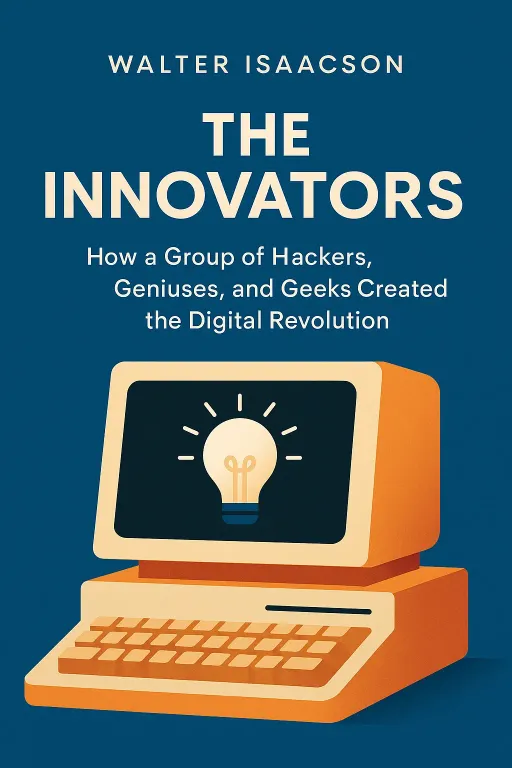
Nova: Exactly. Walter Isaacson's incredible book "The Innovators" masterfully traces the history of the digital revolution, and his central thesis aligns perfectly with Dr. Reed's work. Isaacson shows that innovation is rarely a solitary flash of genius. Instead, it's a collaborative process, a relay race of ideas built on previous insights, often with unexpected detours and failures along the way. Think of the internet itself – it wasn't one person’s lightbulb moment, but a decades-long collaboration across military, academic, and private sectors, with countless individuals building on each other's work.
Atlas: So, the lone inventor in a garage, that's mostly a romantic myth?
Nova: Largely, yes. Even the most celebrated figures, like Steve Jobs or Bill Gates, were standing on the shoulders of giants. They integrated, refined, and commercialized existing technologies. The graphical user interface, for example, wasn't invented at Apple; it was developed at Xerox PARC, itself a hotbed of collaborative research. Apple brilliantly applied it, but the seeds were sown elsewhere.
Atlas: That's a great example. It makes me wonder, if innovation is so collaborative, what does that mean for the individual 'practical innovator' trying to make their mark? Does it devalue their contribution, or does it empower them to seek out connections?
Nova: It absolutely empowers them! Dr. Reed emphasizes that understanding this collaborative nature promotes thoughtful engagement. It shifts the focus from individual heroism to ecosystem building. It means your contribution, however small it seems, is part of a much larger tapestry. And crucially, it means embracing those "unexpected detours and failures" as integral parts of the process, not as roadblocks. Every 'failure' is a piece of data for the next collaborator.
Atlas: That's a much more hopeful and sustainable way to approach things, especially in fast-moving fields like AI. Instead of feeling like you have to have the single, world-changing idea, it's about contributing to a shared pool of knowledge and building on what others have done. It also brings us back to the ethical side of AI. If it's a collaborative symphony, then the ethical dialogue also needs to be collaborative, not just left to a few 'geniuses' behind closed doors.
Nova: Precisely. And that's Nova's take, as Dr. Reed frames it: understanding this historical context helps us appreciate innovation's complexity, manage our expectations for future developments, prevent burnout, and promote that thoughtfully engaged, collaborative approach. It’s about being a participant in a long, winding, multi-authored story, not just a consumer of the latest headline.
Atlas: I can see how that would be a huge relief for anyone feeling the pressure to constantly be "innovating" in a vacuum. It puts the human element back into the narrative.
Synthesis & Takeaways
SECTION
Nova: It really does. So, bringing it all together, Atlas, how does understanding these historical patterns of innovation – this non-linear, collaborative, often messy journey – change your perspective on current technological advancements like artificial intelligence?
Atlas: Oh, it changes everything. It moves AI from this inevitable, almost mystical force to something far more human and understandable. If we see it as a product of countless collaborations, building on past ideas, with plenty of detours and potential failures, then suddenly we have more agency. We can ask better questions about its ethical development, about who is collaborating, and what historical precedents we can draw from. It’s less about being swept away by a tide and more about navigating a complex river.
Nova: That's a beautiful analogy. It shifts us from passive observers to active, informed participants. It means we don't just ask "what can AI do?" but "what kind of AI do we want to collaboratively build, given what history tells us about technological impact?" And for our listeners, whether they're interested in AI ethics, smart home integration, or just the history of computing, this perspective is invaluable.
Atlas: Absolutely. It grounds future trends in past innovations, and it means we can approach new tech with a more critical, yet also more engaged and less anxious, mindset. It's about seeing the humanity in the machine, and the history in the future.
Nova: Exactly. It's about embracing the journey of discovery, knowing that every question, every 'detour,' leads to deeper insight. We hope this conversation sparks some of those insights for you.
Atlas: And maybe even inspires you to tinker with a new digital tool, but with a newfound historical appreciation!
Nova: What a perfect thought to end on. This is Aibrary. Congratulations on your growth!