

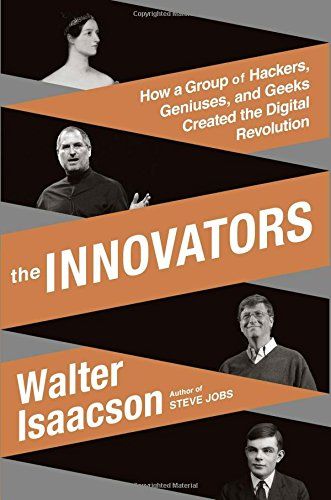
The Innovators
How a Group of Hackers, Geniuses, and Geeks Created the Digital Revolution
Introduction
Nova: Here's a question for you: who invented the computer? Go ahead, take a guess.
Nova: : I mean, everyone says Alan Turing, right? Or maybe Charles Babbage? That feels like a pub quiz answer.
Nova: And that's exactly the trap. Walter Isaacson's book The Innovators opens by blowing up that entire premise. He points out that if you search "the man who invented" on Amazon, you get over eighteen hundred book results. But the digital revolution? It wasn't conjured up by one person in a garage. It was teams — messy, brilliant, competitive, collaborative teams across more than a century.
Nova: : So you're telling me the entire premise we've been fed about the lone genius — the Edison, the Bell, the Jobs — is basically wrong?
Nova: Not wrong exactly, but incomplete. Isaacson had just finished his Steve Jobs biography, which is the ultimate lone-genius story, and he realized he wanted to tell the other side. The subtitle says it all: "How a Group of Hackers, Geniuses, and Geeks Created the Digital Revolution." This is the story of how real innovation actually happens — through collaboration, cross-pollination, and people building on each other's ideas. It spans from Ada Lovelace in the 1840s all the way to Google in the late 1990s.
Nova: : A group biography that covers 150 years? That's ambitious.
Nova: It is, and Isaacson is uniquely suited to tell it. He grew up with a basement workshop, soldering circuit boards, tinkering with ham radios. His father and uncles were electrical engineers. He lived through the transition from vacuum tubes to transistors, from punch cards to personal computers. And he spent over a decade researching this book. He even crowd-sourced corrections by posting drafts on Medium — eighteen thousand people read one excerpt in a single week. He literally used the collaborative tools his subjects invented to write about them.
Nova: : That's wonderfully meta. Alright, I'm sold. Where does this story begin?
Nova: It begins with Lord Byron's daughter — a woman who, in 1843, saw the future more clearly than almost anyone alive.
The Visionary Who Saw Computers Before They Existed
Ada Lovelace and the Birth of Poetical Science
Nova: Ada Lovelace was the daughter of the poet Lord Byron. Her mother, terrified Ada would inherit Byron's wild artistic temperament, steered her hard toward mathematics. But here's the twist — Ada didn't abandon poetry. She fused them. She called it "poetical science."
Nova: : Poetical science. What does that even mean?
Nova: It means she saw mathematics as something beautiful and imaginative, not just cold calculation. She once wrote to her mother: "If you can't give me poetry, can't you give me poetical science?" She believed imagination was the discovering faculty — the thing that "penetrates into the unseen worlds around us." And that mindset led her to Charles Babbage's weekly salons in London.
Nova: : Babbage — the guy with the Difference Engine.
Nova: Exactly. Babbage had designed this mechanical contraption to calculate polynomial functions. But it was huge, expensive, and never fully built. His bigger idea was the Analytical Engine — a general-purpose machine that could be programmed to handle different tasks and even switch between them on its own.
Nova: : So a computer, essentially.
Nova: Yes, but Babbage saw it mainly as a number cruncher. Ada saw something far more profound. When she translated an Italian paper about the Analytical Engine, she added her own notes — which ended up being twice as long as the original. In those notes, she described step-by-step instructions for the machine to calculate Bernoulli numbers. That is widely considered the first computer program ever published.
Nova: : So the first computer programmer was a woman in 1843, writing notes on a machine that didn't even exist yet.
Nova: And that's not even the most astonishing part. Ada articulated what Alan Turing later called "Lady Lovelace's Objection" — the argument that computers can only do what we tell them to do and cannot originate anything truly new. But she also saw something Babbage completely missed: that computers could manipulate not just numbers, but any symbols — musical notes, text, images. She envisioned a general-purpose machine capable of processing anything that could be represented symbolically. A hundred years before it happened.
Nova: : That is genuinely mind-blowing. But wait — you mentioned Alan Turing. How does he fit in?
Nova: Turing picks up where Ada left off in the 1930s, with his famous paper "On Computable Numbers." He conceptualized a universal machine that could perform any logical operation. But Isaacson's book shows that even Turing's brilliance didn't emerge in a vacuum. He built on the work of Kurt Gödel and others, and his practical computing work during World War II at Bletchley Park was intensely collaborative — teams of mathematicians, cryptographers, and engineers working together to crack the Enigma code.
Nova: : So the pattern starts early: even the biggest names are standing on other people's shoulders.
Nova: Exactly right. And Isaacson bookends the entire book with Ada. Chapter one is about her, and the final chapter is literally called "Ada Forever." She's the through-line. Her vision of human creativity and machine capability working in partnership is the thread that ties together every subsequent innovation in the book.
How a Revolt Gave Birth to Silicon Valley
Silicon, Transistors, and the Traitorous Eight
Nova: Let's jump forward to the late 1940s. The computers of World War II were room-sized beasts powered by thousands of vacuum tubes — fragile, hot, constantly burning out. Then, at Bell Labs in New Jersey, three men changed everything: John Bardeen, Walter Brattain, and William Shockley. They invented the transistor.
Nova: : The transistor — the tiny switch that replaced vacuum tubes and made modern electronics possible.
Nova: Right, and Isaacson paints a vivid picture of these three. Bardeen was a quiet theoretical genius. Brattain was a hands-on experimental wizard. And Shockley was — well, brilliant but insufferable. He was so competitive that he once reportedly locked himself in a hotel room to work out the junction transistor design after realizing his colleagues might beat him to it.
Nova: : A classic difficult genius.
Nova: And his difficulty had real consequences. Shockley left Bell Labs and founded Shockley Semiconductor in what would become Silicon Valley. He recruited the brightest young minds — including Robert Noyce and Gordon Moore. But Shockley was a terrible manager, paranoid and authoritarian. He once administered lie detector tests to his staff to find out who had made a minor mistake.
Nova: : Are you serious? Lie detector tests?
Nova: Absolutely serious. So in 1957, eight of his best engineers — including Noyce and Moore — decided they'd had enough. They quit together and formed their own company: Fairchild Semiconductor. Shockley branded them "the traitorous eight."
Nova: : What a name. But that breakaway turned out to be monumentally important.
Nova: It changed the world. Fairchild Semiconductor became the prototype for Silicon Valley culture — flat hierarchies, open communication, meritocracy over seniority. And it was at Fairchild that Noyce developed the integrated circuit, the microchip, independently of Jack Kilby at Texas Instruments. Then Noyce and Moore left Fairchild and founded Intel, where Moore articulated his famous law: processing power doubles roughly every two years.
Nova: : So the entire semiconductor industry, Intel, Silicon Valley culture — all of it traces back to eight engineers walking out on a tyrannical boss.
Nova: Isaacson makes this point beautifully: innovation isn't just about the technical breakthrough, it's about the environment that enables it. Shockley had the technical brilliance but created a toxic culture. The traitorous eight had the collaborative ethos that turned a brilliant invention into an industry. Gordon Moore, by the way, emerges from this book as a genuinely admirable figure — soft-spoken, collaborative, the anti-Shockley.
Nova: : And here's another fascinating detail Isaacson includes. Remember the transistor radio? That pocket-sized device that teenagers in the 1950s went crazy for? Isaacson argues it was the first major example of a defining theme of the digital age: technology making devices personal. Before that, radios were living-room appliances. Suddenly they were fashion accessories you carried around. It's the spiritual ancestor of the iPod.
Nova: : That's such a crisp observation. A transistor radio in a teenager's pocket to an iPhone — the arc is the same.
How Counterculture Created the Personal Computer
Hackers, Hippies, and the Homebrew Computer Club
Nova: Now we enter one of my favorite parts of Isaacson's narrative. The 1960s and 70s saw a collision between two worlds that nobody expected to fuse: the counterculture hippies and the hardware hackers.
Nova: : This sounds like a strange pairing.
Nova: It was, but it makes perfect sense. Both groups shared a deep suspicion of centralized authority. The hippies wanted to take power away from the establishment. The hackers wanted to take computing power away from the giant mainframes controlled by corporations and the military. Stewart Brand, who created the Whole Earth Catalog, was the bridge figure. His catalog was like a paper version of Google before Google existed — and he argued that computers could become tools for personal liberation, not just control.
Nova: : So the personal computer was, in a sense, a political statement.
Nova: Absolutely. And the epicenter of this movement was the Homebrew Computer Club, which started meeting in 1975 in Menlo Park, California. It was a gathering of hobbyists, tinkerers, and dreamers. At one of the very first meetings, a company called MITS showed off the Altair 8800 — a do-it-yourself computer kit that sold for $397. It was featured on the cover of Popular Electronics, and orders went through the roof.
Nova: : And who was in the audience at these Homebrew meetings?
Nova: A young Steve Wozniak, who would soon demonstrate his prototype Apple I at the club. And Steve Jobs, who saw the commercial potential. Isaacson tells the story of how Wozniak — pure engineer, collaborative to the core — actually gave away his blueprints for free at the Homebrew Club. Jobs, the entrepreneur, had to convince him that they could actually sell these things. The Apple I went for $666.66.
Nova: : That price point is wonderfully odd. But this dynamic between Woz and Jobs is exactly Isaacson's thesis, isn't it? Innovation requires both types of people.
Nova: Precisely. Wozniak could design a beautiful circuit board but had no interest in business. Jobs couldn't engineer a computer but understood exactly what people wanted and how to sell it to them. Neither could have created Apple alone. The collaboration made it possible.
Nova: : And there's a whole chapter in the book on software that covers the Gates and Allen partnership at Microsoft, right?
Nova: Yes, and that chapter actually had a notable correction. In the original edition, Isaacson credited Bill Gates with virtually all of Microsoft's early innovations. But after readers pointed out the imbalance, he revised the electronic edition in 2015 to properly acknowledge Paul Allen's contributions — including archival material where Gates himself called Allen "the idea man" in charge of R&D. Isaacson was humble enough to correct his own book using the same collaborative principles he was writing about.
Nova: : That's remarkable. The author living his own thesis.
When the Military, Academia, and Industry Joined Forces
Weaving the Web: ARPANET to the World Wide Web
Nova: Now let's talk about the Internet, because it's the ultimate case study in collaborative innovation. Isaacson traces it through what he calls the military-industrial-academic complex.
Nova: : That phrase usually has negative connotations — but here you're saying it was a force for good?
Nova: In this specific case, absolutely. It starts with Vannevar Bush — no relation to the presidents — who was the dean of MIT's School of Engineering, the top military science advisor during World War II, and the founder of the defense contractor Raytheon. He was the rare figure who could bridge all three worlds. After the war, he pushed the government to create the National Science Foundation, arguing that basic research — not just applied military projects — deserved public funding.
Nova: : And from that foundation came the Internet?
Nova: Through a series of brilliant collaborators. J. C. R. Licklider, a psychologist-turned-computer-scientist, articulated a vision of a "galactic network" where computers would enable real-time human communication. Bob Taylor at ARPA — the Advanced Research Projects Agency — secured funding for a network connecting university research computers. Larry Roberts helped design and build it. The result was ARPANET, which went live in 1969 with four nodes.
Nova: : Four nodes. That's it?
Nova: That's it. UCLA, Stanford Research Institute, UC Santa Barbara, and the University of Utah. But the architecture was designed for growth. Paul Baran and Donald Davies independently invented packet switching, which breaks data into little chunks that can find their own routes through the network. Then Vint Cerf and Bob Kahn developed the Internet Protocol — TCP/IP — which became the universal language of the network.
Nova: : And what's striking is how many different people, working in different places, contributed essential pieces that all had to fit together.
Nova: That's Isaacson's core argument. No single person invented the Internet. It emerged from layers of contributions across institutions and decades. And then, in the early 1990s, Tim Berners-Lee at CERN in Switzerland created the World Wide Web — the hypertext-based system that made the Internet accessible to ordinary people. He famously chose not to patent it. He gave it away.
Nova: : He could have been a billionaire.
Nova: He could have, and he chose otherwise because he believed the web should be an open, universal space. Isaacson also gives Al Gore his due here — Gore sponsored legislation in the early 1990s that opened the Internet to commercial and public use, and he pushed for the funding that led to the Mosaic browser developed by Marc Andreessen. The "Al Gore invented the Internet" mockery was a distortion of what was actually meaningful policy leadership.
Nova: : So from government funding to academic research to private commercialization — the entire ecosystem mattered.
Nova: Exactly. And Isaacson closes the book with Google, where Larry Page and Sergey Brin built their search engine on the shoulders of that entire infrastructure. The web existed. The browsers existed. They created the best way to navigate it. Innovation is a relay race, not a sprint.
Conclusion: Ada Forever
Conclusion: Ada Forever
Nova: Isaacson's final chapter is called "Ada Forever," and it brings the whole book full circle. He returns to the question Ada Lovelace raised in 1843: can machines truly think? Can artificial intelligence ever match human creativity?
Nova: : And what's his answer?
Nova: He's skeptical. He writes: "Decade after decade, new waves of experts have claimed that artificial intelligence was on the visible horizon, perhaps only 20 years away. Yet it has remained a mirage, always about 20 years away." Isaacson argues that the real magic of the digital age isn't machines replacing humans — it's the partnership. Ada's vision of "poetical science" — human imagination augmented by machine processing — is what actually changed the world.
Nova: : So the big takeaway from the entire book — what is it?
Nova: Three things. First, innovation is almost never a solo act. The myth of the lone genius is a distortion. Real breakthroughs come from teams, from collaboration, from people with different strengths working together. Second, the best innovations happen at the intersections — between art and science, between the military and academia, between hippies and hackers, between hardware engineers and visionary entrepreneurs. And third, the most transformative innovators are those who, like Tim Berners-Lee, are willing to share what they create. Progress accelerates when ideas are open.
Nova: : So if someone reads this book, they're not just getting a history of computers. They're getting a philosophy of how to create.
Nova: Exactly. And Isaacson himself modeled it. He posted his drafts online for thousands to critique. He corrected his errors when the crowd pointed them out. He wrote a book about collaboration using collaboration. The medium was the message.
Nova: : I love that. One more question — of all the fascinating characters in this book, who surprised you the most?
Nova: I think Grace Hopper deserves more recognition. She wrote the first computer compiler and helped develop COBOL, one of the first major programming languages. She was a Navy rear admiral and a true pioneer who made programming accessible. Isaacson gives her a well-deserved spotlight, representing the many forgotten women who programmed the giant mainframes of the 1940s and 50s. The book is full of these recoveries — people whose contributions were enormous but whose names never became household words.
Nova: : Because the story is bigger than any one name.
Nova: That's it. That's the whole book in one sentence. The story of the digital revolution is the story of all of us — building, sharing, improving, generation after generation. Ada Lovelace saw it coming in 1843. We're still living in the world she imagined.
Nova: : This is Aibrary. Congratulations on your growth!