

The Collaboration Code: Lessons from History's Greatest Innovators
Golden Hook & Introduction
SECTION
Nova: Alan, welcome. I want to start with a quick question. When you think of a great innovator, what's the first image that pops into your head?
alan: That's a great question, Nova. I think for most people, myself included, the default image is the lone genius. You know, someone tinkering away in a garage or a lab, having that 'eureka' moment all by themselves. We picture a Steve Jobs, an Edison, or an Einstein. It’s a very romantic and powerful image.
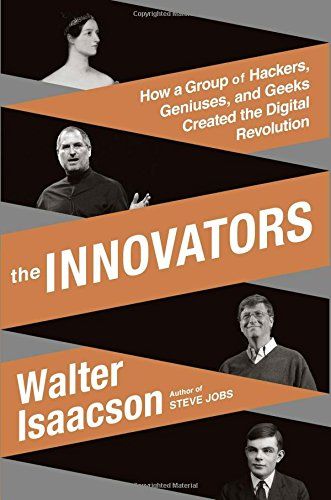
Nova: It really is. It’s the story we’ve been told our whole lives. But what if that story is mostly a myth? That’s the explosive idea at the heart of Walter Isaacson’s brilliant book, "The Innovators." He argues that the real story of the digital revolution is far more interesting and, frankly, more human. It’s a story of collaboration.
alan: Which feels much more true to my own experience. Nothing significant gets built by one person.
Nova: Exactly. And that’s what we’re going to explore today. We’re going to look at the commonalities of history's greatest innovators through the lens of this book. Today we'll dive deep into this from two perspectives. First, we'll debunk that myth of the lone genius by uncovering the incredible power of teams. Then, we'll zoom in on one of the most potent forms of collaboration: the partnership between a visionary and an engineer. Ready to rewrite some history?
alan: I can't wait. Let's do it.
Deep Dive into Core Topic 1: The Collaborative Imperative
SECTION
Nova: Alright, so let's start by tearing down that statue of the lone genius. Isaacson’s central argument is that innovation is, and has always been, a team sport. And there's no better example of this than the story of the world's first general-purpose electronic computer, the ENIAC.
alan: Right, the giant machine from the 1940s. I mostly know the names of the men credited with building it, John Mauchly and J. Presper Eckert.
Nova: And they were brilliant hardware engineers, no doubt. They built this behemoth during World War II for the U. S. Army to calculate artillery firing tables. It was a room-sized monster of wires, vacuum tubes, and switches. But here's the crucial part Isaacson highlights: a computer without a program is just a very expensive, very large hunk of metal.
alan: It's just a space heater, really. It can't do anything.
Nova: Precisely. And in the 1940s, there was no such thing as a programming language. There was no software. So the Army hired a team of six brilliant female mathematicians to be the first-ever programmers. Their names were Kay McNulty, Betty Jennings, Betty Snyder, Marlyn Meltzer, Fran Bilas, and Ruth Lichterman.
alan: I'm embarrassed to say I've never heard those names before.
Nova: You're not alone, and that's the point. For decades, they were written out of the story. When the ENIAC was unveiled to the public, the men were celebrated, and the women who made it work were treated like models, just there to stand and look pretty next to the machine. But their work was monumental. They were given only the wiring diagrams for the machine—no instruction manual, no one to ask for help—and were told, 'Figure out how to make it calculate a differential equation.'
alan: That's an unbelievable task. It's like being given a car engine in a million pieces with no instructions and being told to invent the concept of driving.
Nova: What a perfect analogy. They had to invent the very discipline of programming from scratch. They would crawl inside the machine, physically plugging and unplugging cables on these massive patch panels to route data and instructions. It was this intense, collaborative process of huddling together, drawing flowcharts on the floor, and debugging their logic by hand. They were the world's first software team.
alan: That's incredible, Nova. It completely reframes the story. It wasn't just about the hardware; it was about the human logic applied to it. This is the absolute origin story of the hardware-software divide, and it shows that from day one, the software side—the thinking, the logic, the user's intent—was just as, if not more, critical.
Nova: And it was done as a team. They succeeded because they worked together, bouncing ideas off each other, checking each other's work. It was a collective genius.
alan: You know, it reminds me so much of the best modern software teams. The concept of pair programming or mob programming, where developers work together on one problem—it’s not a new idea. It’s right there at the very beginning. It also strikes me, as someone building a team, how vital it is to recognize and celebrate every contribution, not just the most visible ones. These women were the soul of the machine, and they were treated like ghosts. It’s a powerful lesson about value and recognition in innovation.
Nova: A powerful and, sadly, a recurring one. But it proves the point so beautifully: the first great leap in computing wasn't the act of a lone genius, but a symphony of collaboration.
Deep Dive into Core Topic 2: The Visionary-Engineer Symbiosis
SECTION
Nova: And that idea of a symphony brings us perfectly to our second point. Because while innovation requires a team, Isaacson shows that one of the most common and powerful patterns is a partnership of two people with perfectly complementary skills. We're talking about the symbiosis between the visionary and the engineer.
alan: Ah, the classic duo. The dreamer and the doer.
Nova: Exactly. And there is no more iconic example in the entire history of technology than Steve Jobs and Steve Wozniak.
alan: The two Steves. The foundation of Apple. It’s a story every tech founder studies.
Nova: It is, but Isaacson tells it in a way that really isolates the magic of their dynamic. Let's go back to the mid-70s, to the Homebrew Computer Club. This was a gathering of hobbyists and geeks in Silicon Valley, obsessed with building their own computers. Steve Wozniak, or 'Woz,' was their quiet, unassuming king.
alan: He was the pure engineer, right? The technical wizard.
Nova: A wizard is the perfect word. Wozniak could design computer circuit boards that were breathtakingly elegant and efficient. He did it for the sheer joy of it, for the intellectual puzzle. He designed what would become the Apple I computer so he could show it off to his friends at the club. He had absolutely no intention of selling it or starting a business. He was just going to give the plans away for free.
alan: That's the hacker ethos right there. Information wants to be free. Build cool stuff and share it.
Nova: Totally. But his friend, Steve Jobs, saw something different. Jobs was not an engineer. He couldn't design a circuit board to save his life. But when he looked at Wozniak's elegant, simple board, he didn't just see a hobbyist's toy. He saw the future. He saw a product. He saw a 'personal computer' that could be sold not just to hobbyists, but to everyone.
alan: And that's the leap. That's the visionary moment. Wozniak made a thing, but Jobs created a around it.
Nova: Precisely. Jobs was the one who said, "Let's sell these." He was the one who pushed to make it a single, fully assembled board, not a kit of parts. He was the one who understood branding, user experience, and the market. He had the vision for what it could become, and he had the relentless drive to make that vision a reality.
alan: This dynamic is the absolute core of my world as a product manager. It's a constant dance. You have brilliant engineers who can build incredible things, the 'Wozniaks'. My job, and the job of any good founder, is to be the 'Jobs' in that equation—not necessarily in terms of personality, but in function. To ask: "Who is this for? What problem does it solve? How do we make this not just functional, but desirable, intuitive, and magical for a user?"
Nova: So you're the bridge between the technical possibility and the human need.
alan: Exactly. You need both. Without Jobs, Wozniak is the most popular guy at the Homebrew Computer Club, and that's it. His genius stays in that room. But without Wozniak, Jobs is just a guy with a lot of intense ideas and no product to sell. One person has the 'what' and 'how,' the other has the 'who' and 'why.' Innovation happens at their intersection.
Nova: Isaacson says that Wozniak's design was a work of art, but it was Jobs who turned that art into an industry. It's this pairing of a brilliant engineer with a savvy visionary that you see again and again throughout the book and throughout tech history.
alan: It's the essential partnership. And it highlights that the 'commonalities of innovators' isn't just a personality trait. It's often about finding your complementary other half.
Synthesis & Takeaways
SECTION
Nova: So, as we pull these threads together, it seems we have two profound commonalities among the great innovators, at least according to Isaacson. First, they almost never work alone; they thrive in collaborative teams.
alan: Right, like the women of the ENIAC, whose collective effort brought the first computer to life. The myth of the lone genius is just that—a myth.
Nova: And second, a recurring pattern for success is that powerful, symbiotic partnership between a visionary who can see the future and an engineer who can build it. The Jobs and Wozniak model.
alan: A model that defines the best product teams to this day. It’s about pairing a deep understanding of the user and the market with deep technical excellence.
Nova: So, for you, alan, as a founder in the AI and education space, what’s the big, actionable takeaway from revisiting these stories?
alan: I think it’s a powerful reminder to be intentional about how you build. It’s not enough to just have a great idea. You have to build a great team. So the takeaway for me, and for anyone listening who is building something, is to look around you. Stop trying to be the lone genius. It's a trap.
Nova: And instead?
alan: Instead, ask yourself two questions. First: 'Have I created a truly collaborative culture where every contribution is seen and valued, where the 'programmers' are as celebrated as the 'architects'?' And second: 'Have I found my other half? Who is the visionary on my team, and who is the master builder? Do we have our Jobs and our Wozniak?' Because if history teaches us anything, it’s that you’re going to need both to change the world.
Nova: A perfect synthesis. Find your team, find your partner. Alan, thank you so much for exploring these ideas with us.
alan: This was fantastic, Nova. Thank you.