

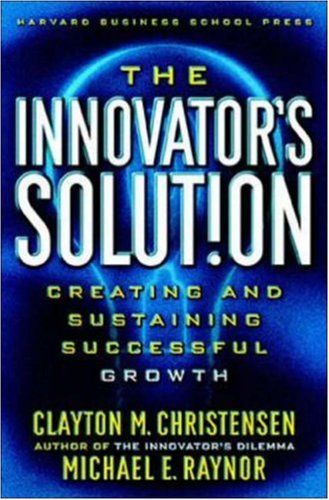
The Innovator's Solution
Creating and Sustaining Successful Growth
Introduction
The Paradox of Success: Why Good Management Fails
Nova: Welcome back to 'The Growth Curve.' Today, we're diving into a book that fundamentally changed how we view market leadership and failure: Clayton Christensen's 'The Innovator's Solution.' Here’s a staggering fact to kick us off: In the 1970s, Digital Equipment Corporation, or DEC, was the undisputed king of computing. They invented the minicomputer, crushing the mainframe giants. Yet, just two decades later, DEC itself was crushed by the personal computer. They did everything right, so what went wrong?
Nova: : That’s the central, terrifying question the book tackles. It’s the sequel, in a way, to 'The Innovator's Dilemma.' If the first book explained great companies fail, this one promises the roadmap for they can survive and even lead the disruption themselves.
Nova: Exactly. Christensen and Raynor shift from diagnosis to prescription. They argue that the very management practices that lead to success in established markets are the ones that guarantee failure when a new, disruptive technology emerges. It’s a masterclass in organizational psychology meeting market dynamics.
Nova: : I’m ready to take notes. I always found the concept of disruption fascinating, but often vague. I need the concrete framework. Where do we start? Is it all about technology?
Nova: Not at all. It starts with understanding the two fundamental types of innovation. This distinction is the bedrock of the entire book, so let's break that down first.
Key Insight 1: Defining the Battlefield
Sustaining vs. Disruptive: The Two Paths of Progress
Nova: Let's define our terms. On one side, we have Sustaining Innovation. This is what most successful companies excel at. It’s about making good products better for your existing, most demanding customers. Think faster processors, higher resolution screens, or more features in your enterprise software.
Nova: : So, if Apple releases an iPhone with a slightly better camera and a faster chip, that’s classic sustaining innovation. It keeps the high-end customers happy and willing to pay a premium.
Nova: Precisely. It follows the established trajectory of performance improvement that the market demands. Now, the Disruptive Innovation is the tricky one. Christensen emphasizes that it almost always starts out than the existing product, based on the metrics the incumbent values.
Nova: : Worse? How can worse be a solution? That seems counterintuitive to every business school lesson about quality and performance.
Nova: That’s the genius of it. Disruptive innovations are simpler, cheaper, smaller, or more convenient. They don't appeal to the incumbent's best customers initially. They appeal to two groups: either customers who were previously by existing products, or, crucially, —people who couldn't afford or access the old technology at all.
Nova: : Ah, the non-consumer angle is key. Like how early personal computers couldn't run complex engineering software like mainframes, but they were cheap enough for a student or a small business owner to buy one just for word processing or basic accounting. They weren't competing on raw power.
Nova: Exactly. The early PC wasn't a better mainframe; it was a tool for a job. Christensen points to the disk drive industry—the 5.25-inch drives weren't better than the 8-inch drives for mainframe storage, but they were small enough to power the nascent desktop market. The incumbent engineers looked at the 5.25-inch drive specs and said, 'That's garbage. Our customers need 1000 megabytes, this only has 10.'
Nova: : And that’s the trap! They were measuring the new thing by the old market’s standards. So, if I understand correctly, sustaining innovation is about moving the performance curve, while disruptive innovation starts at the and moves to eventually intersect and overtake the incumbent’s market.
Nova: You nailed it. The disruptive technology’s performance improves rapidly, eventually meeting the needs of the mainstream market, but by then, the incumbent is too slow and too focused on their high-margin customers to react effectively. This leads us directly to Chapter Two: why the incumbent’s structure actively prevents them from seeing the threat.
Key Insight 2: Organizational Values and Resource Dependence
The Trajectory Trap: Why Good Management Leads to Failure
Nova: In 'The Innovator's Solution,' Christensen argues that the failure isn't due to bad management or complacency; it's due to management. The processes and values that make a company great at sustaining innovation actively repel disruptive innovation.
Nova: : That sounds like a paradox wrapped in an organizational chart. Can you give us the mechanism? Why would a rational manager reject a potentially huge new market?
Nova: It comes down to resource dependence and profit margins. Established companies are dependent on their current, high-paying customers. These customers demand better performance, and they demand high margins. When a disruptive technology emerges, it offers low margins and initially appeals to customers the incumbent barely acknowledges, or worse, customers they actively try to shed because they are too small.
Nova: : So, if a new division proposes a product that will only generate $5 million in revenue in year one, but the parent company requires $50 million just to justify the overhead, the rational decision is to kill the project, even if that $5 million opportunity could become $5 billion later.
Nova: Exactly. The company's internal metrics—its cost structure, its profit expectations, its established customer feedback loops—all scream 'No!' to the disruptive idea. Christensen found that the incumbent's engineers often build the disruptive product, but the couldn't fund it, market it, or value it.
Nova: : It’s like trying to fit a square peg into a round hole, but the hole is the entire corporate structure. The research showed this clearly in industries like steel, right? The big integrated mills couldn't bother with the low-grade scrap metal market that the minimills started with.
Nova: The steel minimills are a textbook case. The integrated mills were focused on high-quality, high-margin sheet steel for auto bodies. The minimills started with rebar—low-grade, low-margin steel made from scrap. The big mills looked at rebar and said, 'Why would we chase that tiny, low-profit market when we can make premium steel?' By the time the minimills had improved their technology enough to produce higher-grade steel, the integrated mills were structurally incapable of pivoting fast enough.
Nova: : It’s a story of rational self-preservation leading to eventual self-destruction. So, if the existing organization is the problem, what is the prescription for creating a successful disruptive venture within a large company?
Key Insight 3: Matching Structure to Opportunity
The Prescription: Creating an Autonomous Home for Disruption
Nova: This is where 'The Innovator's Solution' moves from theory to actionable strategy. Christensen’s main prescription for an incumbent wanting to manage disruption is this: Do not try to force the disruptive business model into the incumbent's existing organizational structure.
Nova: : That means no trying to run the low-margin, simple product line through the same sales team that handles the high-margin flagship product. That team will always prioritize the flagship.
Nova: Absolutely. The solution is organizational separation. You must create a separate, autonomous entity. This new organization needs its own cost structure, its own metrics for success, and crucially, its own customer base—which should be the non-consumers or the low-end users.
Nova: : So, if you’re a major software company, you don't try to sell your new, simple, subscription-based mobile app through your enterprise sales force that deals in million-dollar licensing agreements. You spin it off into a small, agile team that lives and breathes that $9.99 monthly revenue model.
Nova: Precisely. The new organization must be small enough that the disruptive opportunity is to its P&L. If the potential revenue is too small to move the needle for the parent company, it will be starved of resources. The new unit needs to be scaled to the size of the market, not the market.
Nova: : And what about the technology itself? Does the incumbent have to invent something entirely new, or can they use their existing tech?
Nova: Often, the technology is already available, or it’s a simpler version of what they already have. The key is the and the. Christensen stresses that you must manage the correctly. You need to find the market where the incumbent compete effectively, which is usually the low end or the non-consumption space.
Nova: : This sounds like a recipe for internal conflict. How do you keep the parent company from interfering or demanding the new unit conform to legacy processes?
Nova: That’s where the leadership commitment comes in. The parent company must be willing to let the new unit fail on the incumbent’s terms. They must accept that the disruptive unit might look messy, might have lower initial margins, and might even occasionally compete with the parent company later on. The parent must be patient and let the disruptive unit climb the performance trajectory on its own terms, without imposing the high-cost structure of the mother ship.
Case Studies and Critical Nuances
Modern Relevance and The Misuse of 'Disruption'
Nova: Fast forward two decades since this book was published. The term 'disruptive innovation' has become one of the most overused—and often misused—terms in business jargon. We hear about 'disruptive marketing' or 'disruptive pricing' for incremental improvements.
Nova: : It drives me crazy! If a company just makes a slightly better version of an existing product faster, that’s sustaining innovation, not disruption by Christensen’s definition. Uber is often cited as disruptive, but many argue it was actually sustaining innovation for the taxi market—it offered a better, more reliable service to existing riders, albeit with a new business model.
Nova: That’s a major critique found in recent analyses. Christensen himself later clarified that many so-called disruptions—like Netflix’s initial mail-order DVD service—were actually low-end disruptions targeting over-served customers. But when Uber came along, it didn't start by serving non-consumers; it served people who already used taxis, just better.
Nova: : So, the theory is powerful, but its application requires rigorous self-discipline. Companies need to check: Are we targeting non-consumers, or are we just making a better product for our existing, profitable customers? If it’s the latter, it’s sustaining.
Nova: Precisely. The book provides a powerful filter. Another key takeaway for modern companies is the concept of 'job to be done,' which is closely related. Customers 'hire' products to do a specific job. A disruptive innovation offers a cheaper, simpler way to get that done, even if the product itself is inferior on other metrics.
Nova: : I recall reading about how early digital cameras were terrible compared to film—low resolution, poor color. But they could instantly share photos, which film couldn't do. That instant sharing was the 'job' they were hired for by early adopters, even if the image quality was poor.
Nova: A perfect example of the trajectory. The initial market valued instant sharing over image fidelity. The incumbents, like Kodak, were so invested in the high-fidelity film ecosystem that they couldn't pivot to prioritize the new, lower-fidelity, high-convenience job. The book’s enduring value is forcing leaders to look outside their current customer base and ask, 'Who are we serving, and what simple tool could serve them?'
Conclusion
The Mandate for Intentional Growth
Nova: So, let’s synthesize this massive framework. If you take away only three things from 'The Innovator's Solution,' what should they be?
Nova: : First, stop viewing disruption as a random event that happens you. It’s a predictable process. Second, recognize that your current success metrics—your high margins and demanding customers—are your biggest liability when facing a low-end threat. And third, the only way to manage disruption is to create a separate, small, autonomous organization whose P&L is small enough to care about the small, initial disruptive market.
Nova: That’s a perfect summary. The mandate of this book is not just to to disruption, but to it intentionally. It’s about building the organizational muscle to pursue growth where the money isn't yet, but where the future market will be.
Nova: : It’s a tough mandate because it requires leaders to willingly accept lower returns in the short term for the sake of long-term survival. It demands a different kind of courage than simply optimizing the existing business.
Nova: It does. It forces us to confront the idea that sometimes, the most rational thing a great company can do is to invest in something that looks, by all current measures, like a terrible business decision. It’s a challenging, but essential, lesson for anyone leading an established organization in a dynamic world.
Nova: : It certainly reframes how we look at every new startup that seems too small or too simple to matter. We should be watching them closely, not dismissing them.
Nova: Indeed. Thank you for joining us for this deep dive into Christensen’s essential work. This is Aibrary. Congratulations on your growth!