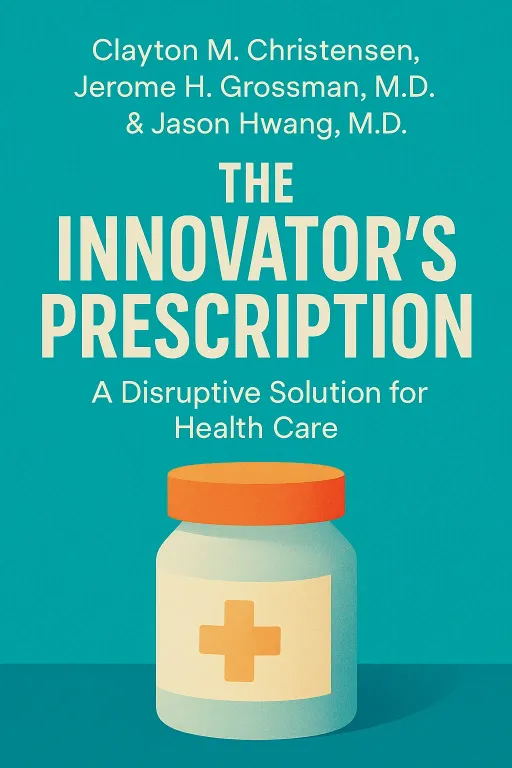
The Innovator's Prescription: Decoding the DNA of Healthcare Disruption
Golden Hook & Introduction
SECTION
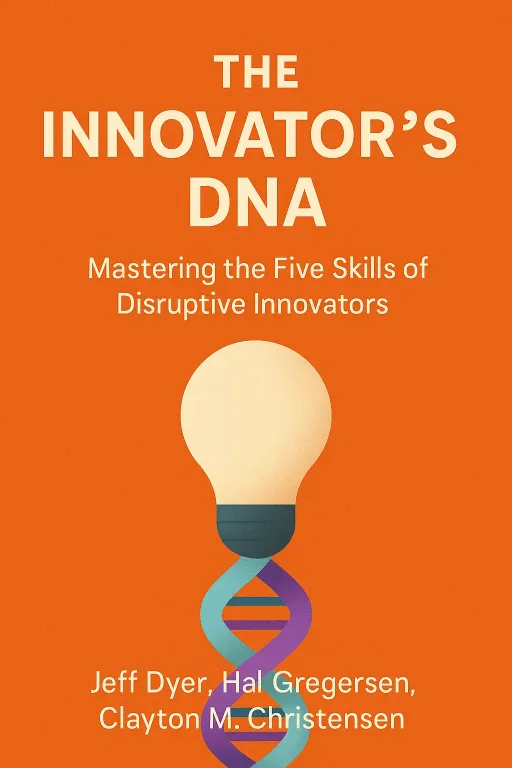
Shakespeare: What if I told you that the key to revolutionizing an entire industry wasn't a stroke of genius, but a simple, almost childlike question? In the 1980s, a young consultant named Orit Gadiesh faced a failing steel company. She knew nothing about steel, but she asked a question that executives had ignored for decades: "Why?" That single word saved a company and redefined an industry. This power to question, to connect, to see the world differently, is what Jeff Dyer, Hal Gregersen, and Clayton Christensen call. And today, with my guest, healthcare professional Atidri, we're going to decode it.
Atidri: It's a pleasure to be here, Shakespeare. That idea—that innovation is a behavior, not a birthright—is something I think about a lot in my own field.
Shakespeare: I can only imagine. The stakes are so high. And that's our goal today: to see if this book offers a kind of prescription for innovation. Today we'll dive deep into this from two perspectives. First, we'll explore the innovator's mindset, focusing on how questioning and connecting ideas can challenge the 'way we've always done it.' Then, we'll discuss the innovator's method, looking at how real-world observation and experimentation can lead to breakthroughs that truly serve people's needs.
Deep Dive into Core Topic 1: The Innovator's Mind
SECTION
Shakespeare: So Atidri, let's start with that core idea. The book argues that innovation isn't magic, it's a set of behaviors. The central engine is 'associating'—connecting different ideas—but it's sparked by 'questioning.' Let's go back to that steel company I mentioned.
Atidri: I'm fascinated by that setup. An outsider in a legacy industry.
Shakespeare: Precisely. So, Orit Gadiesh is a new consultant at Bain & Company. She's assigned to a steel manufacturer that's bleeding money. They're convinced they can't adopt a new, cheaper technology called continuous casting because, they claim, it's impossible to produce their 350 different product variations with it. It's an article of faith in the company.
Atidri: Three hundred and fifty. That number alone sounds like a symptom of a deeper problem.
Shakespeare: Exactly. So Gadiesh, knowing nothing about steel, starts asking questions. She visits the plant. She flies to Japan to see the new technology in action. But the breakthrough comes when she does something no one else thought to do. She goes to the steel company's. And she asks them, "Why do you need all these different types of steel? What job are you hiring this steel to do?"
Atidri: She went to the end-user. In my world, that's going to the patient, not just talking to other doctors.
Shakespeare: And what she found was astonishing. The customers didn't really need 350 variations. Many of the differences were trivial, historical accidents. Through this relentless questioning, she helped the company realize they could serve their market with just thirty products. Thirty! They adopted the new technology, their costs plummeted, and they became a market leader. Her questions sliced through decades of dogma.
Atidri: That story is a powerful metaphor for healthcare. We operate under the weight of 'evidence-based practice,' which is absolutely essential, but it can also lead to what some call 'clinical inertia.' We follow protocols because that's the established, safe path.
Shakespeare: The 'way we've always done it.'
Atidri: Right. Gadiesh's questioning is the antidote. It's asking, 'Is this diagnostic protocol from ten years ago still the best for specific patient population, given the new genetic markers we can now test for?' Or, 'Why do we require this time-consuming paperwork for every admission when 80% of it could be automated?' It's about challenging the 'why' behind the what.
Shakespeare: And the book gives us a fantastic tool for that, borrowed from Toyota and now famous at Amazon: the 'five-whys' process. They tell a story about a safety incident where an Amazon fulfillment center worker seriously injured his thumb on a conveyor belt.
Atidri: Okay, a classic workplace injury scenario.
Shakespeare: So Jeff Bezos himself walks over to a whiteboard. First why: Why did the associate damage his thumb? Because it got caught in the conveyor. Second why: Why did it get caught? Because he was chasing his bag on a running conveyor. Third why: Why was he chasing his bag? Because the conveyor turned on by surprise. Fourth why: Why was his bag on the conveyor in the first place? Because he was using it as a makeshift table.
Atidri: Ah, now we're getting somewhere.
Shakespeare: And the fifth and final why: Why did he use the conveyor as a table? Because there was no place near his workstation to put his personal items. The root cause wasn't carelessness. It was a lack of a simple table.
Atidri: That's a perfect parallel to a hospital setting. A patient falls. The first 'why' is 'they were dizzy.' The second is 'it was a side effect of their medication.' And honestly, the investigation often stops there. We might adjust the dose.
Shakespeare: Blaming the immediate, visible cause.
Atidri: Exactly. But the fifth 'why' might be 'the pharmacy's new software has a confusing user interface, leading to a higher rate of dosage errors across the hospital.' Or 'the ward was understaffed, so the patient waited too long for assistance.' The five-whys methodology forces you to move from blaming an individual—the patient for being clumsy, the nurse for being busy—to fixing a system. That is a profound and necessary shift for improving patient safety. It's about designing a safer environment, not just demanding more vigilance from tired humans.
Deep Dive into Core Topic 2: The Innovator's Method
SECTION
Shakespeare: And moving from fixing a system to creating an entirely new one often starts not with a question, but with a simple observation. This brings us to what the book calls the innovator's method: getting out of the building to gather real-world data.
Atidri: Getting out of the conference room and onto the hospital floor.
Shakespeare: Precisely. The book tells the story of Ratan Tata, the chairman of India's massive Tata Group. It's 2003, he's driving through Mumbai during a monsoon downpour. And he sees a sight that's common, but that day, it hits him differently. He sees a family of four—a father, a mother, two children—all precariously balanced on a single scooter, soaked to the bone, weaving through dangerous traffic.
Atidri: I can picture that vividly. It’s a scene of incredible risk born of necessity.
Shakespeare: And that single, powerful observation sparked a question in his mind: "Why can't this family own a car?" Not a fancy car, but a safe, dry, four-wheeled vehicle. This led to the Tata Nano project, a radical experiment in cost reduction. The goal was to build a car for about one lakh, or roughly $2,200 at the time. The result, the Tata Nano, had its own market challenges, but the act of observing a real human problem and trying to solve it completely disrupted the global auto industry's idea of what a car could be.
Atidri: That is the absolute essence of what we now call 'patient-centered design' or 'human-centered design' in healthcare. You can't innovate from a boardroom by looking at spreadsheets of patient satisfaction scores. You have to be on the ward,.
Shakespeare: What kind of things would you be looking for?
Atidri: You see an elderly patient's family struggling to understand a complex set of discharge instructions filled with medical jargon. You see a nurse creating a 'workaround' with tape and a rubber band to make a clunky piece of IV equipment more user-friendly. Those workarounds are goldmines. They are unmet needs screaming for a solution, just like that family on the scooter. They represent a gap between how a system is designed and how it's actually used.
Shakespeare: And once you have that observation, that identified need, the book says you must. You can't just assume your solution is right. They tell the story of Rent the Runway, the designer dress rental company. The founders, Jennifer Hyman and Jennifer Fleiss, had the idea, but they didn't just go build a massive website and warehouse.
Atidri: That would have been a huge, risky bet.
Shakespeare: Instead, they ran a series of small, brilliant experiments. First, they bought about 100 dresses and set up a pop-up shop at Harvard. They wanted to see: would women rent a dress if they could try it on first? The answer was a resounding yes. Then, they went to Yale, but this time, women could only the dresses, not try them on. Fewer rentals, but still some. The final test was just showing photos to women in New York City. A small percentage, about 5%, were willing to rent based on a picture alone.
Atidri: So they were testing their core assumptions at each step, with minimal investment.
Shakespeare: Exactly. Those small experiments gave them the data and the confidence to build their business model. They learned what worked and what didn't before betting the farm.
Atidri: That's the pilot study model. It's something healthcare needs to embrace more aggressively. We can't just overhaul the entire emergency department workflow overnight. But we pilot a new digital triage process in one shift, with one team, for one week. We can test a new patient communication app with a single department before a hospital-wide rollout. These small, low-risk experiments, just like Rent the Runway's, are how you validate an innovative idea and build the case for larger change without jeopardizing patient care or wasting millions on a flawed assumption.
Synthesis & Takeaways
SECTION
Shakespeare: So, when you put it all together, it's a powerful, continuous cycle. You question the status quo and associate ideas from different fields. You go out into the real world and observe to find the real problems. And you run small, smart experiments to test your solutions.
Atidri: Exactly. It's a diagnostic and therapeutic process, not just for patients, but for the very systems we work in. It demystifies innovation. It's not about waiting for a lightning bolt of inspiration; it's about developing a set of skills and applying them with discipline. It moves innovation from a 'big idea' to a daily practice.
Shakespeare: A daily practice. I love that. So, for everyone listening, especially those in complex, high-stakes fields like Atidri, here's a challenge from the book. A call to action. For one week, become an observer.
Atidri: Put on your anthropologist's hat.
Shakespeare: Yes! Don't try to solve anything. Just carry a small notebook or use your phone, and write down every single 'workaround' you see—by a colleague, a customer, a patient, or even yourself. What are people doing to make a broken process work? What are the unofficial fixes and clever shortcuts? That list, the book argues, is where your next innovation begins.
Atidri: I couldn't agree more. That's not just a list of problems; it's a map to the future.
Shakespeare: Atidri, thank you for bringing such a sharp and relevant perspective to this. It has been a true pleasure.
Atidri: The pleasure was all mine, Shakespeare. Thank you.