The Architecture of Creative Genius
Golden Hook & Introduction
SECTION
Nova: Atlas, I'm going to give you a challenge. Describe "creative genius" in exactly five words. Go!
Atlas: Oh, man, five words? Hmm. "Messy. Persistent. Uncomfortable. Essential. Learnable."
Nova: "Uncomfortable. Learnable." I love that. Especially "learnable." Because today, we're tearing down the myth that creative genius is some divine spark bestowed upon a lucky few, and instead, we're looking at it as an. A structure you can build, brick by brick.
Atlas: Right? My five words tried to capture that exact shift. It’s so often framed as this lightning bolt moment, but what we're really talking about are deliberate actions.
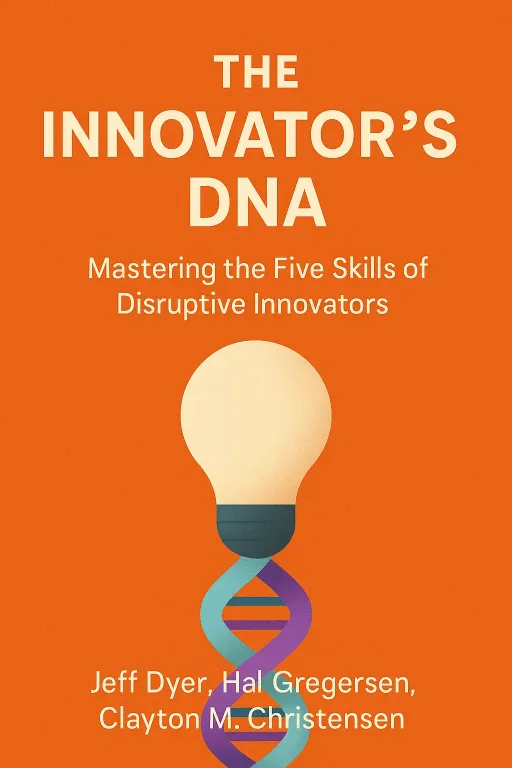
Nova: Absolutely. And we’re drawing from two incredible blueprints. First, "The Innovator's DNA" by Jeff Dyer, Hal Gregersen, and the late, brilliant Clayton M. Christensen. This book wasn't just theory; it emerged from a decade-long study of thousands of successful innovators and entrepreneurs, really pinpointing they actually.
Atlas: Which is so crucial, because you can theorize all day, but seeing the actual habits of high performers—that’s where the real insight is.
Nova: Exactly. And then, we're pairing that with "IdeaFlow" by Jeremy Utley and Perry Klebahn, who come from the heart of Stanford's d. school, emphasizing practical, rapid iteration and getting things done. They really push the idea of generating ideas at speed.
Atlas: So, we’re talking about both the foundational skills and the sheer output required. This already sounds like it’s going to resonate with anyone who’s trying to build momentum, especially when time is a precious commodity.
Nova: Precisely. Because the core of our podcast today is really an exploration of how creative genius isn't some mystical gift, but a set of learnable skills and a strategic numbers game. We're going to dive deep into these discovery skills, then discuss why generating a high volume of ideas is your secret weapon, and finally, give you a concrete strategy to put it all into practice.
The Innovator's DNA - Unlocking Discovery Skills
SECTION
Nova: So, let's start with "The Innovator's DNA." What Christensen and his co-authors found was that highly innovative people aren't necessarily smarter; they just differently. They identified five key "discovery skills" that set these innovators apart.
Atlas: Okay, so it’s not about being born a genius, but about developing specific habits. That's a game-changer for anyone who feels like they're "not creative." What are these skills?
Nova: They are: associating, questioning, observing, networking, and experimenting. Think of them as the building blocks. 'Associating' is about connecting seemingly unrelated ideas. 'Questioning' is about asking "why" and "why not," challenging the status quo. 'Observing' is intense, focused watching of customers, companies, and technologies. 'Networking' is about actively seeking diverse perspectives, not just building a contact list. And 'Experimenting' is about relentlessly testing new ideas.
Atlas: That’s a lot to take in. And for someone who's already juggling a packed schedule, these sound like they could easily become another overwhelming to-do list. How do these translate into building momentum and growth without turning into a full-time job of "discovery"?
Nova: That’s a fantastic point, Atlas. The key here isn't to suddenly become a full-time anthropologist or philosopher. It's about into your existing routines. Let's take 'observing,' for instance. It's not just staring; it's about truly seeing. Imagine a CEO who wants to innovate in their tech company. Instead of just reading market reports, they might spend an hour a week silently watching how their customers use their product, or even a competitor’s product, without intervention.
Atlas: So, like, a silent, almost anthropological study. I can see how that would uncover insights that data alone might miss. Data tells you, but observation can reveal the and the.
Nova: Exactly. Or 'questioning.' Instead of accepting the first answer, it’s about having a "five whys" mindset. When a project hits a snag, instead of just fixing the immediate problem, you ask "why did this happen?" five times to get to the root cause. This isn't about adding hours; it's about changing the of your thought process within the time you already have.
Atlas: So it's less about a sudden spark and more about disciplined curiosity, integrated into daily operations. That's actually quite liberating for someone trying to master new trends or scale a venture; it turns every interaction into a potential learning opportunity.
Nova: It absolutely does. These aren't separate tasks; they're lenses through which you view your work and the world. They build on each other. A great question might lead to a new observation, which could spark an association, prompting you to network with someone new, and then, inevitably, to experiment.
IdeaFlow - The Power of Idea Velocity
SECTION
Nova: Speaking of building momentum and deliberate curiosity, there's another crucial piece to this puzzle that "The Innovator's DNA" sets up beautifully, and "IdeaFlow" doubles down on. It's the idea that the best way to get a good idea isn't to meticulously craft one perfect idea, but to generate a of ideas.
Atlas: Wait, so the best way to get a good idea is to have a lot of bad ones? That feels counterintuitive for someone who values efficiency and direct results. My instinct is always to refine one idea until it’s perfect before I even share it. Isn't that just wasting time?
Nova: That’s a common and very understandable instinct, especially for focused strategists. We’re taught quality over quantity. But Utley and Klebahn introduce the concept of the 'Idea Ratio.' Think about it this way: a stand-up comedian might write 100 jokes to find 10 truly great ones that make it into their set. A scientist might run dozens of experiments where only a few yield significant breakthroughs.
Atlas: I see. So the 'bad' ideas aren't wasted effort; they're the necessary raw material, the stepping stones to the genuinely good ones. It's almost like a filtering process.
Nova: Precisely. And often, the truly innovative ideas aren't just one brilliant thought, but a combination of several seemingly mediocre ones. If you filter too early, you kill those potential combinations. This approach, heavily influenced by design thinking and the rapid prototyping culture at places like Stanford's d. school, is about de-risking through volume. You explore a wider solution space, increasing your chances of finding something truly novel and impactful.
Atlas: That's a good way to put it. So it’s about de-risking by generating options, rather than putting all your eggs in one basket. I can see how that would help with scaling ventures in uncertain markets, where you need to adapt quickly. It means you always have a pipeline of potential solutions.
Nova: Exactly. It's about speed and iteration, not just volume. You're not aiming for perfection in the first draft; you're aiming for. The more possibilities you generate, the more likely you are to stumble upon a breakthrough. It’s a subtle but profound shift in mindset from scarcity to abundance when it comes to ideas.
Synthesis & Takeaways
SECTION
Nova: So, we have the five discovery skills – associating, questioning, observing, networking, experimenting – which are about cultivating a mindset. And we have the Idea Ratio, which is about embracing quantity in your output. How do we combine these powerful insights into something actionable? This is where the 'Idea Sprint' comes in.
Atlas: The 'Idea Sprint.' This sounds like something a pragmatic learner, short on time, can actually implement. What does it entail?
Nova: The recommendation is to implement a daily 'Idea Sprint' where you generate 10 solutions to a single business problem before selecting one to prototype. Just 10 solutions. Every day. For a specific problem.
Atlas: Ten solutions? For someone with a packed schedule, that still sounds like a lot. How do we make this a 'small step that builds momentum' rather than another item on an overwhelming to-do list? And how do you choose which one to prototype? Is there a trick to picking the "best" one?
Nova: That’s the beauty of it. It’s designed to be a focused, finite exercise. Think 20 minutes, maybe even 15. The goal isn't to have 10 solutions, but 10 solutions. It's about exercising that idea generation muscle. You could dedicate your first 20 minutes of work to it, treating it like an important meeting. As for choosing one to prototype, it's often not about the "best" one, but the one that's most feasible to test quickly, or the one that will teach you the most.
Atlas: So it's about rapid iteration and learning, not necessarily picking the grand slam home run every time. That makes sense. It sounds like it's really about building that muscle of creative output and then testing quickly, which sounds like the ultimate productivity hack for growth, especially in fast-moving industries.
Nova: Absolutely. It’s about building a consistent architecture for creative genius, one focused sprint at a time. It shifts creativity from a mysterious gift to a systematic process. By consistently practicing these discovery skills and embracing the power of idea velocity, you're not just waiting for inspiration; you're actively constructing an environment where breakthrough ideas are inevitable.
Atlas: And that's incredibly empowering. It means anyone, regardless of their perceived "creativity," can intentionally become a more potent innovator. It turns the abstract concept of genius into a daily habit.
Nova: Exactly. It democratizes innovation. It tells us that consistent, small, deliberate actions—questioning, observing, generating ideas—are the true engines of profound impact. This isn't just about coming up with a new product; it's about fundamentally changing how you approach problem-solving and growth in any venture.
Atlas: That’s such a hopeful way to look at it. It takes the pressure off the single, brilliant idea and puts it on the consistent, disciplined effort.
Nova: And that, my friend, is how you build an architecture of creative genius. It’s not about waiting for the muse; it’s about showing up and doing the work.
Nova: This is Aibrary. Congratulations on your growth!