The Architecture of Breakthrough Innovation
Golden Hook & Introduction
SECTION
Nova: Atlas, if I asked you to define "innovation" in just five words, what would they be? No pressure, just a lightning round.
Atlas: Oh, I love a good challenge! Five words... Hmm. Okay. "Change, risk, future, fear, breakthrough."
Nova: "Fear"? That's an interesting one to throw in there. Most people jump straight to "new ideas" or "progress." Why fear?
Atlas: Well, I imagine a lot of our listeners, especially those in established careers or larger organizations, feel that innovation often comes with a hefty dose of fear. Fear of failure, fear of the unknown, fear of disrupting the comfortable. Isn't that often the silent partner in any big breakthrough?
Nova: You've hit on something profound there, Atlas. And it's precisely that tension – the desire for breakthrough versus the inherent resistance, whether personal or organizational – that we're diving into today. We’re exploring "The Architecture of Breakthrough Innovation," drawing insights from two incredibly impactful books.
Atlas: Lay them on me. My curious learner ears are perked.
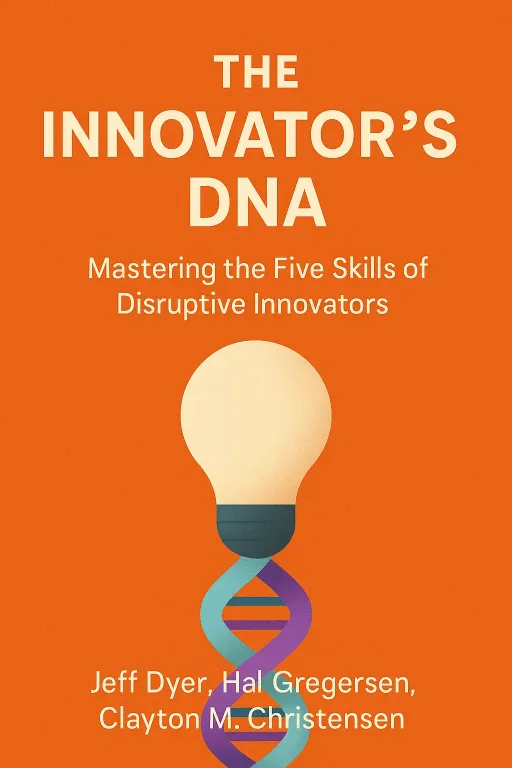
Nova: First up, we have "The Innovator's DNA: Mastering the Five Skills of Disruptive Innovators" by Jeff Dyer, Hal Gregersen, and the late, great Clayton M. Christensen. This book is a foundational text, born from extensive research over a six-year period, where they interviewed thousands of founders and executives, meticulously dissecting top innovators actually think and behave. It really shifted the conversation from innovators do to they are and they cultivate those traits.
Atlas: That makes me wonder if these are innate abilities, or if they’re skills that can actually be developed, like building a muscle? Because I imagine many people feel they're just "not innovative."
Nova: Exactly! And that’s where the second book comes in, providing a crucial, practical counterpoint for the strategic thinkers out there. "No-Excuses Innovation: Driving Growth and Profitability in Business and Life" by Bruce A. Vojak and Walter B. Herbst. This one is less about the individual genius and more about providing a blueprint for mature enterprises to overcome that very internal resistance you mentioned, and drive meaningful, systematic change. It's about making innovation happen, no excuses.
Atlas: So, we're talking about both the personal toolkit and the organizational landscape. That's a powerful combination, especially for anyone looking to build a strong career foundation and make impactful choices. So where do we start with building that individual toolkit?
The Innovator's DNA: Cultivating Discovery Skills
SECTION
Nova: We start with the core of "The Innovator's DNA": the five discovery skills. These aren't about execution; they're about how innovators. They are: associating, questioning, observing, networking, and experimenting. Think of them as the building blocks of innovation.
Atlas: That sounds like a lot to master. Can you give us an example of one of these in action? Like, what does "associating" even mean in practice?
Nova: It's one of the most fascinating ones! Associating is the ability to connect seemingly unrelated questions, problems, or ideas from different fields. It’s about synthesizing information. Think of it like this: your brain is a giant pinball machine, and every piece of information you take in is a bumper. The more diverse bumpers you have, the more interesting the connections and collisions become.
Atlas: Right, like finding patterns where others just see chaos.
Nova: Precisely. The classic example is Steve Jobs. He famously took a calligraphy class in college that, at the time, seemed utterly irrelevant to his tech aspirations. Years later, when designing the Macintosh, he remembered the beauty of different typefaces and proportional spacing. He associated that artistic discipline with computer typography, and —the Mac became the first computer with beautiful fonts, a defining feature that set it apart. No one else was thinking about fonts in computers back then.
Atlas: Wow, that’s incredible. So, he wasn't just executing a plan; he was drawing from a diverse well of experiences. But how do you that? I can't just sign up for a random calligraphy class and expect to be the next Jobs.
Nova: That’s a great question, and it speaks to the core of what these authors found. These aren't passive traits; they're active behaviors. For associating, it means exposing yourself to diverse stimuli. Read books outside your field, visit art galleries, talk to people with vastly different jobs or hobbies. Force yourself to look for connections between disparate things.
Atlas: So, it's about broadening your input, almost intentionally creating more "bumpers" in your brain's pinball machine. That sounds like a very actionable step for someone who values self-growth. What about "questioning"? That seems more straightforward, but I bet there’s a deeper layer to it.
Nova: Absolutely. Innovators don't just ask; they ask questions that challenge the status quo. They constantly ask "Why?" and "Why not?" and "What if?" Edwin Land, the founder of Polaroid, was famous for this. His daughter once asked why she couldn't see the photo he'd just taken immediately. Instead of dismissing it, he asked, "Why not?" That simple, childlike question led to the invention of instant photography. He challenged a fundamental assumption of photography at the time.
Atlas: That’s so powerful. It makes me think of all the times we just accept "that's how things are done" without ever digging into the "why." So, practicing questioning means consciously challenging assumptions, even the ones we hold ourselves.
Nova: Exactly. And the beauty of these skills is that they feed each other. Questioning leads to observing, which leads to networking, and all of it fuels your ability to associate and experiment. It’s a virtuous cycle. The core takeaway here is that you don't have to be a born genius; you can your innovative edge. But here's the rub: what happens when you bring these individually powerful skills into an organization that perhaps isn't designed to embrace them?
No-Excuses Innovation: Overcoming Organizational Inertia
SECTION
Atlas: That’s the million-dollar question, isn't it? I can imagine all our strategic thinkers out there, diligently practicing their discovery skills, only to hit a brick wall of bureaucracy and "that's not how we do things here."
Nova: It’s a very real challenge, and it's precisely what Vojak and Herbst tackle in "No-Excuses Innovation." They argue that while individual skills are vital, mature enterprises often have deep-seated, systemic resistance to meaningful change. It’s not just one person saying "no"; it's the entire architecture of the organization. Think about a legacy tech company, for example. They might have brilliant engineers experimenting in their labs, but if their sales channels are entrenched, their leadership is risk-averse, and their incentive structures punish failure, those individual sparks of innovation can easily be extinguished.
Atlas: So, it's not enough to have a few innovative individuals; the environment itself has to be fertile ground. But how do you change something as massive and complex as an entire corporate culture? That sounds like trying to turn a supertanker with a paddle.
Nova: It’s not easy, but Vojak and Herbst offer a blueprint. They emphasize that innovation isn't just about R&D; it's about leadership, culture, and processes. It requires leaders who are not only willing to take risks but who actively champion a culture of experimentation and learning, rather than just execution. They talk about creating "innovation champions" and dedicated teams with clear mandates, protected from the day-to-day pressures of the core business.
Atlas: So, it’s about creating pockets of fertile ground, almost like internal startups, within the larger organization. That makes sense, but it still feels like a huge undertaking. For someone who wants to make impactful choices, how do they navigate that tension? How do they drive change without becoming completely disillusioned?
Nova: It comes down to understanding that systemic change often starts small. You can be an innovation champion at any level. It might mean advocating for a small experimental project, building a coalition of like-minded individuals, or simply demonstrating the value of a discovery skill in your immediate team. The book stresses that it requires a "no-excuses" mindset from – leaders have no excuse for not fostering innovation, and individuals have no excuse for not trying to drive it.
Atlas: That’s a powerful shift in perspective. Instead of waiting for permission, it’s about taking agency, even within a challenging environment. It’s about making those strategic choices to push for change where you can.
Synthesis & Takeaways
SECTION
Nova: Exactly. What ties these two powerful books together is the recognition that innovation is both an individual journey and an organizational imperative. "The Innovator's DNA" gives us the personal toolkit—the five discovery skills that can transform how we think and generate ideas. "No-Excuses Innovation" then shows us how to translate those individual sparks into sustainable, systemic change within even the most resistant environments.
Atlas: So, for our curious learners and strategic thinkers, what's the one most impactful thing they can do, starting today, to build that innovative edge and strong career foundation?
Nova: It's beautifully simple, and it comes directly from the synthesis of these ideas: don't just execute; practice one 'discovery skill' daily. Don't try to master all five at once. Pick one – like questioning a standard process at work, or observing how customers actually use a product, or networking with someone completely outside your usual circle. Just one, for 15 minutes.
Atlas: I love that. It makes it feel approachable, not overwhelming. It's not about inventing the next big thing overnight, but about cultivating a habit of discovery. That’s going to resonate with anyone who feels overwhelmed by options and seeks clarity.
Nova: Absolutely. It’s about embracing the journey of discovery, understanding that every small question, observation, or connection builds towards a more innovative you, and ultimately, a more innovative world. That daily practice is your personal architecture for breakthrough.
Atlas: That’s such a hopeful way to look at it. It’s not just about the big, flashy ideas, but the consistent, deliberate practice that leads to them.
Nova: Indeed. And that consistent practice is how you build a strong career foundation, one curious question and one new connection at a time.
Atlas: This is Aibrary. Congratulations on your growth!