

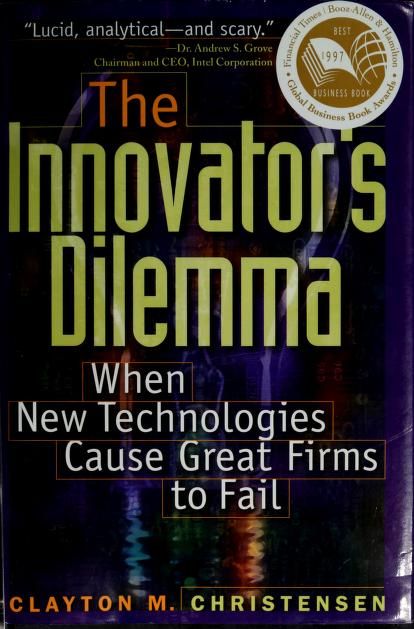
The Innovator's Dilemma
Introduction: The Paradox of Success
Introduction: The Paradox of Success
Nova: Welcome to 'Strategy Shift,' the podcast where we dissect the foundational texts that shape modern business. Today, we are diving into a book that is arguably responsible for coining the most overused business buzzword of the last two decades: Clayton Christensen’s 1997 masterpiece, The Innovator's Dilemma.
Nova: Exactly. The central paradox is that the very management practices that lead to success in established, high-performing companies are the exact mechanisms that cause them to stumble when faced with a specific type of technological change. It’s not about incompetence; it’s about competence.
Nova: Terrifying, but incredibly illuminating. Over the next hour, we’ll break down what Christensen calls 'disruptive innovation,' explore the classic case studies that prove his theory, and figure out the counterintuitive steps required to escape the dilemma. Ready to explore the dark side of good management?
The Fatal Flaw of Success
The Paradox of Good Management
Nova: Let's start with the foundation. Christensen argues that the failure isn't due to bad managers, but managers. They follow established, rational decision-making processes. These processes prioritize sustaining innovation.
Nova: Precisely. Sustaining innovation is about making good products better. It targets your existing, high-value customers with higher performance, better features, and often, higher margins. Think of a car company releasing a model with a slightly more fuel-efficient engine or a better infotainment system. That’s sustaining innovation. It’s essential for survival in the current market.
Nova: It breaks down when a technology emerges. Disruptive innovations, by Christensen’s definition, are initially simpler, cheaper, smaller, and often than established products according to the metrics that mainstream customers currently value. They usually target an entirely different segment—often the low end of the market or an entirely new, non-existent market.
Nova: That’s the dilemma! Your best customers—the mainframe manufacturers, for example—don't want that tiny drive. They demand more capacity, faster access times. If you dedicate resources to that low-margin, low-capacity product, you risk upsetting your most profitable clients and diverting resources from your core business that is currently thriving.
Nova: That’s the crucial second part of the theory. Disruptive technologies have a different trajectory of improvement. While the incumbent is busy making their high-end product incrementally better for their high-end customers, the disruptive technology improves rapidly along its own trajectory, eventually crossing over the performance threshold required by the mainstream market.
Nova: Christensen notes that in nearly every case he studied, the established leaders were aware of the new technology. They weren't ignorant. They simply couldn't justify the investment using their existing financial models and customer feedback loops. It’s a failure of, not. The company is trapped by its own success metrics.
Performance Trajectories
Sustaining vs. Disruptive: The Two Paths of Innovation
Nova: Imagine a graph. The Y-axis is performance—capacity, speed, whatever the customer values most. The X-axis is time. Sustaining innovation creates a steep, upward-sloping line. Companies are constantly pushing that line higher, meeting the increasing demands of their most sophisticated customers. For instance, in the 1980s, the high-end disk drive market was dominated by 14-inch drives, then 8-inch drives.
Nova: Exactly. They managed the sustaining innovation perfectly. Now, look at the disruptive technology, say, the 5.25-inch drive that came next. Initially, the 5.25-inch drive offered abysmal capacity compared to the 8-inch drives. If you were an 8-inch drive maker, you looked at the 5.25-inch drive and saw maybe 10% of the capacity at a lower margin. It was a terrible business proposition.
Nova: And here’s the critical insight: the rate of improvement for the disruptive technology often outpaces the rate at which mainstream customers can absorb that improvement. The 5.25-inch drive improved its capacity so fast that within a few years, it met the minimum requirements of the 8-inch drive’s customers. But by then, the 8-inch drive makers had already invested heavily in their own architecture and were structurally incapable of pivoting to the new, smaller standard profitably.
Nova: A fantastic analogy. Christensen found this pattern repeated across industries: mechanical excavators replacing cable-operated shovels, and later, smaller excavators disrupting the larger ones. In every case, the incumbent was technically capable but organizationally constrained from serving the low-end market that the disruptive technology initially created or targeted.
The Low-End Foothold
The Anatomy of Disruption: Starting Small and Ugly
Nova: Let’s zoom in on the classic disk drive saga, because it’s the clearest illustration. We’re talking about the evolution from 14-inch to 8-inch, to 5.25-inch, to 3.5-inch, and ultimately the 1.8-inch drives that powered early laptops. The established leaders in the 14-inch market were the giants of their day.
Nova: But the 8-inch drive technology improved its density rapidly. Soon, it was good enough for the lower end of the mainframe market. The 14-inch leaders watched this happen, but they couldn't shift their entire manufacturing base and cost structure to compete on the lower end without cannibalizing their massive profits from the 14-inch segment.
Nova: The 1.8-inch drive is the final, brutal chapter in this sequence. It was developed specifically for the emerging portable electronics market. Companies that were leaders in the 3.5-inch space—the PC standard—often failed to adopt the 1.8-inch format, even though they had the technical know-how. Why? Because the 1.8-inch drive was initially too expensive per megabyte for the low-end applications it served, and the margins were non-existent compared to their established PC business.
Nova: Exactly. Christensen emphasizes that the company’s —the things they prioritize, like high gross margins and serving large customers—become the very things that prevent them from embracing the future. The dilemma isn't about technology; it's about organizational structure and financial incentives. The success of the incumbent creates the very blindness that allows the disruptor to gain a foothold.
Organizational Separation
The Prescription: How to Survive the Dilemma
Nova: The core prescription is organizational separation. You cannot ask the existing, successful business unit to nurture a disruptive technology. The processes, cost structures, and customer demands of the core business will inevitably starve the disruptive venture to death.
Nova: Correct. Christensen advises creating a completely separate, autonomous organization, often physically separated, with its own P&L, its own customer base, and its own cost structure. This new entity must be free to pursue the low-margin, small-market opportunity without the pressure of the parent company’s financial expectations.
Nova: Absolutely not. The management style must match the market. If the disruptive technology is targeting a nascent market, the new organization needs to be comfortable with ambiguity, small initial revenues, and a high tolerance for failure on the path to finding product-market fit. They need to be managed for and, not for efficiency and predictable quarterly growth.
Nova: It requires patience and a clear mandate: this entity exists to figure out how to serve the low-end or new market, and it must be allowed to develop its own processes that are appropriate for that market. Once the disruptive technology matures and its performance trajectory starts to meet the needs of the mainstream market, the parent company can consider integrating it, or acquiring it back into the core structure, because the margins will finally be attractive enough.
Nova: It’s the enduring lesson. To manage disruption, you must manage it. You must create an organizational home where the unattractive economics of the disruptive technology look attractive—which means creating a small organization whose expectations for revenue and profit are also small.
The Overused Buzzword
Legacy and Critique: Hindsight and Hype
Nova: The most significant critique, often highlighted by writers like Jill Lepore, is that the term 'disruptive innovation' has been diluted to mean 'any successful innovation.' People now call Uber disruptive, or Netflix disruptive, simply because they succeeded against incumbents. But Christensen was very specific.
Nova: That’s the nuance often lost. The iPhone was a massive technological leap, but it didn't start by being 'worse' than the existing Blackberry or Nokia devices in the metrics those users cared about—like enterprise security or battery life initially. It was superior, but it created a new market segment that eventually swallowed the old one. Christensen himself later clarified that the term had become too broad.
Nova: Yes. Christensen’s work isn't deterministic. He showed that success is possible when companies adhere to his prescriptions—like creating those separate organizations. Companies that successfully navigated transitions often did so by spinning off the disruptive unit early and letting it operate independently, rather than trying to force it into the main company’s structure.
Nova: Precisely. It’s a diagnostic tool. It forces introspection about resource allocation and organizational inertia. Even if the definition is sometimes misused, the underlying mechanism—the conflict between serving the present and investing in the future—remains profoundly relevant in the age of AI, blockchain, and rapid software deployment.
Conclusion: Escaping the Trap
Conclusion: Escaping the Trap
Nova: We’ve covered a lot of ground today, Alex. From the paradox where good management leads to failure, to the distinct performance trajectories of sustaining versus disruptive innovation.
Nova: And the actionable advice is clear: Don't try to force the disruptive technology into the existing structure. Create a separate entity with its own metrics, its own customer base, and its own mandate for learning. That entity must be allowed to fail small and learn fast, without being judged by the profit expectations of the core business.
Nova: It’s about managing two different time horizons simultaneously. The incumbent must continue to feed the present through sustaining innovation while simultaneously planting seeds for the future through nurtured, separate disruptive ventures. It’s a constant balancing act that requires vigilance, because the moment the disruptive venture becomes 'big enough' to matter to the core business, the dilemma reasserts itself.
Nova: My pleasure, Alex. The lesson is clear: success breeds rigidity. To survive tomorrow, you must be willing to undermine your success today, strategically and intentionally. This is Aibrary. Congratulations on your growth!