

The Engineer's Edge: Deconstructing the Innovator's Dilemma
Golden Hook & Introduction
SECTION
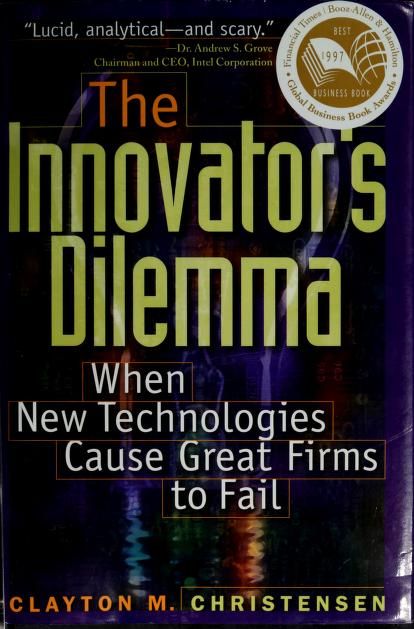
Nova: What if I told you that doing everything right—listening to your best customers, investing in your most profitable products, and chasing higher margins—is the single biggest reason great companies fail? It sounds like a paradox, right? But it’s the brutal reality at the heart of one of the most important business books ever written: Clayton Christensen’s. This isn't just a theory; it's a pattern that has toppled giants in industry after industry.
Peris Karanga: It's an idea that's both terrifying and incredibly exciting. As a founder, you're always looking for that crack in the armor of the big players, and Christensen essentially gives you a map to find it.
Nova: Exactly! And that's why I'm so thrilled to have you here, Peris. As an entrepreneur in the engineering and manufacturing space, you live on the other side of this dilemma every single day.
Peris Karanga: I try to, anyway. It's a fascinating framework.
Nova: Well, let's get into it. Today, we're going to deconstruct this with your unique perspective. We'll dive deep into this from two angles. First, we'll explore the 'Trap of Excellence'—the fundamental difference between the innovations that keep you safe and the ones that change the world. Then, we'll uncover the 'Chains of the Value Network,' explaining exactly why large, successful companies find it almost impossible to escape this trap, and where that leaves the door wide open for people like you.
Peris Karanga: Sounds perfect. Let's do it.
Deep Dive into Core Topic 1: The Trap of Excellence
SECTION
Nova: Alright, so let's start with that map. Christensen's first big, crucial distinction is between two types of innovation: sustaining and disruptive. Let's make this real with his classic example: the disk drive industry.
Peris Karanga: The one that basically imploded and rebuilt itself multiple times.
Nova: Multiple times! It's the perfect laboratory. So, imagine it's the 1970s. The kings of the computer world are mainframe companies—think giant rooms full of humming machines. They buy 14-inch disk drives, these massive platters that store data. The companies making these drives are brilliant. They are masters of what Christensen calls.
Peris Karanga: Meaning they're just making their existing products better for their existing customers.
Nova: Precisely. Their mainframe customers are saying, "We need more storage! We need it to be faster!" And these companies deliver, year after year, making the drives a little faster, with a little more capacity. They are doing everything right, listening to their best customers and giving them exactly what they're paying top dollar for.
Peris Karanga: A classic, healthy business model.
Nova: You'd think so. But then, a tiny startup comes along with an 8-inch drive. Now, on the metrics that matter to the mainframe market, this thing is a joke. It's smaller, sure, but it has way less storage and it's slower. It's an objectively worse product.
Peris Karanga: So the established companies' engineers could have easily built an 8-inch drive, right? The technology itself wasn't the barrier.
Nova: That's the absolute key to the whole dilemma! Of course they could. Their engineers were the best in the world. They probably prototyped it in a lab. But then the managers did their job. They took the 8-inch drive concept to their best customers—the mainframe companies—who looked at it and said, "Why would we ever want that? It's not powerful enough for our needs. Get this toy out of here."
Peris Karanga: And the manager, making a completely rational financial decision, says, "Okay, no market for this. Let's focus our resources on the high-margin 14-inch drives that our customers are actually asking for."
Nova: Exactly! A decision that gets them a promotion. But here's the twist. The 8-inch drive wasn't for mainframes. It was for a brand-new, emerging market: minicomputers. A market the big guys weren't even serving. The startups making these 8-inch drives weren't trying to steal the mainframe customers; they were creating entirely new ones who valued different things.
Peris Karanga: They valued the smaller size and lower cost more than they valued raw capacity. It was 'good enough' for their new application.
Nova: And once they got that foothold, the technology improved. The 8-inch drives got better and better until, eventually, they good enough for the low-end mainframe market. But by then it was too late. The startups owned the market. And the cycle repeated itself viciously. The successful 8-inch companies were then blindsided by 5.25-inch drives for the new personal computer market.
Peris Karanga: Which they, in turn, probably dismissed. Their minicomputer clients didn't need a 5.25-inch drive.
Nova: They didn't! And then the 5.25-inch leaders were disrupted by 3.5-inch drives for laptops. Each time, the established, successful, well-managed leader was too focused on serving its best customers to see the new, seemingly 'inferior' technology that was busy creating a whole new world.
Peris Karanga: You know, that's the playbook for a startup right there. It's not about building a better, cheaper version of what the incumbent sells. That's a fight you'll probably lose. It's about finding a new application, a new customer base, that values different attributes—like size, energy consumption, cost, or simplicity—over the raw performance metrics the leaders are chasing.
Nova: That's such a great way to put it. You're not just innovating on the product; you're innovating on the customer.
Peris Karanga: Exactly. You're finding who the big guys are actively ignoring.
Deep Dive into Core Topic 2: The Chains of the Value Network
SECTION
Nova: And that brings us perfectly to our second point. Why is this pattern so inescapable? Why do smart leaders keep falling into this trap? It's not just a series of bad decisions; it's what Christensen calls the 'value network.'
Peris Karanga: The ecosystem that holds a company captive.
Nova: Yes! The whole web of suppliers, investors, and most importantly, customers. Their expectations and profit formulas create invisible walls. Let's switch from high-tech to heavy machinery to see it in action. Think about mechanical excavators in the 1960s.
Peris Karanga: Big, loud, diesel-powered machines.
Nova: The biggest! You have these huge, powerful, cable-operated excavators made by companies like Bucyrus-Erie. They are the undisputed titans of massive construction projects—dams, highways, quarries. They are masters of their craft. Then, hydraulics come along.
Peris Karanga: A completely different technology for providing force.
Nova: Right. And initially, hydraulic excavators are weak. They're pathetic compared to the mechanical giants. They can't move nearly as much earth. The only thing they're good for is small-scale, niche jobs, like digging narrow trenches for residential utility lines.
Peris Karanga: A job that a big construction company using a massive Bucyrus-Erie machine would see as a low-margin distraction. The numbers just wouldn't work for their business model.
Nova: Precisely! The profit margins are tiny compared to selling a million-dollar mechanical beast for a dam project. So Bucyrus-Erie's whole organization—from its R&D department focused on stronger steel cables to its sales team that has relationships with huge construction firms—is built to serve the 'big project' value network. They are trapped in their own success.
Peris Karanga: And meanwhile, the hydraulic technology is quietly getting better.
Nova: Not just better—it's on a much, much steeper improvement curve. This is the 'Technology S-curve' concept you mentioned earlier. The mechanical technology was at the top of its S-curve—it was mature, and any new investment only yielded tiny, incremental improvements.
Peris Karanga: Whereas the hydraulic tech was at the bottom of a brand new S-curve. Every dollar invested in R&D was yielding massive leaps in performance.
Nova: You nailed it. And so, year after year, the hydraulic excavators got more powerful. First they could only dig small trenches. Then they were strong enough for basements. Then for small roads. And then, one day, they became so powerful they could do everything the mechanical ones could, and more, with greater precision and reliability.
Peris Karanga: And by the time the big players like Bucyrus-Erie realized the threat was real, it was all over. The hydraulic companies already owned the market, they had the best engineers, the manufacturing expertise, the brand recognition in that space... everything.
Nova: It was a total market takeover. Bucyrus-Erie, once an industrial giant, a pillar of American manufacturing, eventually went bankrupt. They were killed by a technology they saw, understood, and rationally ignored because it didn't fit their value network.
Peris Karanga: This is so incredibly relevant for manufacturing today. You see the exact same pattern with additive manufacturing, or 3D printing, versus traditional subtractive manufacturing like CNC machining. For years, the argument from established players was, '3D printing is just for prototypes. It's too slow, the parts aren't strong enough for production.'
Nova: They were judging it by the metrics of their current value network.
Peris Karanga: Exactly. But they were ignoring the new value networks it was creating—in custom medical implants, in rapid tooling for assembly lines, in aerospace where complex, lightweight parts are worth a fortune. An entrepreneur's job is to bet on that steep S-curve. You build a business around the value network that needs the technology, even if that network seems small or unprofitable to the giants.
Synthesis & Takeaways
SECTION
Nova: So, to bring it all together, the innovator's dilemma is this brutal, ironic trap where the logical, profit-focused decisions that strengthen a company in the short term—listening to your best customers, investing in your most profitable products—are the very things that cause it to miss the next wave of innovation.
Peris Karanga: And from the other side, for an entrepreneur, it's a gift. It's not a bug, it's a feature of the market. The blind spots of large corporations are the fertile fields where new ventures can grow. They are structurally, almost physically, unable to chase the small, uncertain, low-margin markets that are the seedbeds of the future.
Nova: That's a powerful reframe. Their disability is your opportunity. So, as we wrap up, what's the one piece of advice you'd give to another founder or engineer listening to this, based on Christensen's work?
Peris Karanga: I'd say, don't just ask 'What problem can my technology solve?' That's only half the question. The more important question is, 'Whose problem is being ignored or poorly served by the current market leaders?' Look for the customers who are actually by the expensive, complex solutions of today. Find the people who would be absolutely thrilled with something simpler, cheaper, more convenient, or 'good enough.'
Nova: Find the people who want the 8-inch drive, not the 14-inch one.
Peris Karanga: Exactly. That's where disruption begins. Don't try to fight Goliath on his terms, in his castle. Create a whole new battlefield that he doesn't even see until you've already won.
Nova: A perfect, actionable takeaway. Peris, this has been an incredibly insightful conversation. Thank you so much for helping us deconstruct this.
Peris Karanga: My pleasure. It's a book every person in tech or manufacturing should read.