

The 'Why We Play' Paradox: Rethinking Peak Performance.
Golden Hook & Introduction
SECTION
Nova: Atlas, five words. Describe your typical Monday morning before coffee.
Atlas: Chaos, emails, dread, more chaos, repeat.
Nova: Perfect. Now, five words for what your Monday morning could feel like if you truly mastered your inner game.
Atlas: Focused, effortless, engaged, joyful, unstoppable.
Nova: Unstoppable. I love that. And that's exactly what we're talking about today, that profound shift from dread and external pressure to an internal sense of effortless mastery. We're diving into a book that, surprisingly, started on the tennis court but quickly became a foundational text for understanding performance far beyond any game.
Atlas: Oh, I'm intrigued. What's the book that promises to transform my chaotic Mondays into unstoppable ones?
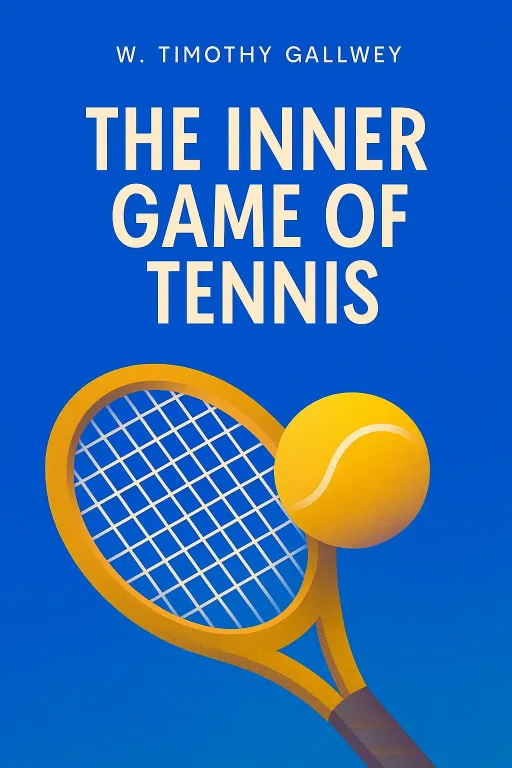
Nova: Today, we're cracking open "The Inner Game of Tennis" by W. Timothy Gallwey. What's fascinating about Gallwey is that he wasn't a traditional coach shouting instructions. He was a former tennis coach who stumbled upon these groundbreaking insights not through conventional methods, but by observing what truly unlocked his students' potential. He often found himself teaching them less, rather than more, allowing their natural abilities to shine.
Atlas: That makes me wonder, if it's not about more instruction, then what it about? Because for so many of us, especially in high-pressure environments, the default is always to try harder, to push through, to add more to the plate.
Nova: Exactly. And that leads us straight into the heart of Gallwey's work: the 'opponent within.'
The 'Opponent Within': Quieting Self 1 for Peak Performance
SECTION
Nova: Gallwey argues that our biggest adversary isn't the person across the net, or the deadline looming, or the market competitor. It's the 'opponent within'—that constant chatter, the self-doubt, the overthinking, the critical voice in our own heads. He brilliantly calls this 'Self 1.'
Atlas: Oh, I know Self 1 intimately. It’s the voice that tells me, "Don't mess this up," right before I mess it up. Or, "You should have started this earlier."
Nova: Precisely. Self 1 is your conscious, critical, instructing mind. It's the part that says, "Keep your eye on the ball! Bend your knees! Follow through!" And while it thinks it's helping, what it actually does is interfere with 'Self 2,' which is your intuitive, performing self. Self 2 is the part that just. It's the part that knows how to swing a racket, or write a brilliant email, or navigate a complex negotiation, without conscious instruction.
Atlas: So you're saying that when I'm overthinking a presentation, meticulously planning every word, that's my Self 1 derailing my Self 2, which could just deliver a compelling message naturally?
Nova: Exactly. Think of a tennis player who suddenly starts thinking about their backhand technique mid-swing. The moment they consciously analyze it, their natural flow is disrupted, and the shot goes wide. Their Self 1, trying to "correct" things, actually makes them falter. This isn't just about sports; it translates directly to any field. A musician might hit a wrong note when they start thinking about their finger placement instead of just feeling the music. A manager might stumble during a crucial speech because they're too busy internally critiquing every syllable instead of connecting with their audience.
Atlas: That’s going to resonate with anyone who struggles with performance anxiety. We're told to "focus," but maybe we're focusing on the wrong thing. It's not about trying harder; it's about trusting harder.
Nova: It's about shifting from conscious control to conscious trust. Gallwey's radical insight was that true peak performance often comes not from more conscious effort, but from the internal interference caused by Self 1. When you quiet that inner critic, Self 2—your natural, skilled self—flourishes. It's not about suppressing negative thoughts, but about diverting your attention, focusing on external, non-judgmental cues. Like the seam on the tennis ball, or the rhythm of your breath.
Atlas: But wait, looking at this from a strategic player's perspective, isn't there a risk of becoming complacent if you're not constantly self-critiquing? How do you know you're improving if you're not analyzing your mistakes?
Nova: That’s a brilliant question, and it's where the nuance comes in. It’s not about ignoring self-improvement. It's about and you do it. Self 1 is great for learning, for analyzing afterwards, for strategic planning. But in the moment of performance, it's a hindrance. The goal is to learn how to switch between these two selves—to analyze and refine or the performance, but to trust and let go it. Think of a chess master. They study deeply, but in the heat of the game, their moves are often intuitive, born from deep experience, not conscious calculation of every single possibility.
The Intrinsic Reward System: Cultivating Flow for Sustained Excellence
SECTION
Nova: Once you quiet that inner critic, once you learn to trust your intuitive self, what fills that space? Often, it's something truly profound: a state of complete absorption and joy. And that brings us to the work of Mihaly Csikszentmihalyi and his groundbreaking concept of 'flow.'
Atlas: Oh, I love that. So it's not just about removing the negative, but actively cultivating something positive and powerful?
Nova: Exactly. Csikszentmihalyi reveals that optimal experience, or 'flow,' occurs when a person's skills are perfectly matched to a challenge. It's that state where you're so intensely focused on an activity that everything else fades away. You lose track of time, you lose self-consciousness, and the activity itself becomes intrinsically rewarding.
Atlas: So it's like when a coder is so deep into solving a problem, they forget to eat lunch? Or a musician completely lost in a performance?
Nova: Precisely. Or a surgeon meticulously performing a complex operation, where their skills are stretched to their limits, but they feel fully in control and completely absorbed. The key here is the balance: the challenge isn't too easy and not too hard. It's that sweet spot where your abilities are fully engaged.
Atlas: That makes me wonder, how can you intentionally design your practice or performance environments to foster this 'flow state,' especially for someone who's always dissecting the 'why' and looking to optimize skill acquisition? Because in many fields, we're driven by external metrics – sales targets, project deadlines, quarterly reports. How do you find flow in that?
Nova: That's the deep question, isn't it? It's about shifting your perspective. Instead of solely chasing the external metric, you find the intrinsic reward within the process itself. For a strategic player, it might be about reframing a challenging project as an intricate puzzle to solve, where the joy comes from the elegant solution, not just the successful outcome. It's about setting clear, immediate goals, getting immediate feedback on your progress, and ensuring the activity requires your full concentration.
Atlas: So, it's not just for artists or athletes. A leader could find flow in a complex problem-solving session, or a researcher in the meticulous pursuit of a new discovery. That’s actually really inspiring. It suggests that sustained excellence isn't about constant grinding, but about finding deep, internal satisfaction in the work itself.
Nova: Yes, and that's the paradox of peak performance. We often fixate on the external rewards – the promotion, the championship, the recognition. But those things, while nice, are fleeting. True, sustained excellence, and the well-being that comes with it, arises from cultivating an internal environment where skill and challenge merge into an absorbing, rewarding experience. It's about playing the inner game, not just the outer one.
Synthesis & Takeaways
SECTION
Nova: So, bringing it all together, what Gallwey and Csikszentmihalyi teach us is that true peak performance is a beautiful dance. It's about learning to quiet Self 1, that critical, interfering voice, and then creating the conditions for Self 2, your intuitive, skilled self, to enter into a state of flow.
Atlas: That’s such a hopeful way to look at it. It means we don't have to constantly battle ourselves or feel burnt out chasing external validation. We can find a deeper, more sustainable source of motivation and satisfaction. It's about trusting our inner knowing and cultivating environments where our skills can truly sing.
Nova: Exactly. It's about understanding that our profound internal experience is what truly fuels peak states. When we focus on cultivating that inner environment, the external metrics often take care of themselves, but with far less anxiety and far more joy. It’s like a well-tuned instrument playing its own beautiful music, rather than constantly being forced.
Atlas: That makes me wonder, for our listeners who are always seeking high-value insights and challenging conventional thinking, what's one practical step they can take this week to start cultivating more of this 'inner game' or 'flow' in their own lives?
Nova: I'd say, identify one activity this week where you typically overthink or feel external pressure. Then, for a set period, try to consciously shift your focus away from the outcome and onto one small, immediate, non-judgmental aspect of the process. For a writer, focus on the rhythm of the words, not the finished chapter. For a leader, focus on truly listening in a conversation, not just planning your next point. Trust your Self 2 to handle the rest.
Atlas: I love that. A simple, actionable shift. Thank you, Nova, for shedding light on such a profound and often overlooked aspect of peak performance.
Nova: It's been a pleasure, Atlas. And to all our listeners, remember, the game within is often the one that matters most.
Atlas: This is Aibrary. Congratulations on your growth!









