

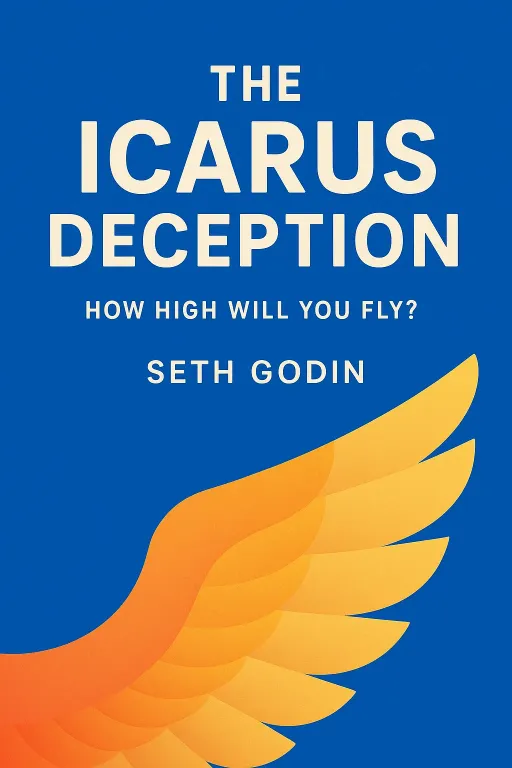
The Protector's Art: Redefining Confidence with The Icarus Deception
Golden Hook & Introduction
SECTION
Socrates: Imagine you're in a meeting. It's full of smart, capable people. The boss asks for a great idea, and the room is met with... absolute silence. Why? Why do we, as Seth Godin puts it, hide our best work, our best insights, and our best selves from the world every single day?
Guanyin: That's a scene I think everyone recognizes. There's this palpable tension, this fear of being the first one to speak, to be wrong, to be judged.
Socrates: Exactly. It's not because we lack ideas. It's because we've been taught a dangerous lesson: that it's safer to be silent, to follow the rules, to fly low. But in his book, 'The Icarus Deception,' Godin argues that this 'safety' is the biggest risk of all. Welcome, Guanyin. I’m so glad we’re digging into this book today, because it feels like a direct answer to so many of the things you’re interested in—mindset, motivation, and especially self-confidence.
Guanyin: I’m excited, Socrates. The title alone is provocative. It feels like it’s giving us a permission slip to be brave.
Socrates: That's the perfect way to put it. And today we'll dive deep into this from two perspectives. First, we'll expose the 'Icarus Deception'—the lie that playing it safe is actually safe. Then, we'll discover the antidote: what it truly means to think and act like an artist in our everyday lives, and why it's the key to building real self-confidence and connection.
Deep Dive into Core Topic 1: The Deception of Safety
SECTION
Socrates: So where did this fear come from? This instinct to fly low? Godin argues it starts with a myth we all got wrong. We all know the story of Icarus, right? His father, Daedalus, makes him wings of wax and feathers to escape a prison, and warns him, "Don't fly too high, or the sun will melt your wings." Icarus gets cocky, flies too high, and plummets to his death. The moral: Don't be arrogant. Don't overreach.
Guanyin: Right. It’s a cautionary tale we learn as kids. Stay in your lane.
Socrates: But here's the deception. Godin points out that Daedalus gave a second warning, one we've conveniently forgotten. He also said, "Icarus, don't fly too low, or the sea spray will soak your wings and you'll drown." Society has spent centuries hammering the first warning into us, creating a culture of compliance. But it's the second warning—the danger of flying too low, of settling, of being too timid—that Godin says is the real tragedy of our time.
Guanyin: Wow. So the risk isn't just in ambition, it's in the lack of it. That changes everything.
Socrates: It does. And to illustrate how we got here, he tells this brilliant allegory called "The Wily Fox Trap." Imagine a resourceful fox in a forest. A builder wants to trap it. He doesn't build a cage and chase the fox in. That's too hard. Instead, one day, he just builds a single wall of a fence and leaves some bait. The fox is wary but takes the easy meal. A week later, the builder adds a second wall, at a right angle. More bait. The fox gets used to it. This is easy food! A week later, a third wall and a gate, left wide open. The fox now feels secure in its little three-walled enclosure. It's predictable. It's safe. Finally, one day, the builder quietly closes the gate.
Guanyin: And the fox is trapped without a fight. It walked right in.
Socrates: It walked right in. And Godin's point is devastating: that trap is the industrial age, and we are the fox. We were seduced by the bait of a steady paycheck, the promise of security, the shiny prizes of promotions. We were told this was the safe, responsible path. And once the gate was shut, we were kept in line not by physical walls, but by the threat of shame, the fear of risk, and society's obsession with conformity.
Guanyin: That's such a powerful image, Socrates. It's not a violent capture; it's a seduction. The promise of 'decent pay' and 'security' feels so responsible, especially for someone like me, an ISFJ personality type. We're wired to be dependable, to protect and provide stability. But the story shows that in exchange for that 'safety,' the fox gives up its very essence—its resourcefulness, its freedom.
Socrates: Exactly. And Godin says we're kept in not by walls, but by the threat of shame and the promise of more prizes. How does that resonate with your goal of building self-confidence?
Guanyin: It's the core of the problem, isn't it? Self-confidence comes from trusting your own judgment, your own instincts. But the trap, the industrial system, teaches you to only trust the system, the rules, the boss. Every time you hold back an idea, like in that silent meeting, you're reinforcing the cage. You're choosing the 'safety' of the fence over the freedom of your own voice. You're flying low because you're afraid of the sea spray, and you forget you can even reach for the sun.
Socrates: You're choosing the fence. I love that. So if playing it safe is the trap, what's the way out? This brings us to our second point. Godin's answer is simple, but it's not easy: Make art.
Deep Dive into Core Topic 2: The Artist's Mandate
SECTION
Guanyin: And I think for a lot of people, that sounds intimidating. "Make art? I can't even draw a straight line."
Socrates: And that's the first hurdle he clears. He redefines art completely. For Godin, art is not a painting or a sculpture. His definition is this: "Art is the unique work of a human being, work that touches another." It's an act of generosity. It's making a connection. It's seeing a problem and offering a solution no one else thought of. It is, by its very nature, an act of vulnerability.
Guanyin: I love that definition because it democratizes creativity. It's not about being a painter; it's about having the empathy to offer a gift of connection. That could be a well-thought-out email, listening deeply to a friend, or even just offering a different perspective in that silent meeting. It reframes contribution as an act of care.
Socrates: An act of care that requires you to be seen. He tells a personal story about this. For years, he wore a suit jacket whenever he gave a speech. It was his armor. It made him feel professional, invulnerable. One day, he's about to speak to a huge crowd and realizes he forgot his jacket. He panics. He feels naked, exposed. But then he realizes that the whole point of his work is to connect with the audience, and that armor was actually a barrier. He had to be vulnerable to make a real connection.
Guanyin: He had to take off the armor to let people in. That's a beautiful metaphor for what we do in our relationships, in our work, in any meaningful interaction. We think we need to present this perfect, polished version of ourselves, but real connection, real empathy, happens in the imperfections.
Socrates: But that vulnerability is terrifying, right? Because what if people don't like our art? What if they reject our gift? He tells another story about this. He gave a speech he’d worked on for a year, something deeply personal. It ended with a massive standing ovation. He was thrilled. On the way to the airport, he checked Twitter. He saw over a hundred glowing tweets, but his brain latched onto the one negative one. A single, nasty comment. And it consumed him for the entire flight home.
Guanyin: Oh, that is so relatable. That one drop of criticism can poison the whole ocean of praise. It speaks to our brain's negativity bias.
Socrates: It does. And he realized his 'lizard brain,' the part that fears rejection, was using that one tweet to try and stop him from ever being that vulnerable again. To stop him from making art. And in that moment, he made a decision. He decided to stop reading reviews. Not out of cowardice, but as a strategic act of self-preservation.
Guanyin: That's fascinating. So how do you, as someone who values harmony and connection, navigate that fear of negative feedback? It seems like a paradox. To connect, you must be vulnerable, but being vulnerable opens you up to pain that makes you want to disconnect.
Socrates: And what's the solution he offers?
Guanyin: That's where the book's advice to 'choose your audience' is so critical. It's a form of self-care. You can't be vulnerable for everyone. The book says, 'Figure out who your art is for... and ignore the rest.' It's not about being callous; it's about protecting your ability to keep creating. It's about making a conscious choice to separate the act of vulnerability, which is essential for connection and empathy, from the poison of shame, which is a choice to accept. You don't have to accept the shame from people your art isn't for.
Socrates: That is the whole key. Accept vulnerability, reject shame. They are not the same thing.
Synthesis & Takeaways
SECTION
Socrates: So, let's bring this all together. We've seen the trap of flying too low, a comfortable cage built by an old, industrial system that baited us with false security. And we've found the key to escape: making 'art' by being vulnerably human, by offering our unique gifts of connection.
Guanyin: And doing so with the courage to choose who we do it for, so we don't let the fear of judgment put us back in the cage.
Socrates: Beautifully put. So, as we close, Guanyin, what’s the one thought or action you think this book inspires for someone wanting to build that muscle of confidence and start flying a little higher?
Guanyin: It feels like the whole book is a call to practice. It’s not about a single grand gesture. So maybe the takeaway isn't to go quit your job and become a painter. Maybe it's to ask yourself, as you said earlier, 'What is one small, true thing I can share today?' Maybe it's a feeling you share with a partner, a creative idea you offer to a friend, or a thoughtful question you ask a colleague. The goal isn't to fly to the sun tomorrow, but just to lift off the ground, even an inch, and feel what it's like to fly on your own. That's where real confidence begins.









