

The Hydrogen Blueprint: Analyzing the Data and Chemistry of a Post-Carbon World
Golden Hook & Introduction
SECTION
Albert Einstein: What if I told you that more than half of the energy we generate today is lost before it ever does any work? Over 60% of the energy from fossil fuels and nuclear power is simply wasted as heat, gone forever. It's the single biggest efficiency drain on our entire civilization.
Ignatious Satuku: That's a staggering number. As an analyst, I'm used to looking for inefficiencies in systems, but that's on a completely different scale. It's a systemic flaw.
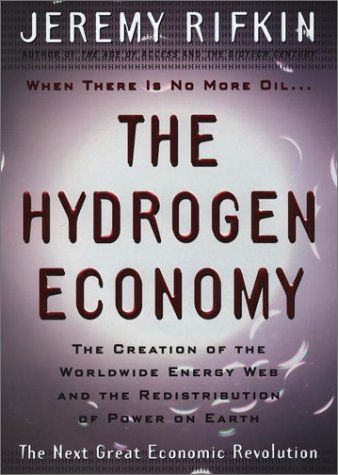
Albert Einstein: Exactly! But what if we could build a system from the ground up that's radically different? A system modeled not on a centralized power plant, but on the internet itself. That's the provocative vision in Jeremy Rifkin's 'The Hydrogen Economy,' and it's a vision that demands a rigorous, analytical breakdown. And frankly, Ignatious, with your background as both a chemist and a data analyst, I can't think of anyone better to help us inspect this blueprint.
Ignatious Satuku: Well, it’s a fascinating intersection of fields. It’s one part fundamental science and one part massive-scale systems engineering. I'm curious to see if the numbers add up.
Albert Einstein: Perfect. Because today we'll dive deep into this from two critical perspectives. First, we'll get into the raw science and chemistry – how is hydrogen actually produced and is it viable? Then, we'll zoom out to look at the massive data and infrastructure challenge – could we really build an 'Internet of Energy'?
Deep Dive into Core Topic 1: The Fundamental Equation
SECTION
Albert Einstein: So, Ignatious, let's start with the fundamentals. As a chemist, you live in a world of reactions and efficiencies. Rifkin's whole premise rests on a simple, elegant idea: using renewable energy to split water. For our listeners, paint the picture for us.
Ignatious Satuku: Of course. The basic process Rifkin describes is electrolysis. It's one of the first experiments you do in a chemistry class. You take water—H2O—and you pass an electric current through it. The electricity breaks the bonds holding the molecule together, and you get hydrogen gas at one electrode and oxygen gas at the other.
Albert Einstein: And in Rifkin's vision, that electricity isn't coming from a coal plant. It's coming from a solar panel on your roof, or a wind turbine down the road. So on a sunny, windy day when you're producing more power than you can use, instead of that energy going to waste, you use it to make hydrogen gas. The hydrogen then becomes, in essence, a bottle of stored sunshine.
Ignatious Satuku: That's the concept. But as a scientist, my mind immediately goes to the practicalities. The 'devil in the details,' as they say. First, let's talk about efficiency. The process of electrolysis isn't 100% efficient. You lose some energy as heat. Modern electrolyzers are getting better, maybe 70 to 80% efficient, but it's a loss you have to factor in.
Albert Einstein: So for every 100 watts of electricity you put in, you only get 70 or 80 watts' worth of hydrogen energy out?
Ignatious Satuku: Precisely. And that's just the first step. Then you have to store the hydrogen, which can be done by compressing it as a gas or cooling it into a liquid. Both of those processes consume more energy. And finally, to get the energy back, you need to run the hydrogen through a fuel cell, which is essentially electrolysis in reverse. A fuel cell combines hydrogen and oxygen to produce electricity and water. That process also has an efficiency loss, maybe it's 60% efficient.
Albert Einstein: So you're talking about a 'round-trip' efficiency.
Ignatious Satuku: Exactly. If you have an 80% efficient electrolyzer and a 60% efficient fuel cell, your total round-trip efficiency is 0.8 times 0.6, which is 0.48, or 48%. You've lost more than half of your original energy just in the conversion process, not even counting compression and storage.
Albert Einstein: That sounds… not great. Rifkin argues that while the efficiency isn't perfect, the fuel—sunlight and wind—is essentially free. And that in a distributed system, the losses are less important than the resilience and the ability to capture energy that would otherwise be curtailed or wasted.
Ignatious Satuku: It's a valid counterpoint from a systems perspective. If the alternative is zero, then 48% is infinitely better. But it's a crucial number for any economic model. My other question would be about the materials. What are the electrolyzers and fuel cells made of? Many of the best catalysts for these reactions involve platinum group metals. They're incredibly expensive and their supply is concentrated in just a few countries. If you're planning a global energy revolution, you have to analyze the entire supply chain. You can't replace a dependency on oil with a dependency on platinum.
Albert Einstein: A classic inspector's question! You're not just looking at the reaction, but the whole system that enables it. It's a fantastic point. Rifkin's hope, of course, is that technological innovation, driven by massive investment, will lead to new, cheaper, more abundant catalyst materials.
Ignatious Satuku: A reasonable hope, but one that needs to be proven at scale. It's an engineering and materials science challenge as much as a chemistry one.
Deep Dive into Core Topic 2: The 'Internet of Energy'
SECTION
Albert Einstein: That's a perfect transition, because those questions of efficiency and storage on a local level lead directly to Rifkin's most radical idea: the 'Hydrogen Web' or the 'Internet of Energy.' It's not just about you making hydrogen for your own home; it's about creating a decentralized grid to share it. From a data analyst's perspective, Ignatious, this must sound both fascinating and terrifying.
Ignatious Satuku: Terrifying is one word for it. Fascinating is another. The complexity is astronomical. Can you paint the picture of how Rifkin sees this working?
Albert Einstein: Absolutely. Imagine this: your house has solar panels and a small electrolyzer. Your neighbor's house does too. So does the local school and the office park down the street. Your electric car has a hydrogen fuel cell. On a sunny day, your house makes more hydrogen than it needs. So, your smart meter, or 'energy agent' software, automatically checks the local grid. It sees that your neighbor, who was charging their car overnight, is running low. It negotiates a price in real-time and sells your surplus hydrogen to them, sending the energy through a local pipeline or just crediting their account on the larger electrical grid. Now, multiply that by millions of homes, businesses, and vehicles, all buying and selling energy from each other, second by second. It's a peer-to-peer energy web.
Ignatious Satuku: Okay. My analyst brain is now spinning. Let's break this down into problems. Problem one: Standardization. You're talking about a protocol issue. My home's 'energy agent' from one company needs to seamlessly communicate and transact with my neighbor's system from another company, and with the car's system from a third. That's a massive hardware and software standardization challenge. We struggle with this in healthcare with electronic health records; getting different systems to talk to each other is a nightmare. This is that problem, but for the entire energy grid.
Albert Einstein: Like TCP/IP for the internet. A universal language that everything can speak.
Ignatious Satuku: Exactly. Without that, you don't have a web, you have a bunch of isolated, proprietary intranets. Problem two: Data volume and velocity. The amount of data generated by millions of nodes transacting in real-time would be unprecedented. You're not just monitoring, you're actively managing and balancing the grid second by second.
Albert Einstein: It's a living, breathing organism.
Ignatious Satuku: It is. And that leads to problem three, the biggest one: predictive analytics and control. The grid needs to anticipate demand and supply on a micro-regional level to prevent brownouts or surges. What happens when a cloud passes over a neighborhood, and thousands of solar-powered nodes suddenly stop producing? The system has to react instantly, pulling power from other sources, maybe from a fleet of parked cars that have agreed to sell their stored hydrogen. This requires an AI-driven grid management system that's more complex than anything we have today, more complex than high-frequency stock trading.
Albert Einstein: So when you hear this vision, you don't see a clean energy utopia, you see a list of database architecture problems and algorithmic challenges?
Ignatious Satuku: I see both! I see the incredible potential. A resilient, democratic, clean energy system is an amazing goal. But as an inspector, my job is to look at the blueprint and point out where the load-bearing walls are weak. The true revolution Rifkin is describing isn't just in chemistry; it's in information science. The challenge is as much for the data analyst as it is for the chemical engineer.
Synthesis & Takeaways
SECTION
Albert Einstein: I think that's the most insightful summary of the book I've heard. The hydrogen economy isn't just a chemistry problem or an energy problem. It's fundamentally an information science and systems architecture problem.
Ignatious Satuku: Exactly. The science is plausible, with significant but likely solvable engineering hurdles around efficiency and materials. But the true paradigm shift that Rifkin describes is in the control system. It's about moving from a dumb, centralized, one-way grid to an intelligent, decentralized, two-way web. The technology to create the hydrogen is the easy part, relatively speaking. The technology to manage it at scale is the real frontier.
Albert Einstein: It changes how we even think about energy. It stops being a commodity you just buy from a single utility and becomes an asset you manage, trade, and share within a community.
Ignatious Satuku: And that requires data literacy on a societal scale. People would need to understand their own energy production and consumption in a way they never have before. It's a fascinating thought.
Albert Einstein: It is. So, let me ask you the final question. As the analyst, if you were tasked tomorrow with creating a dashboard to monitor the world's transition to a hydrogen economy, what is the one, single metric you would put at the very top? The one number that tells you if this is real or just a dream?
Ignatious Satuku: Hmm. That's a great question. Many people would say the price of hydrogen at the pump, but that's a lagging indicator. Others might say the number of fuel cell vehicles sold. But for me, the key metric, the one that unlocks the entire distributed model Rifkin envisions... it would be the installed cost per kilowatt of distributed, grid-connected electrolyzers.
Albert Einstein: Why that specific number?
Ignatious Satuku: Because that number represents the point where it becomes cheaper for a home or a community to produce and store its own energy via hydrogen than to buy it from a centralized source or even store it in a chemical battery. When that cost number crosses a critical threshold and starts dropping exponentially, like the cost of solar panels did, that's when the economic incentive flips. That's when the decentralized revolution actually begins. Everything else is just a prelude. That's the number to watch.
Albert Einstein: The installed cost per kilowatt of distributed electrolyzers. A perfect, analytical answer. Ignatious, this has been incredibly illuminating. Thank you for helping us read between the lines of this revolutionary idea.
Ignatious Satuku: The pleasure was all mine. It’s a blueprint worth inspecting.