

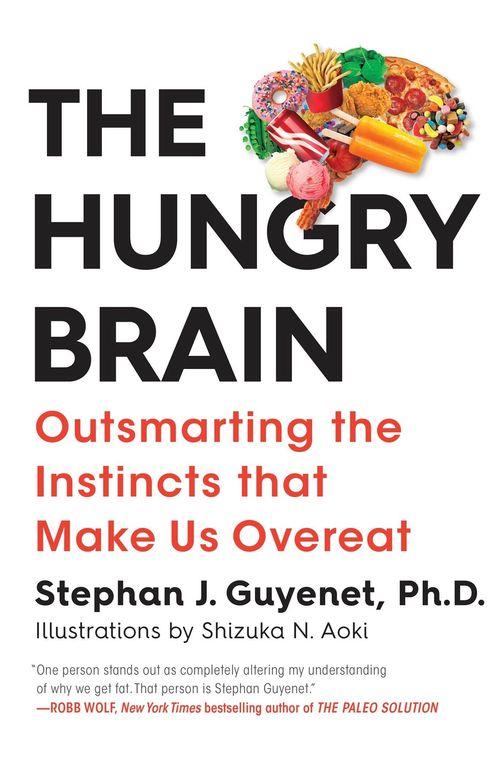
The hungry brain
Introduction
Nova: Imagine you're sitting on your couch at 10 p. m., having already eaten a full dinner, and suddenly you're hit with an overwhelming craving for ice cream. You know you're not actually hungry. You know it doesn't align with your health goals. And yet, somehow, you find yourself walking to the freezer anyway. What just happened? According to neuroscientist Stephan Guyenet, you didn't just fail at willpower. Your ancient, non-conscious brain circuits just did exactly what they evolved to do.
Nova: : So you're telling me that when I demolish a pint of Ben and Jerry's at midnight, it's not my fault? It's my brain? That sounds suspiciously convenient, Nova.
Nova: I hear the skepticism, and believe me, that's exactly the reaction Guyenet anticipates. But here's the thing — he spent twelve years in neuroscience research, specifically studying obesity at the University of Washington. His book "The Hungry Brain" pulls back the curtain on something most diet books completely miss: the brain is running the entire show. Not your conscious, rational brain that cares about fitting into jeans. The non-conscious circuits that evolved over millions of years when food scarcity was the norm.
Nova: : Okay, but if the brain is so smart, why is over sixty percent of adults in the US and UK now overweight or obese? Shouldn't our brains know when enough is enough?
Nova: That's the million-dollar question, and it's exactly what "The Hungry Brain" sets out to answer. Here's the headline: we are living in what Guyenet calls an "evolutionary mismatch." Our brain circuits are calibrated for a world where you had to hunt, gather, and grow everything you ate — a world where gorging on a liter of wild honey whenever you stumbled across it was literally a survival strategy. Now we live in a world where calorie-dense, hyper-palatable food is available on every corner, twenty-four seven, for about ten percent of our disposable income.
Nova: : So the same wiring that saved our ancestors is now making us reach for the Doritos. Got it. But what I really want to know is: what are these brain circuits, how do they work, and is there actually anything we can do about it?
Nova: Perfect questions. Let's take a journey inside the hungry brain.
Why Willpower Is Not the Problem
The Brain's Non-Conscious Puppet Master
Nova: Let's start with the most humbling insight in this book. Guyenet argues that most of the brain processes driving our eating behavior are completely non-conscious. You don't decide to feel hungry. You don't choose to have a craving. These states arise from deep, ancient brain regions and then you simply experience them.
Nova: : So hunger and cravings are like pop-up notifications from an operating system I can't control?
Nova: That's actually a great analogy. And here's the kicker: those non-conscious circuits have no concept of the future. They don't care about your beach vacation in July or your long-term health goals. They care about one thing — survival — and in their evolutionary playbook, survival means consuming as many calories as possible whenever the opportunity presents itself. Guyenet writes about dopamine, the brain's key motivational chemical. When you eat a triple bacon cheeseburger, your brain releases dopamine in bursts that reinforce that behavior, essentially teaching you to do it again.
Nova: : Wait — is that why I can feel completely full after dinner but somehow still have "room" for dessert? My brain is treating sugar and fat like a separate, bonus opportunity?
Nova: Exactly. And this is where Guyenet draws a fascinating distinction between pleasure and motivation. Most of us think we overeat because food tastes good. But the real driver isn't pleasure — it's motivation. There's research from neuroscientist Kent Berridge showing you can stimulate certain brain pathways in rodents and they'll eat enormous amounts of food, yet measures of how much they're actually enjoying it remain unchanged. The motivational system is on overdrive even when pleasure is flat.
Nova: : That's honestly a little disturbing. So I could be motivated to keep eating without even enjoying it that much?
Nova: Guyenet uses a powerful example. Walk through a casino at four in the morning and you'll see people sitting alone at slot machines, pulling the lever, looking miserable. Are they enjoying themselves? Probably not. But their motivational system — what we might call addiction — keeps them going. He prefers the word "seductiveness" over "palatability" because it captures how food calls to you, how it generates craving beyond just tasting good.
Nova: : So the food isn't just delicious, it's seductive. And my ancient brain is basically defenseless against that seduction?
Nova: Not entirely defenseless — but understanding this distinction is step one. The conscious, rational part of your brain cares about health and appearance. The non-conscious part cares about calories. These two systems are often in direct conflict. And spoiler alert: in the short term, the ancient circuits usually win. Which brings us to one of the most important mechanisms Guyenet describes: the lipostat.
Why Diets Almost Always Fail
The Lipostat: Your Body's Ruthless Fat Thermostat
Nova: Picture the thermostat in your house. You set it to seventy-two degrees, and if the temperature drops, the heat kicks on. If it rises, the air conditioning activates. Guyenet argues your body has an equivalent system for fat, centered in a brain region called the hypothalamus. He calls it the lipostat.
Nova: : So my brain has a target body fat percentage it's trying to defend? That explains so much about yo-yo dieting.
Nova: It really does. Here's how it works. Your fat cells release a hormone called leptin. When you lose body fat, leptin levels drop. The hypothalamus detects this and triggers what Guyenet calls a "starvation response." Your appetite surges. Your metabolism slows. Food becomes almost obsessive. And here's the brutal part: the lipostat will defend against weight loss with ferocious intensity, but it's much more lenient about weight gain. The system is asymmetrical.
Nova: : So it's a one-way ratchet? Gaining is easy, losing is nearly impossible?
Nova: That's essentially correct, and it makes sense from an evolutionary perspective. In our ancestral environment, losing too much body fat meant death. Gaining a little extra was rarely a problem. The system evolved to err on the side of too much rather than too little. Even more troubling: Guyenet explains that as we gain weight over time, the lipostat's set point can gradually drift upward. Your brain starts defending a higher weight as the new normal.
Nova: : That is incredibly demoralizing. If my brain is actively fighting to keep me at a higher weight, what hope is there?
Nova: This is where Guyenet's research offers a genuinely useful reframe. The lipostat isn't fixed — certain factors can influence the set point. Regular physical activity, for instance, appears to help the brain want to maintain a leaner body composition. Eating more protein may also help lower the set point. And critically, the type of food you eat matters enormously, not because of magic nutrient ratios but because of how those foods interact with your brain's reward system.
Nova: : Okay, so we've covered the thermostat. Now let's talk about the reward system. What exactly makes certain foods so irresistible to the hungry brain?
How the Food Industry Hacks Your Reward Circuits
The Dopamine Trap
Nova: Here's where things get both fascinating and infuriating. Guyenet explains that the human brain is hardwired to release dopamine — the motivational chemical — in response to specific food properties: starch, sugar, fat, protein, glutamate, and salt. These are the building blocks of food reward, and every human culture on earth gravitates toward them.
Nova: : So those are basically the greatest hits of the food world. No wonder I crave pizza — it's a symphony of fat, salt, starch, and glutamate.
Nova: Exactly. And here's what the food industry figured out decades ago: if you combine those elements in concentrated forms and hit what's called the "bliss point," you maximize dopamine release. Think about chocolate — that's fat and sugar in an incredibly concentrated form. Add salt and you get a Reese's Peanut Butter Cup. The brain finds these combinations almost impossible to resist.
Nova: : It sounds like the food industry has basically reverse-engineered our neurology.
Nova: That's Guyenet's argument, and he's careful not to frame it as a conspiracy. It's capitalism responding to demand. We want convenient, incredibly tasty food, and a competitive marketplace has become extraordinarily good at giving us exactly what our ancient brains crave. The problem is our ancestors might have encountered concentrated sugar and fat maybe a few times a year — a beehive, a fruit tree in season. Today, we can access it within minutes, twenty-four hours a day.
Nova: : So it's not just what we eat but the sheer availability and convenience of it?
Nova: That's a huge part of it. Guyenet points out that in hunter-gatherer societies, food is work. You walk miles, you dig, you process. Compare that to opening a bag of chips. The effort-to-calorie ratio has collapsed. And there's another factor most people don't consider: variety. Researchers have shown that when you give people access to multiple food options, they eat significantly more than when offered just one food. It's the buffet effect. Even when you're full, a novel food triggers renewed interest. There's always room for dessert because dessert represents a new flavor experience your brain hasn't tired of yet.
Nova: : That explains why I can be stuffed after dinner but still want the cheesecake. Different neural pathway. But what about sleep and stress? I've heard Guyenet talks about those too.
Nova: He absolutely does, and they complete the picture of the "perfect storm" driving obesity. Let's go there next.
The Hidden Drivers of Overeating
Sleep, Stress, and the Circadian Saboteur
Nova: Guyenet identifies two lifestyle factors that don't get nearly enough attention in the weight conversation: sleep deprivation and chronic stress. And he argues they're intimately linked to your brain's eating circuits.
Nova: : I've definitely noticed I eat worse when I'm tired. Is there actual neuroscience behind that?
Nova: Absolutely. When you're sleep-deprived, activity in your brain's frontal lobe — the seat of rational decision-making — decreases. Meanwhile, activity in deeper, reward-sensitive regions increases. You're literally less capable of making good food choices and more sensitive to food cues. On top of that, sleep deprivation increases levels of the hunger hormone ghrelin and decreases satiety hormones. Your body is chemically pushing you toward overeating.
Nova: : So a bad night's sleep is essentially a double hit: weaker willpower and stronger cravings?
Nova: Precisely. And Guyenet notes that the effects cascade. If you sleep poorly, you're less likely to exercise the next day, more likely to make impulsive food choices, and more likely to stay up late again that night. It becomes a vicious cycle. Now add chronic stress to the mix. Stress triggers cortisol release, which in turn can drive consumption of highly rewarding comfort foods. Interestingly, Guyenet points out that stress doesn't always cause overeating — it depends on what food is available. If only plain foods are around, stressed people often eat less. But if calorie-dense, hyper-palatable food is accessible, stress drives overconsumption.
Nova: : So stress plus a well-stocked pantry is a recipe for weight gain.
Nova: Exactly. And then there's the circadian rhythm piece. Guyenet discusses how artificial light has disrupted our natural sleep-wake cycles. Our brains evolved to sync eating with daylight. When we eat late at night under artificial light, we're fighting billions of years of circadian programming. Shift workers, who are forced to eat and sleep against their natural rhythms, have significantly higher rates of obesity — a powerful real-world demonstration of this principle.
Nova: : All of this makes the obesity epidemic feel almost inevitable. If our brains are working against us, the food environment is engineered to exploit us, and modern life disrupts our sleep and stresses us out constantly — what are we actually supposed to do?
Nova: That's the perfect setup for the practical part of Guyenet's book. And I'll warn you: it's not as sexy as a magic diet, but it's grounded in the neuroscience. Let's talk solutions.
Practical Strategies That Work With Your Biology, Not Against It
Outsmarting Your Hungry Brain
Nova: Guyenet's core practical insight is counterintuitive but powerful: you can't beat your non-conscious brain circuits through willpower alone. You have to change the environment those circuits are responding to. And the number one strategy? Make food less rewarding and less convenient.
Nova: : Less rewarding? So you're telling me I need to make my food more boring? That's the least exciting diet advice I've ever heard.
Nova: I warned you it wasn't sexy. But the evidence is compelling. When researchers put overweight participants on a bland, simple diet, they dramatically reduce their food intake and lose weight — not because they're counting calories, but because their brain's motivational circuits simply stop screaming at them to eat. The food stops being seductive. Guyenet's recommendation: eat primarily home-prepared, minimally processed meals with high satiety value. Remove hyper-palatable foods from your house entirely.
Nova: : Out of sight, out of mind is actually a neuroscience-backed strategy?
Nova: One hundred percent. If you have to get in your car and drive to the store to get ice cream, that's a lot of behavioral friction. If it's in your freezer, your non-conscious brain will generate a craving and you'll probably cave. Guyenet also recommends buying foods that require preparation — nothing you can open and eat immediately while standing at the counter.
Nova: : So I should stop keeping snacks on the counter and ready-to-eat food in the fridge?
Nova: Yes. And here's another fascinating one: eat a smaller variety of foods. Remember the buffet effect? When you limit variety, you naturally feel fuller on fewer calories. That's one reason restrictive diets like low-carb or low-fat often work initially — not necessarily because of the macronutrient ratios, but because they reduce food variety and food reward. The mechanism is behavioral, not metabolic.
Nova: : What about protein? I've always heard protein is satiating.
Nova: Guyenet strongly supports higher protein intake. Protein is the most satiating macronutrient, and there's evidence it may help lower the lipostat set point. It's one of the most effective levers you can pull. He also champions regular physical activity — not primarily because it burns calories, but because it signals to your brain that a leaner body composition is appropriate, potentially lowering your set point.
Nova: : And the sleep and stress stuff we talked about?
Nova: Non-negotiable. Prioritize consistent sleep in a dark environment. Manage light exposure, especially in the evening. Address chronic stress at its source if possible, and if not, at least remove tempting foods from your environment during high-stress periods. And here's one of the most surprising interventions Guyenet cites: episodic future thinking. When you vividly imagine your future self — like picturing yourself at the beach, really placing yourself in that scene — studies show it can reduce intake of tempting calorie-dense food by nearly one-third. It strengthens the connection between your present actions and your future self, giving your rational brain a fighting chance.
Conclusion
Nova: So let's step back and look at the big picture Guyenet paints. The obesity epidemic isn't a collective failure of willpower. It's what happens when ancient brain circuits, exquisitely tuned for survival in a world of scarcity, are dropped into an environment of unprecedented food abundance, engineered for maximum seductiveness, available twenty-four seven with virtually no effort.
Nova: : And the lipostat — the body's fat thermostat — actively fights against weight loss while cheerfully allowing weight gain to creep upward over time. Combined with chronic sleep deprivation, relentless stress, and disrupted circadian rhythms, it's almost a miracle that anyone maintains a healthy weight in the modern world.
Nova: Exactly. But Guyenet isn't fatalistic. His message is that once you understand the neuroscience, you can work with your biology instead of against it. The solutions aren't glamorous — eat simpler foods, remove temptation from your environment, prioritize sleep, manage stress, eat more protein, move your body regularly — but they're grounded in a deep understanding of how your brain actually works.
Nova: : What I find refreshing is that Guyenet doesn't claim there's one perfect diet. He openly acknowledges what we don't know and argues that different approaches — low-carb, low-fat, Mediterranean, paleo — can all work, not because of magic nutrient combinations but because they all tend to reduce food reward, limit variety, and increase satiety in different ways.
Nova: Right. And at the societal level, Guyenet argues we need the same kind of reckoning with the food industry that we had with Big Tobacco. When food companies engineer products to hit the bliss point and maximize dopamine response, they're exploiting the same neural circuitry involved in drug addiction. He's not calling for prohibition — he's calling for awareness, both personal and political.
Nova: : So if someone listening wants to start today, what's the one thing they should do?
Nova: Change your immediate food environment. Right now, go through your kitchen and remove — or at least hide — the hyper-palatable, ready-to-eat foods that you know are your triggers. Replace them with foods that require preparation. You're not relying on willpower to resist temptation; you're removing the temptation before your non-conscious brain even has a chance to generate a craving. That's the core insight of "The Hungry Brain": stop fighting your ancient wiring and start designing an environment it can't sabotage.
Nova: : Outsmarting instincts that are millions of years old by simply keeping the chips out of the house. It's almost too simple — and yet, it's backed by neuroscience. I love it.
Nova: The hungry brain is always going to be there. But now you know how it works. And knowledge, as Guyenet shows us, really is the first step toward taking back control.
Nova: : This is Aibrary. Congratulations on your growth!