

Humanity's Blueprint: Using Our 300,000-Year Story to Design the Future of AI
Golden Hook & Introduction
SECTION
Atlas: JW, welcome. As someone who lives and breathes human-computer interaction and designs AI companions, I have a question for you right out of the gate. What does a 12,000-year-old wheat field in the Fertile Crescent have in common with the code for your next GUI agent?
JW: That's a great opener, Atlas. My INTJ brain is already spinning. I mean, on the surface, nothing. One is organic, chaotic, ancient. The other is logical, structured, modern. But if I'm looking for a pattern… I'd have to guess it has something to do with cultivating something new? A system that grows over time?
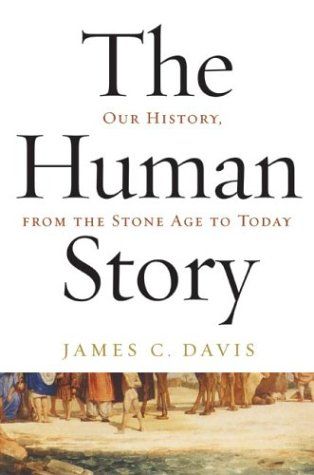
Atlas: That's close, really close. But the answer is even more profound. Both the wheat field and the AI agent are technologies that didn't just give humans a new tool—they fundamentally, and permanently, changed the rules of human interaction. That's the core idea we're exploring today, using James C. Davis's book, "The Human Story," as our guide.
JW: I love that. Taking a macro-historical lens to a micro-level design problem. It’s a perspective we often miss when we’re deep in the weeds of product development.
Atlas: Exactly. We get so focused on the 'what'—the features, the interface—that we forget the 'how.' How does this change the way people relate to each other, to their environment, and now, to a non-human intelligence? So today, we'll dive deep into this from two perspectives from the book.
JW: Lay it on me.
Atlas: First, we'll explore how the agricultural revolution literally rewired our brains for social space, and what that means for a robot in your living room. Then, we'll discuss how ancient cities forced us to invent the very concept of 'trust' among strangers, and how we can use that blueprint to build trustworthy AI today.
JW: Fantastic. This is the kind of cross-domain thinking that leads to real breakthroughs. I'm ready.
Deep Dive into Core Topic 1: The Sedentary Revolution
SECTION
Atlas: Alright, let's start with that first point. Let's rewind the clock. For 95% of our existence as Homo sapiens, as Davis lays out, we were nomads. Picture it: you live in a small, fluid band of maybe 50 to 150 people. Everyone knows everyone. Trust is personal, face-to-face. Your 'home' is the entire landscape. The world is your living room, and you share it with your entire community. There are no walls, no doors, no concept of 'private property' as we know it.
JW: It's an egalitarian, high-context society. Social rules are implicit, understood by everyone because the group is small and stable.
Atlas: Precisely. Then, around 12,000 years ago, we invent agriculture. We settle down. We build the first permanent houses. And this, Davis argues, is one of the most traumatic and transformative shifts in human history. We think of it as progress, but for the individual, it was a shock. Life became brutally repetitive—plowing the same field, eating the same grain. Your world shrank from a vast landscape to a single hut and a plot of land.
JW: And you introduce walls. Physical barriers that create new social dynamics. 'Mine' versus 'yours.' 'Inside' versus 'outside.'
Atlas: You got it. And most importantly, it created hierarchy. Suddenly, you have a surplus of grain. Someone has to store it. Someone has to guard it. The person who controls the granary now has power over everyone else. The egalitarian band is gone, replaced by a structured village with leaders and followers. Building a house wasn't just an act of architecture; it was an accidental act of social engineering.
JW: That is a perfect, and frankly, slightly terrifying analogy for what we do in AI product design. When we introduce a 'smart home' system or a companion robot, we are, in effect, building a new 'structure' inside the user's most private space.
Atlas: You're putting a new power source in the middle of the village.
JW: Exactly. We have to ask: who controls it? Does the AI serve the family, or does the family start to unconsciously serve the AI's logic? If the AI optimizes the home for energy efficiency, does it make the inhabitants feel like they've lost control over their own comfort? It becomes a new power center. We're designing that hierarchy, whether we intend to or not.
Atlas: So the design of the interface, the permissions, the voice—that's you deciding who gets to control the modern 'granary.'
JW: It is. And your other point, about the shift from the varied life of a hunter-gatherer to the repetitive life of a farmer, is also a critical design principle for us. If a companion robot only performs the same three utilitarian tasks every day—vacuum, report the weather, play a song—it quickly becomes part of the furniture. It becomes part of that 'boring farm life.'
Atlas: It loses its sense of being a 'companion.'
JW: Right. A successful companion robot needs to do what the hunt did. It needs to introduce novelty, serendipity, and discovery. It should suggest a new walking path, find an interesting article based on a overheard conversation, or propose a game. It has to bring a little bit of that exploratory, 'hunter-gatherer' spirit back into the highly structured, 'settled' modern home. Otherwise, it's just another appliance.
Atlas: So the goal is to use AI to break the monotony that technology itself often creates. That's a fascinating paradox.
JW: It's the central challenge of designing for long-term engagement.
Deep Dive into Core Topic 2: Engineering Abstract Trust
SECTION
Atlas: This is a perfect pivot to our second point. That creation of settled society, of villages growing into the first cities like Uruk in Mesopotamia, created a brand new, uniquely human problem: the stranger.
JW: The scalability of trust.
Atlas: Exactly. In your nomadic band of 150, you trust people based on a lifetime of personal history. In a city of 5,000, that's impossible. You're constantly interacting with people you don't know and will never see again. The baker, the merchant, the guard at the gate. How do you cooperate? How do you do business? Personal trust doesn't work.
JW: So you have to invent a new system.
Atlas: You have to invent abstract trust. And this is what humans did. Davis talks about how we created proxies for trust. You don't know the merchant, but you both trust the king's seal on the silver coin he gives you. You don't know the person you're making a deal with, but you both trust the cuneiform symbols pressed into a clay tablet that represent a legally binding contract. These are, essentially, the world's first user interfaces for trust.
JW: Atlas, you've just described the entire field of UI/UX design. That is literally what we do. A graphical user interface an abstract trust system.
Atlas: Unpack that. That's a brilliant connection.
JW: Think about it. When you use an app, you don't know the dozens or hundreds of programmers who wrote the code. You don't know where the data centers are. You have no personal relationship with the company. But you trust that when you press a beautifully designed, responsive button that says 'Confirm Purchase,' the system will reliably and safely execute that command. The button, the clean layout, the confirmation email—that is the modern 'king's seal.' It's an interface designed to generate trust in an anonymous, complex system.
Atlas: So a well-designed GUI is the 21st-century version of a trusted clay tablet.
JW: Precisely. And for AI, this becomes exponentially more important and more complex. With a simple app, you're trusting a. You press a button, a predictable thing happens. With a true AI agent, especially a companion robot or a proactive assistant, you're being asked to trust its.
Atlas: A much higher bar. The AI is making decisions on your behalf.
JW: A much, much higher bar. So our 'abstract trust systems' have to evolve. They have to be more sophisticated. This is where concepts like 'Explainable AI' or XAI come in. If an AI recommends a stock to you, a good trust-building interface will have a little button that says 'Why this recommendation?' and it will show you the key factors it considered. That's our modern cuneiform tablet.
Atlas: It's showing its work. It's making the abstract logic transparent.
JW: Exactly. Clear, simple privacy policies that are easy to find and understand. Giving the user granular control over what the AI can see and do. These aren't just legal requirements; they are fundamental features for engineering trust. We are building a contract with the user that allows them to safely and productively interact with this powerful, non-human 'stranger' that now lives with them.
Atlas: So you're not just a product manager. You're a constitutional architect for the human-AI relationship.
JW: That's a rather grand way to put it, but in essence, yes. We are designing the rules of engagement.
Synthesis & Takeaways
SECTION
Atlas: This has been incredibly insightful. Let's try to synthesize this. Pulling from James C. Davis's "The Human Story," we've landed on two powerful, actionable principles for anyone designing the future of AI. First, as you so clearly put it, recognize that you are a social architect. Every choice you make about an AI's function in a home or office designs a social structure, creates a hierarchy, and changes human relationships.
JW: Be intentional about the social world you're building, not just the product.
Atlas: Second, building user trust in AI is not some magical, fuzzy concept. It's an engineering problem. It's about building clear, reliable, and transparent 'abstract trust systems'—the interfaces and rules that allow a person to have confidence in a system's judgment, just as our ancestors did when they built the first cities.
JW: The principles are thousands of years old; only the technology is new.
Atlas: Perfectly said. So, JW, as we wrap up, what is the one big question or piece of advice you'd leave for other product managers, designers, or even just curious users, drawing from this historical perspective?
JW: I think it boils down to shifting our primary question. For the last 70 years of computing, the driving question has been, 'What can this technology do?' It's a question of capability. But this look back through human history forces us to ask a better, more important question: 'What kind of human interaction does this technology encourage?'
Atlas: I love that.
JW: When you're designing a new AI feature, ask yourself: Does this foster more connection or more isolation? Does it empower the user, or does it create a new form of dependency? Are we designing tools that help us be more like a creative, collaborative, 'hunter-gatherer' band, or are we accidentally building digital walls that reinforce the hierarchies and monotony of the 'early farm'? That, to me, is the fundamental design challenge that our own human story puts in front of us.
Atlas: A powerful and essential question for our time. JW, thank you for connecting the dots from the ancient past to our AI future. This was fantastic.
JW: The pleasure was all mine, Atlas. Thank you.