

Unearthing Meaning: How Archaeology Reveals The Human Story Beyond The Written Word
Golden Hook & Introduction
SECTION
Nova: We think we know history, right? All those dates and names, the rise and fall of empires, the big inventions. But what if I told you that 99% of human history, and the vast majority of human experiences, are completely missing from the books we typically read?
Atlas: Wait, 99%? That sounds like a statistic designed to shock me, but honestly, it’s working. How are we missing so much? I thought we had pretty good records.
Nova: That's the blind spot, Atlas. We tend to rely almost exclusively on written records. And while incredibly valuable, writing is a relatively recent invention in the grand scheme of human existence. It's only been around for a tiny fraction of our time on this planet. This means entire millennia, diverse cultures, and countless innovations simply don't show up in our conventional historical narratives.
Atlas: So, it's like trying to understand an entire novel by only reading the last chapter, and even then, only the parts written by the main character?
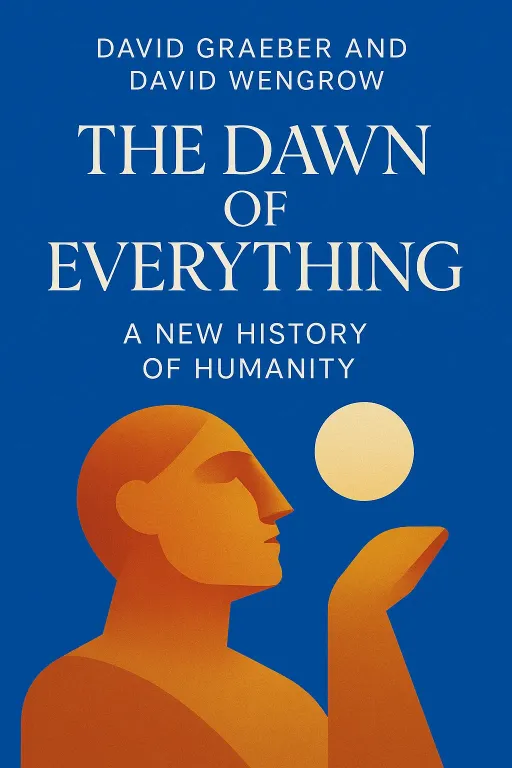
Nova: Exactly! It leaves vast periods and diverse societies unexamined, leading to these incredibly incomplete narratives. And that's where the absolutely groundbreaking work of archaeology comes in. Today, we're diving into how archaeology is not just filling in those gaps, but fundamentally rewriting our understanding of human history, notably through books like "The Dawn of Everything: A New History of Humanity" by David Graeber and David Wengrow. Graeber, for those unfamiliar, was a fascinating anarchist anthropologist whose unique perspective really challenged conventional thinking.
Atlas: Ah, "The Dawn of Everything," a truly groundbreaking title. I know it sparked a lot of conversation. So, if written history is our blind spot, what's filling in the gaps for this missing, massive 99%? What's the lens that lets us see beyond the written word?
The Blind Spot of Written History: Unearthing the Unwritten Past
SECTION
Nova: That lens, Atlas, is archaeology. It's this powerful tool that allows us to piece together stories from fragments – ancient tools, forgotten settlements, burial sites, even microscopic plant remains. Think of it like a meticulous detective piecing together a crime scene from clues left behind, long after everyone involved has gone.
Atlas: That makes sense. So, what kind of blind spots are we talking about? Give me an example of something written history totally misses that archaeology brings to light.
Nova: One of the most compelling examples is our understanding of pre-agricultural societies. For a long time, the narrative was that before farming, humans were simple, nomadic hunter-gatherers, living in small, egalitarian bands, almost like a "primitive" precursor to "civilization." But archaeology has utterly shattered that simplistic view.
Atlas: So, you're telling me those cavemen cartoons I grew up with were totally off base?
Nova: In many crucial ways, yes! Take Göbekli Tepe in modern-day Turkey. This site is a monumental complex of massive, intricately carved stone pillars, built by hunter-gatherers around 10,000 BCE. That’s thousands of years the invention of agriculture, before settled towns were thought to be possible. It totally upends our understanding of when and how complex social organization, monumental architecture, and even religious practices first emerged.
Atlas: Wow, Göbekli Tepe! That’s incredible. So, we're not just talking about missing dates, but missing entire ways of life, entire philosophies, complex social structures that we just assumed weren't possible until much later?
Nova: Precisely. Archaeology shows us these incredibly sophisticated social structures, spiritual beliefs, and technological innovations that written records completely ignore because they simply didn't exist yet, or weren't designed to record such things. It reveals the incredible ingenuity and varied paths taken by human cultures across millennia, far beyond the narrow scope of what we traditionally consider "history." It's not just about what we, but what we and how we ourselves in ways we can barely imagine today.
Archaeology's Revolutionary Insights: Rewriting the Human Story
SECTION
Nova: And that leads us perfectly into how these archaeological findings aren't just filling gaps, Atlas, they're actively the script. They're challenging some of our most fundamental ideas about human society and progress.
Atlas: Rewriting the script? That sounds a bit out there. What kind of fundamental ideas are we talking about? Like, that we're inherently good or bad?
Nova: Even deeper than that. "The Dawn of Everything," for example, directly challenges the conventional wisdom about the origins of inequality and the state. The long-held belief was that once humans settled down and started farming, it was an almost inevitable march towards hierarchy, private property, and centralized states. It's often presented as the "natural" progression of human society.
Atlas: So, you're saying that the idea of humans naturally progressing from simple hunter-gatherers to complex, unequal states is actually... a myth? That's a huge claim. I mean, it feels pretty ingrained in how we view human development.
Nova: It is ingrained, but Graeber and Wengrow, drawing heavily on archaeological and ethnographic evidence, argue that early societies were far more diverse and experimental than we give them credit for. They show examples of societies that consciously to be egalitarian, even when they had the means for hierarchy. Or societies that would cycle through different forms of governance seasonally – embracing hierarchy for certain tasks, then dismantling it for others.
Atlas: So, human societies weren't just on one conveyor belt towards "civilization" and inequality? They were actively experimenting with different social structures? That’s like saying humans had a whole palette of social colors, not just three primary ones.
Nova: Exactly! And "The Human Past" edited by Chris Scarre, which is a comprehensive overview of global archaeological findings, further reinforces this. It showcases countless examples of complex chiefdoms that never became states, or bustling cities that operated without a central authority as we understand it. It debunks the idea of a fixed "state of nature" and shows how adaptable and creative humans have been in organizing themselves. It really highlights that human progress wasn't a straight line, but a sprawling, branching river with many different currents.
Atlas: This is fascinating. It sounds like archaeology is giving us a much more nuanced view of human potential, not just a simplified, inevitable march towards "progress." It's like it's saying, 'Hey, we had more options than we thought!' That could totally change how we think about our own social structures today.
Synthesis & Takeaways
SECTION
Nova: It absolutely can. Archaeology doesn't just add more details to history; it forces us to critically re-evaluate our pre-conceived notions about human nature, society, and what's truly "natural" or "inevitable." It reveals a richer, more complex tapestry of our cultural evolution than previously imagined, full of choices and pathways we often overlook.
Atlas: So, if we approach our own society with an archaeologist's open mind, what pre-conceived notion about human society might challenge? What's that one thing we just accept as "the way things are" that might actually be a historical construct, not an inevitability?
Nova: That's the deep question, isn't it? It's about cultivating that archaeologist's open mind, looking beyond the surface narratives, questioning the assumptions we hold about how things "must" be. It’s about seeking out the complete story, not just the convenient or well-documented one. For anyone who values understanding and foundational well-being, this expanded perspective is crucial. It offers a deeper wisdom for our present and a more strategic approach to our future.
Atlas: That's a powerful way to think about it. It’s like, if we understand the full spectrum of human possibility from the past, it gives us more wisdom for our present and future. It's an invitation to be more intentional about the kind of society we want to build. We'd love to hear what preconceived notions this makes question. Share your thoughts with us online!
Nova: This is Aibrary. Congratulations on your growth!