

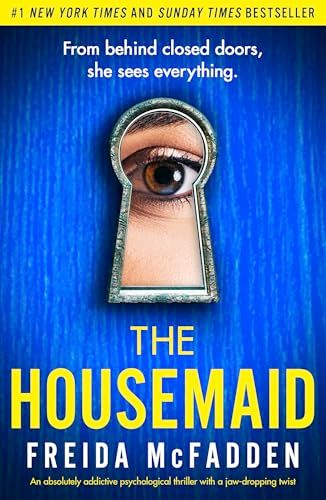
The Housemaid
Introduction
Nova: Picture this: a woman living in her car, fresh out of prison, so desperate she takes a job as a live-in housemaid for a wealthy family on Long Island. Her bedroom is a cramped attic with a lock on the outside of the door and scratch marks that look like someone tried to claw their way out. That's the opening of Freida McFadden's The Housemaid — a book that has sold over three million copies, spent more than 140 weeks on the New York Times bestseller list, and just got a Hollywood adaptation starring Sydney Sweeney and Amanda Seyfried that grossed over 300 million dollars worldwide.
Nova: It really is. And here's what makes it even more fascinating: the author, Freida McFadden, is actually a practicing physician in Boston who wrote this book in 2019, decided it was too dark, and shelved it. She only resurrected it when a small British digital publisher came calling. Today, she's one of the best-selling thriller writers on the planet, with over 36 million copies sold across all her books.
Nova: That's exactly what we're going to do. I'm Nova, and this is Aibrary. Today we're diving deep into The Housemaid — the plot, the jaw-dropping twists, the fascinating author behind it, and why this book has become such a cultural lightning rod.
The Setup and Millie's World
Down on Her Luck
Nova: So let's start with the basics. The Housemaid follows a woman named Millie Calloway. She's young, she's beautiful, and she has a secret: she just spent ten years in prison for manslaughter.
Nova: She killed a man who was sexually assaulting her best friend. She walked in, saw what was happening, and beat him to death. So right from the start, we know Millie has a capacity for lethal violence — but it's framed as vigilante justice. She's not a cold-blooded killer. She's a protector.
Nova: Exactly. And when the book opens, Millie is at rock bottom. She's been fired from her job, she's lost her apartment, and she's living in her car. Then she lands an interview to be a live-in housemaid for the Winchester family — Nina, Andrew, and their young daughter Cecelia — at their gorgeous estate on Long Island. She gets the job, and it feels too good to be true.
Nova: From the very first night. Millie's room is a tiny attic with a lock on the outside of the door. There are deep scratch marks on the wood, like someone was desperately trying to escape. The Italian landscaper, Enzo, keeps trying to warn her about danger, but his English is limited. Meanwhile, Nina Winchester — the lady of the house — seems warm at first, but quickly reveals herself to be volatile, cruel, and completely unhinged.
Nova: Andrew is the opposite. He's handsome, wealthy, charming, and kind. He seems trapped in a nightmare marriage with a mentally unstable wife. He confides in Millie about his struggles. He treats her with tenderness and respect. And Millie, who's been rejected and dismissed by society for years, falls for him hard.
Nova: That's exactly what Freida McFadden wants you to think. Millie and Andrew begin an affair. Nina finds out. Andrew kicks Nina out of the house and commits to a life with Millie. It seems like a happy ending — until the next morning, when Millie wakes up and discovers the attic door is locked. From the outside. And Andrew is nowhere to be found.
How the Midpoint Twist Changes Everything
The Narrative Flip
Nova: This is where the book does something genuinely bold. Just past the halfway point, the narrative switches from Millie's first-person perspective to Nina's. And we learn that everything we thought we knew about the Winchester household was wrong.
Nova: He's not just the villain — he's a sadistic, methodical torturer. Nina reveals that early in their marriage, Andrew locked her in that same attic room for two days because she hadn't touched up her hair roots. To be let out, he forced her to pull out one hundred strands of her own hair and put them in an envelope. And when she threatened to leave him, he tried to drown their infant daughter Cecelia and convinced everyone — the police, the psychiatrists, Nina herself — that she had done it.
Nova: He did. Nina spent eight months in a psychiatric facility, genuinely believing she had hallucinated the abuse and tried to kill her child. When she finally returned home, Andrew had full control. Every few weeks, he would lock her in the attic and force her through humiliating, painful punishments. This went on for seven years. And she couldn't tell anyone because Andrew had preemptively told all her friends about her mental health history. Nobody believed her.
Nova: Every bit of it. Nina deliberately made herself as unattractive and unhinged as possible while making Millie more appealing to Andrew. She orchestrated the affair by buying Broadway tickets she knew she couldn't use, so Andrew would take Millie instead. She even had a fertility doctor lie to Andrew about her inability to conceive, knowing he wanted a younger woman who could give him more children.
Nova: She wanted Millie to do what she couldn't: kill him. Nina had done her research on Millie. She knew about the manslaughter conviction. She knew that when pushed, Millie would fight back with lethal force. The entire job offer, the cruelty, the affair — it was all bait. Nina was setting a trap, and Andrew walked right into it.
Nova: And it's the main reason this book works so well as a thriller. McFadden leads the reader down a familiar path — the mentally unstable wife, the sympathetic husband, the innocent outsider — and then pulls the rug out completely. Everything that seemed like a plot hole or an over-the-top character moment suddenly makes sense when viewed through Nina's perspective.
Millie Turns the Tables
The Revenge
Nova: So we're back in Millie's perspective, and she's now Andrew's prisoner. He forces her to balance heavy books on her stomach for hours while he watches through a hidden camera. He threatens to report her to the parole board if she tries to flee. She's trapped, just like Nina was.
Nova: Exactly. And here's where Nina's planning pays off. She left Millie a bottle of pepper spray hidden in the attic, plus a copy of the key. When Andrew finally lets Millie out, she pepper sprays him in the face, shoves him into the attic, and locks the door.
Nova: And then Millie does something that makes this book genuinely disturbing. She doesn't just imprison Andrew. She forces him through the same humiliations he inflicted on Nina and her. She makes him pull out his own teeth. She makes him balance books on his genitals. She promises to let him out each time and then reneges. Eventually, she leaves him in that room until he dies of thirst.
Nova: She does. And when Nina returns to the house and finds Andrew's body, she tells Millie to leave and never admit she was there. Nina calls the police, prepared to take the blame. But here's another delicious twist — the detective on the case is the father of a woman Andrew was previously engaged to. That woman left Andrew, changed her name, and has never dated since. The detective knows exactly what kind of monster Andrew was, and he covers up the evidence.
Nova: He concludes that Andrew accidentally locked himself in the attic while home alone. Case closed. And at Andrew's funeral, his own mother — who apparently pulled out one of his teeth as a child as punishment — tells Nina she's glad someone continued the lesson. She's not going to turn her in either.
Nova: It's one of the most disturbing implications in the book, and McFadden handles it with a very light touch. She doesn't spell it out. She just leaves the breadcrumb and lets the reader's stomach turn on its own.
Nova: The epilogue jumps forward a year. Millie is living off money Nina deposited into her account. She's interviewing for another housemaid position, this time with a woman named Lisa — who has a bruise on her arm. Lisa tells Millie that Nina recommended her. And then she asks: can you help me? Millie says yes. She's officially become a career vigilante, a protector of abused women.
Freida McFadden's Unlikely Path
The Doctor Behind the Thriller
Nova: So let's talk about the author, because her story is almost as fascinating as her books. Freida McFadden is the pen name of Sara Cohen, a practicing physician in the Boston area.
Nova: That's exactly right. She was born in 1980 and has been practicing medicine her entire adult life. She started writing thrillers on the side and self-published her first novel in 2013. For years, she maintained what she's described as a Hannah Montana-style double life — doctor by day, thriller writer by night, with the two identities kept completely separate.
Nova: Completely. She wrote it in 2019 but abandoned it, thinking it was too dark and too different from her earlier work. Then the British digital publisher Bookouture approached her and offered to publish one of her books with full promotional support. She dusted off The Housemaid, and they released it in April 2022.
Nova: It became what The New York Times called a monster hit. It spent 83 weeks on Amazon's bestseller list, 141 weeks on the New York Times trade paperback list, and kickstarted a voracious readership for all her previous self-published books. In France alone, it sold over 630,000 copies in 2024 and was the best-selling novel of the entire year. Today, McFadden has sold more than 36 million books worldwide.
Nova: Actually, from what we know, she continued practicing medicine alongside her writing for quite a while. She won the International Thriller Writer Award for Best Paperback Original in 2023. She's won the Goodreads Choice Award for Best Thriller. All while maintaining this dual identity.
The Blockbuster Adaptation and Cultural Impact
From Page to Screen
Nova: Let's talk about the film adaptation, because the speed of this book's Hollywood journey is remarkable. Film rights were acquired in July 2022 — just three months after the book was published. Lionsgate and Hidden Pictures won a four-way bidding war.
Nova: It is. By October 2024, they had Paul Feig directing, with Sydney Sweeney cast as Millie and Amanda Seyfried as Nina. Brandon Sklenar from It Ends With Us joined as Andrew, and Michele Morrone — the 365 Days actor — was cast as Enzo. The film hit theaters in December 2025 and grossed 306 million dollars worldwide against a budget of 35 to 60 million.
Nova: And the success keeps snowballing. In January 2026, Lionsgate greenlit a sequel — adapting The Housemaid's Secret, the second book in the series. Feig and Sweeney are returning. The franchise is very much alive.
Nova: That's one of the most interesting things about The Housemaid phenomenon. A French newspaper, Libération, described it as having the finesse of a Stabilo highlighter. One anonymous bookseller called it a book for non-readers. Many reviewers have noted that the prose is written at roughly an eighth or ninth grade reading level. There's a Reddit thread with over 440 comments debating whether it deserved to be a New York Times bestseller.
Nova: That's the other major conversation around this book. The Last Mrs. Parrish, by Liv Constantine, was a Reese Witherspoon Book Club pick that features a strikingly similar plot: a young woman infiltrates a wealthy family, has an affair with the husband, and it's eventually revealed that the wife orchestrated the whole thing to escape an abusive marriage. The Broadway show setup, the fertility deception, the fake mental health incident, even the wife moving to California at the end — it's all there.
Nova: It is. The PhDiva book blog did a detailed comparison and found point after point of similarity. That said, there are meaningful differences — Millie isn't as morally compromised as Amber was in The Last Mrs. Parrish. Nina is more active and strategic than Daphne. The torture element is more extreme. And McFadden added the twist of Millie becoming a serial vigilante at the end. Both books are entertaining for different reasons.
Nova: I think that's the wrong question. The Housemaid is undeniably effective at what it sets out to do. It's propulsive, twisty, and emotionally satisfying — particularly for readers who want to see abusers get what they deserve. McFadden knows exactly how to pace a thriller. The midpoint perspective flip is genuinely surprising. And the book sparked conversations about domestic abuse, gaslighting, and the failures of the mental health and legal systems to protect victims.
Nova: Exactly. Not every book needs to be. There's a reason this book found millions of readers who devoured it in a single sitting. It delivers an experience. And the fact that it was initially deemed too dark — that McFadden shelved it because she didn't think it fit — suggests there's something raw and uncompromising at its core that resonates with people.
Conclusion
Nova: So where does that leave us? The Housemaid is a book about a woman with a dark past who gets hired by a woman with an even darker present, and together — through a morally complicated, violent, and meticulously planned scheme — they take down a monster that the system was never going to stop.
Nova: The book succeeded on multiple levels. As a thriller, it delivers twist after twist — the locked attic, the affair, the narrative flip, the revelation of Andrew's true nature, the vigilante justice, the detective cover-up, and the epilogue that turns Millie into a serial protector. As a cultural artifact, it rode the BookTok wave that has reshaped publishing, proving that a small digital publisher and a doctor writing under a pen name could outsell established literary giants.
Nova: If you're curious, The Housemaid is available everywhere books are sold. And if you finish it and want more, there are three additional books in the series: The Housemaid's Secret, the novella The Housemaid's Wedding, and The Housemaid Is Watching. Plus a major motion picture starring Sydney Sweeney and Amanda Seyfried that you can stream or catch on home release.
Nova: This is Aibrary. Congratulations on your growth!