The Art of Constructive Self-Support and Trust
Golden Hook & Introduction
SECTION
Nova: Most people walk past a mirror and immediately start critiquing their reflection. They scan for the new wrinkle, the messy hair, or the tired eyes. We are essentially walking past our own harshest critic every single day.
Atlas: That is such a vivid way to put it. I know that experience well. You catch your reflection, and your brain defaults to a quick diagnostic of everything that needs fixing. It is almost automatic, like a background app running on your phone that you forgot to close.
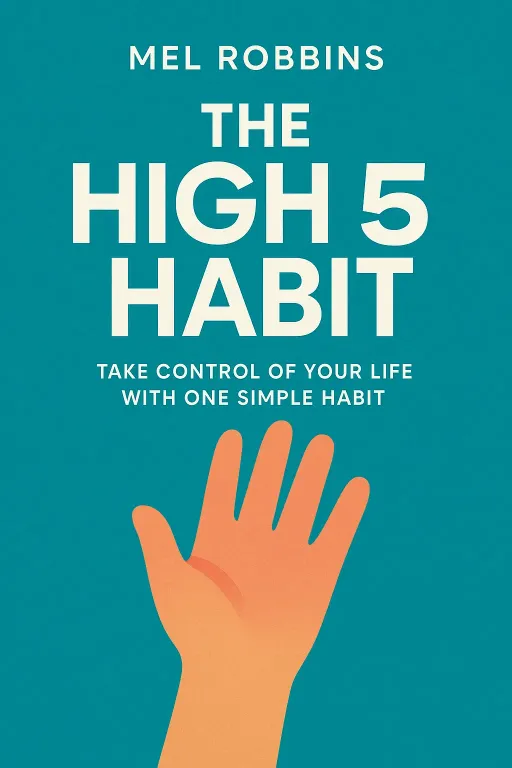
Nova: Exactly. And that is exactly what we are here to dismantle today. We are looking at two powerful, yet very different, approaches to reclaiming your mental space. First, we have The High 5 Habit by Mel Robbins, which is all about using a physical gesture to rewire self-acceptance. Then, we are diving into The Universe Has Your Back by Gabrielle Bernstein, which focuses on shifting from a mindset of fear to one of deep, abiding trust.
Atlas: I love that pairing. One is very grounded in the physical, almost mechanical side of habit change, and the other feels more internal and philosophical. It is like working on the hardware and the software of the human mind simultaneously.
Nova: That is the perfect analogy. Mel Robbins, who famously rose to prominence with her Five Second Rule, brings that same brass-tacks, no-nonsense energy here. She is a former lawyer, so she approaches this with a very practical, almost clinical eye. On the other hand, Gabrielle Bernstein has built a career as a spiritual guide, helping people navigate the often-messy terrain of anxiety and uncertainty. Both authors are trying to solve the same problem: how to stop the internal noise that keeps us stuck.
The Physicality of Self-Support
SECTION
Atlas: Let is start with that hardware upgrade. The High 5 Habit sounds almost comical at first. You are telling me that slapping my own reflection in the mirror is going to change my neural pathways? That feels like something a motivational speaker might say to get a laugh, but does it actually hold up?
Nova: It sounds ridiculous, right? But that is exactly why it works. Robbins argues that we have a lifetime of conditioning where we have learned to look in the mirror and criticize ourselves. That is the default neural pathway. When you go to the mirror and high-five your reflection, you are physically interrupting that pattern. You are doing something so out of character, so tactile, that it forces your brain to pause.
Atlas: I am curious about the science behind that. I imagine our listeners are thinking, okay, I get the interruption part, but why a high-five? Why not just smile at myself or say a positive affirmation?
Nova: The key is the physical anchor. Robbins explains that a high-five is a gesture of celebration and support. We have used it our entire lives to congratulate teammates, friends, or colleagues. When you do it to yourself, you are hijacking that existing association. Your brain recognizes the gesture of a high-five as a positive reinforcement. By doing it to your reflection, you are essentially tricking your brain into treating yourself like a teammate rather than an adversary.
Atlas: That is a fascinating way to look at it. It is like taking a social signal we use for others and redirecting it inward. I can see how that would be powerful. But let is look at this from a practical, day-to-day perspective. If someone is skeptical, they might say, I am not a child, I do not need to high-five the mirror to feel good about myself. How does someone bridge that gap between feeling silly and actually reaping the benefits?
Nova: That is the hurdle everyone faces. The discomfort you feel when you first do it is actually the point. That awkwardness is evidence that you are breaking a rigid, negative habit. Robbins suggests that you do not need to believe it at first. You just need to perform the action. The dopamine release that follows is the biological reward. It is a classic feedback loop. You do the action, you get the chemical hit, and over time, your brain starts to associate the mirror with support rather than judgment.
Atlas: I like that. It moves the conversation away from willpower, which is a finite resource, and into the realm of mechanics. If I can just commit to the physical action for thirty seconds, I am outsourcing the heavy lifting of motivation to my own biology.
The Mental Shift to Trust
SECTION
Nova: Exactly. And once you have established that baseline of self-support, you are in a much better position to tackle the second part of our discussion, which is about external trust. This is where Gabrielle Bernstein’s work in The Universe Has Your Back comes into play.
Atlas: This is the part that usually trips me up. Trusting the universe sounds lovely when things are going well. But what about when things are going sideways? If I am staring down a looming deadline, a financial crunch, or a personal conflict, the idea of trusting the path feels almost dangerous. It feels like giving up.
Nova: That is the central tension Bernstein addresses. She argues that what we call control is actually just fear in disguise. We think that by white-knuckling our way through a situation, we are creating safety. But often, we are just creating more resistance. She suggests that when we focus on trying to control every outcome, we are essentially operating from a place of scarcity. We are assuming the worst will happen unless we micromanage it.
Atlas: That is a really sharp distinction. I have definitely been there. I have spent hours obsessing over the details of a project, thinking that if I just worry enough, I can prevent the failure. But usually, all that does is drain my energy and cloud my judgment. So, what is the alternative? If we are not supposed to control, are we just supposed to sit back and do nothing?
Nova: Not at all. It is about shifting your intent. Bernstein advocates for conscious breathing and meditation as tools to move from a state of fear to a state of receptive trust. Think of it as moving from a defensive posture to an open one. When you are in a state of trust, you are not passive. You are actually more alert and more capable of seeing opportunities for growth in the obstacles that pop up. You are not fighting the current; you are learning how to navigate it.
Atlas: That makes sense. It is like the difference between a rigid branch that snaps in a storm and a flexible one that bends. I am thinking about how this connects to the High 5 Habit. If the high-five is the physical act of saying, I am on my own side, then this mental shift is the act of saying, I am on the side of the process.
Nova: That is a beautiful synthesis. You are absolutely right. The high-five builds the internal foundation—the self-acceptance. Trusting the path builds the external framework—the way you relate to the world. When you have both, you are not just surviving your day; you are engaging with it. You are less likely to spiral when things go wrong because you have that internal anchor of support, and you have that external perspective that says, this is not a catastrophe, this is an opportunity.
Synthesis & Takeaways
SECTION
Atlas: I want to make sure our listeners walk away with something they can actually use tomorrow morning. We have talked about the mirror high-five and the shift to trust. How do these two things live together in a real, busy life?
Nova: It is all about the morning routine. Start your day with the High 5 Habit. It takes five seconds. Walk to the mirror, look yourself in the eye, and give that reflection a high-five. It breaks the pattern of self-criticism before the day has even started.
Atlas: And then, while you are brushing your teeth or having that first cup of coffee, layer in the trust component. Ask yourself: How can I choose to trust my path today instead of trying to control every outcome? It is a simple question, but it changes the entire trajectory of your decision-making.
Nova: It really does. You are essentially setting an intention. The high-five is the physical signal to your brain that you are a teammate, and the question is the mental signal that you are open to whatever the day brings. It is a powerful combination for anyone who feels like they are constantly fighting their own mind or the circumstances around them.
Atlas: I can see how this would be transformative for someone who feels like they are running on a treadmill of stress. It is not about ignoring the problems; it is about changing your relationship to them.
Nova: Exactly. It is about moving from a life of reaction to a life of intention. We spend so much energy trying to force the world to be exactly how we want it, which is an exhausting and impossible task. But we have total control over how we treat ourselves in the morning and how we interpret the obstacles that come our way. That is where the real power lies.
Atlas: This has been a great conversation. I love how we moved from the mechanical, almost funny, act of high-fiving a mirror to the deeper, more profound act of trusting your own journey. It is a reminder that the biggest changes often come from the simplest, most consistent habits.
Nova: That is the truth. It is the small, daily commitments that compound into massive shifts over time. Thank you for digging into this with me.
Atlas: Anytime. It was a pleasure to break these down. And for everyone listening, try the mirror high-five tomorrow. It feels weird, but give it a shot. You might be surprised at how your brain responds.
Nova: This is Aibrary. Congratulations on your growth!